

The Hands-Down Best Smart TV For Every Budget
We may receive a commission on purchases made from links.
One of the best ways to indulge in leading entertainment content from platforms like Netflix, HBO Max, and Disney+ is with a shiny, new smart TV. "Smart" really just means that the TV can connect to the internet, but apps and streaming wouldn't be possible without these networking capabilities. You'll actually be hard-pressed to find a TV that doesn't contain smart features, and leading brands like Samsung and LG have been perfecting their user interfaces and app libraries for years.
Not every TV is a slam-dunk deal, though; some models are fairly inexpensive and provide a lot of bang for your buck, while other higher-priced sets may falter in more ways than one. This can make picking a new TV even more challenging, and we know the pain of strolling up and down the display wall at your local electronics store, wondering which set would be best for your living room and bank account.
You're not alone in your pondering, which is why we created this list of the four best smart TVs for every budget. We chose four TVs from four different brands, and each set has its own strengths and weaknesses.
Premium ($1,500+): LG G5 Series
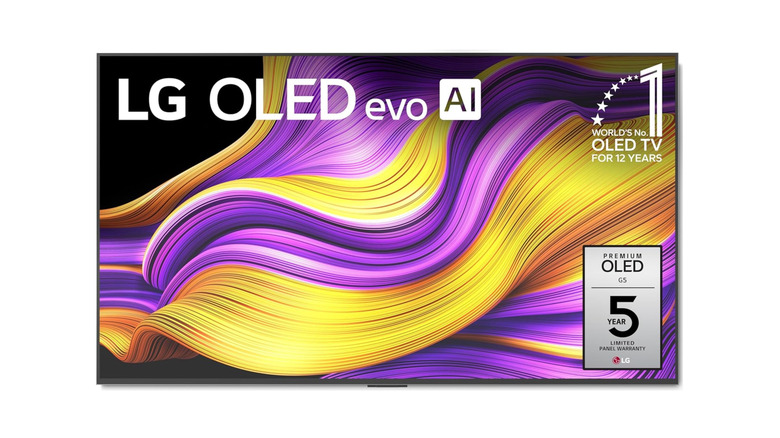
If the sky is the limit when it comes to picture quality and overall performance, your sights should be set on the LG G5 Series. Available in several sizes, this flagship 4K OLED uses LG's Alpha 11 AI Processor Gen 2 Array image processing and upscaling, resulting in one of the strongest bright-room OLEDs on the market. As part of LG's "Gallery" lineup, the G5 Series screen and chassis are designed to look like an art piece when wall-mounted. You'll even be able to set the TV to display paintings, professional prints, and other artwork when it enters screensaver mode (you can manually pull up a slideshow, too).
The LG G5 delivers exceptional picture quality with strong SDR brightness and color accuracy. It also supports all mainstream HDR formats with the exception of HDR10+, but you can expect stunning highlights and a wide color gamut when watching or playing HDR content. Speaking of play, the G5 has four HDMI 2.1 ports that support up to 4K at 165 Hz, and it also has features like Variable Refresh Rate (VRR) and Auto Low Latency Mode (ALLM), so console and PC gamers can expect a great experience.
Traditionally, OLED screens look best in a dark room, and the G5 Series is no exception. That said, the TV has a strong enough anti-glare coating that it actually holds up quite well in a bright room. There can be a bit of color shifting if you're not seated in the center of the screen, but it's still a solid TV for rooms with wide seating arrangements.
Upper Midrange ($1,000-$1,500): Samsung S85F
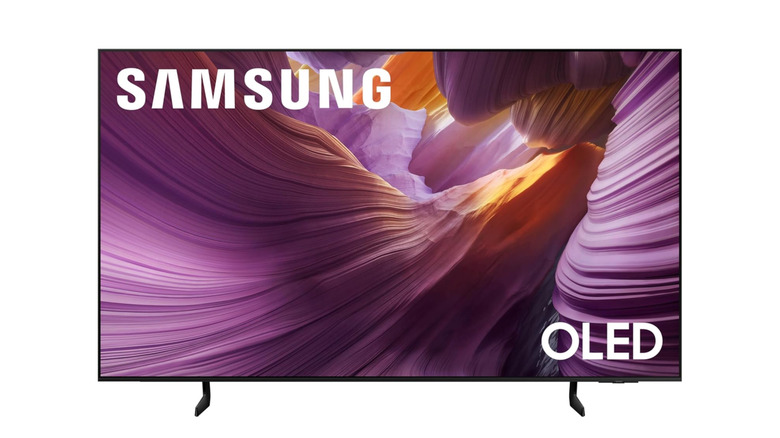
The Samsung S85F is a 4K OLED that's a cut above the rest of the OLED competition, and it costs a few hundred dollars less than the flagship G5 Series. While it doesn't top the SDR and HDR brightness of the flagship G5, the S85F still delivers rich colors, perfect black levels, and a solid lineup of gaming features, including HDMI 2.1 support on all four inputs, on top of 4K at 120 Hz support with VRR and ALLM. And with the exception of Dolby Vision, the S85F offers robust HDR support, too.
Similar to higher-end Samsung OLEDs like the S90F and flagship S95F, the S85F uses a QD-OLED panel for the 55 and 65-inch sizes. This allows the TV to achieve a wide color gamut and stronger highlights, but it still doesn't get as bright as the S90F or S95F. The S85F also uses the older Neural Quantum 4 AI Gen 2 Processor, so content smoothing and picture upscaling won't be as good as it is on Samsung's higher-end OLEDs.
Apps and streaming are handled by Tizen OS, and the S85F supports both 2.4 GHz and 5 GHz Wi-Fi bands. It's also nice that the TV remote has a rechargeable battery that can be topped off via USB-C or the remote's rear-facing solar panel.
Lower Midrange ($700-$1,000): Hisense U8
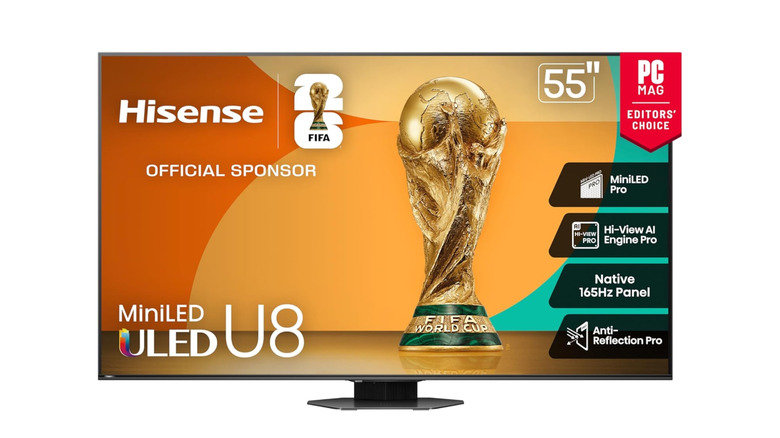
Switching out of OLED terrain and into Mini LED technology, the Hisense U8 is the kind of TV that's tailor-made for lower budgets and brighter rooms. Thanks to its strong SDR brightness, the U8 is able to overcome most glare from sunlight and ambient light fixtures, while colors remain rich and black levels stay inky. Hisense TVs offer support for all mainstream HDR formats, allowing the TV to achieve impressive peak brightness levels, too.
The Hisense U8 carries three HDMI 2.1 ports, plus the unique addition of USB-C for PC gamers interested in using DisplayPort. Unfortunately, this input method is capped at 1080p at 288 Hz and doesn't support VRR (which is supported via HDMI). The U8 doesn't have the greatest off-angle viewing, either, so those with big, wide seating arrangements may want to consider a different set altogether.
Additional pros include a native 165 Hz refresh rate, ALLM support, and impressive upscaling for lower-res content with lots of detail preservation. Apps and streaming are handled by Google TV, and you'll be able to purchase the Hisense U8 in five sizes: 55, 65, 75, 85, and 100 inches.
Budget: ($700 or less) TCL QM6K
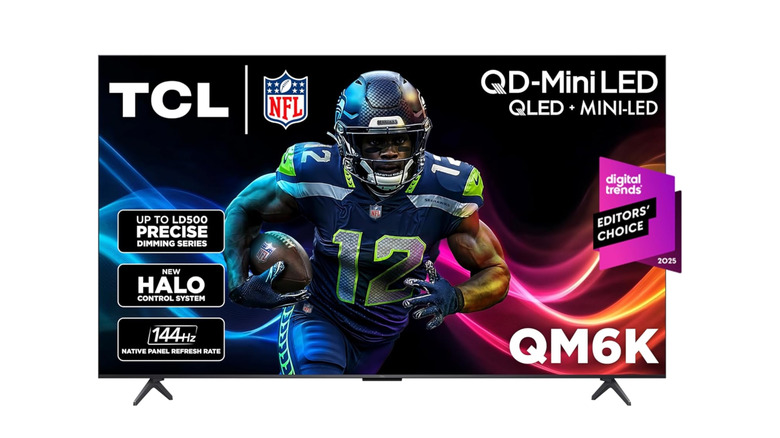
If you're looking to score great picture quality on a stricter budget, check out the TCL QM6K. Available in 55, 65, 75, 85, and 98-inch sizes, the QM6K uses Mini LED lighting with local dimming and quantum dots to achieve a wide color gamut, strong brightness levels, and reduced haloing during darker scenes. The TV also offers impressive gaming specs right out of the box, including 4K at 144 Hz, 1080p at 288 Hz, VRR and ALLM support, and a naturally quick response time.
Two of the QM6K's four HDMI ports are 2.1 certified, while the other two connections are 2.0-rated (one of the 2.0 ports is also the TV's eARC connection). You'll also get support for all mainstream HDR formats, and apps and streaming are provided by Google TV. The TV's SDR brightness is good enough for certain bright room applications, but you may notice glare and reflections in particularly prone areas. The QM6K also doesn't get as bright as other Mini LED models when viewing HDR content.
Unlike other sets mentioned in this roundup, the TCL QM6K supports all major audio formats, including Dolby Atmos and DTS:X. It's also not the worst choice for sound quality, though any set is best paired with a soundbar or home theater system.
Methodology
Shopping for a new TV is no easy feat, and when you consider the sheer amount of brands and models, it can start to feel like finding a needle in a haystack – especially when you're capped for spending power. Fortunately, we stick to the most reliable TV brands when building any kind of TV best-of, and all of our selections are informed by our own AV experience, as well as professional, hands-on reviews and user feedback.
We also did our best to include TVs at four distinct price points, along with a mix of lighting and panel technologies (e.g., OLED, Mini LED, quantum dots, etc.).