

How Fast Can A Hypersonic Missile Launched In China Reach The US?
Technological advancements are a double edged-sword. Telecommunication and fast transport through airplanes have made life much more convenient, and medical advancements have made conditions easier to treat. However, that same science is used to create weapons of mass destruction that can potentially leave everlasting stains on human history. A hypersonic missile is one of the scariest, being able to traverse the globe faster than sound.
Hypersonic missiles move at five times the speed of sound, meaning they can go over Mach 5 (3,836 miles per hour). Most commercial airplanes are slower than Mach 1, making such high speeds impossible to comprehend. China has a number of terrifying technologies at its disposal — such as its large aircraft carrier with a 100 drone capacity or high-powered drone-frying microwave – but even a simple missile is more than a significant threat. If China suddenly targeted U.S. soil, how fast would a hypersonic missile land, and would we even have enough time to intercept it?
To answer, we'd need to calculate wind turbulence, the angle of projection, the curvature of the earth, gravity, and additional factors that require a group of engineers. Fortunately, we don't need all that to get a good estimate. We can just use the formula for speed, distance, and time: Time = Distance/Speed. Generally, it can take anywhere from around an hour to less than 20 minutes, depending on certain factors.
Hypersonic missiles to Hawaii, Seattle, and New York
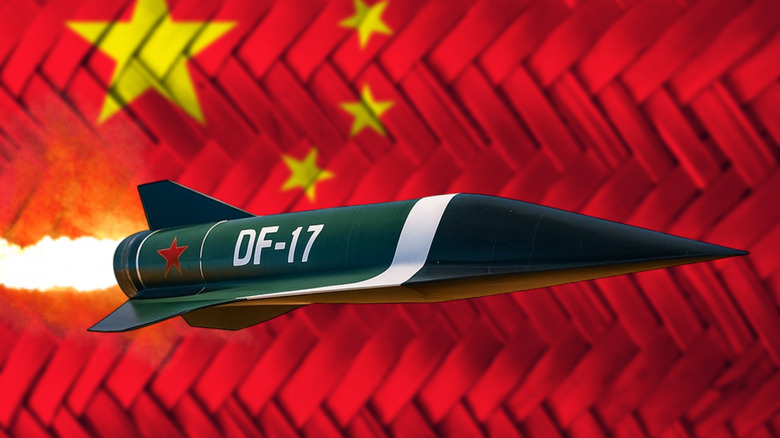
China has many different weapons with varying speeds and distances. For this calculation, we'll use the DF-27A due to its high maneuverability and relatively fast speed –- though China has faster missiles around.
We can assume the missile originates from China's Taiyuan Satellite Launch Center in Shanxi which is 5,130 miles to Hawaii, 5,650 miles to Seattle, and 7,080 miles to New York. The DF-27A is said to reach average speeds of around Mach 8.6, which means it can cover 6,598 miles in an hour. Plugging these numbers into the formula, the missile would take 47 minutes to reach Hawaii, 51 to Seattle, and 64 to New York from mainland China.
Keep in mind that these only account for a specific scenario, though. If China chose to target an island like Guam — just 2,676 miles away from Shanxi — the missile will reach in just 24 minutes. If China launches it from a coastal city like Fuzou — where the distance to Guam becomes just 1,864 miles — it'll only take 17 minutes for the missile to hit.
Is it possible for China to attack the U.S. with a hypersonic missile?
Even if China could send a hypersonic missile at America out of the blue, our theoretical experiment isn't as simple as it seems. China is fully capable of attacking certain U.S. cities, but an Intermediate-Range Ballistic Missile (IRBM) like the DF-27 simply isn't built for such distances. The missile could still hit Guam or other remote islands, but it can't travel further away in Central America.
This doesn't mean that China can't target Central American cities, though, just that a hypersonic missile like the DF-27 wouldn't be what they use. High-supersonic Intercontinental Ballistic Missiles (ICBMs) like the DF-31, the DF-41, and the DF-5C can all travel much further, with DF-5C specifically having global access. The DF-27 is considered more of a threat because of its use of a Hypersonic Glide Vehicle (HGV) that is significantly harder to predict the path of – something that might become even scarier with China getting access to better NVIDIA AI chips.
A DF-5C nuclear warhead would take less than half the time to the American mainland as a DF-27. Resources estimate its speed at tens of Mach, with some claiming it can reach Mach 22. At Mach 22, it'll take 6 minutes to reach Guam, 19 minutes to Hawaii, 20 minutes to Seattle, and 25 minutes to New York. If you order pizza at the same time China presses launch, the missile will likely reach first.