

The Reason Why Some Electrical Outlets Are Installed Upside Down
We may receive a commission on purchases made from links.
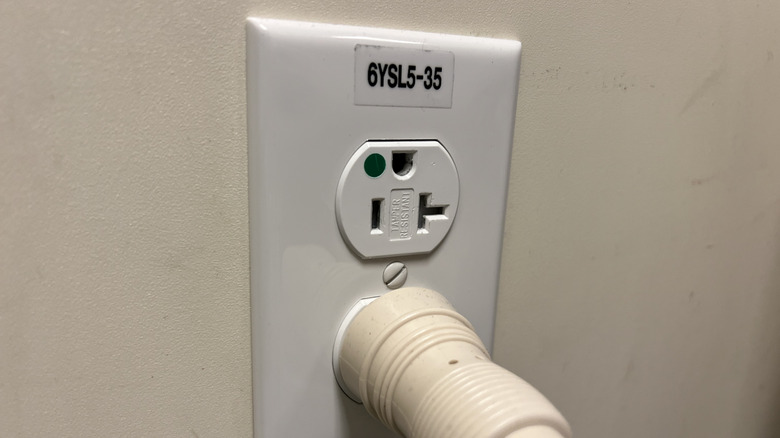
Electrical outlets haven't changed all that much over the last few decades. Sure, we've seen the continued rollout of ground fault circuit interrupters (GFCI) in kitchens, bathrooms, garages, and other moisture-prone locations, but the traditional three-prong grounded outlet has been a U.S. construction staple since roughly 1965. With that in mind, you may be wondering why some outlets are installed upside down (with the ground connection at the top). It's a fair question, and it's one that doesn't have the most straightforward answer.
On the one hand, the National Electrical Code doesn't specify a particular way to install power receptacles. Still, it's generally an unspoken "best practice" to install receptacles with the ground pin facing the bottom. That said, one intentional reason a receptacle may be flipped is that one of the outlets is manually controlled by a light switch. Bedrooms and living rooms are residential spaces where lamps and other plug-in lights are often used. Connecting a lamp to a switched outlet allows you to flick a wall switch to power the bulb, instead of having to manually turn the lamp on or off.
We get it: an "upside down" outlet just doesn't look right. But that's only because we've been conditioned to think the ground-pin-at-the-bottom appearance is "normal." Now, what wouldn't be normal is if your home was built in the '70s or later and the electrician installed two-prong outlets. Fortunately, you can buy adapters to solve this problem.
Another potential reason for upside-down outlets is safety-related
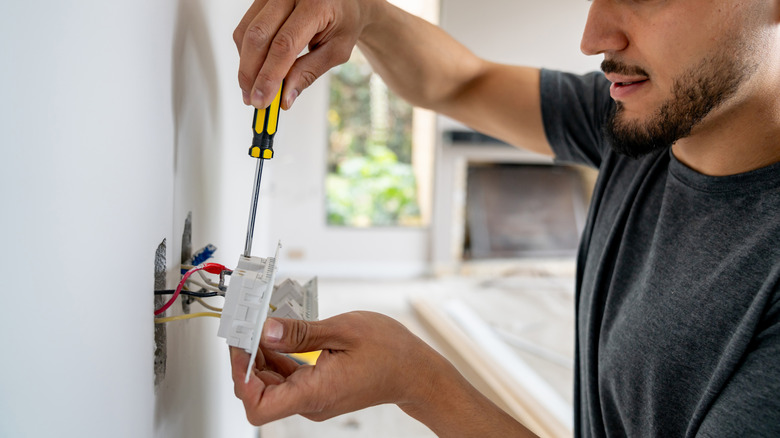
We also did some digging over at r/AskElectricians and discovered another potential reason for outlets being installed with the ground pin at the top: falling objects. Let's say something falls off the kitchen counter and lands on a plug connected to a ground-at-the-top outlet. If the object hits the ground, it'll probably just bounce off it and land on the floor. But if the hot and neutral connectors are at the top of the plug, contact with an object may loosen the prongs enough to cause a short.
Electrical standards continue to change and evolve, though, and today, modern outlets have different-sized holes for proper polarization — with the small opening reserved for "hot" and the wider slot for "neutral." This is a design choice that ties directly back to user safety and preventing electrical shocks. It's also worth mentioning that one country's electricity isn't the same as another's, which is part of the reason why American and European plugs look so different.