

Why Rockets Never Launch In The Middle Of The US

Launching rockets in real life is nothing like launching spaceships in sci-fi movies and shows. You need a ton of space — get too close and your non-heat resistant equipment will melt. The U.S. has several rocket sites, most of which are located on or near the coastlines. NASA didn't build these platforms in the middle of the map because it was too costly, but because it's too dangerous.
NASA and spaceflight government agencies around the globe hand-picked launch sites near oceans in order to minimize the risks for civilians. Plus, many rocket trajectories take spaceships over water instead of land. That way, should something go wrong mid-flight (e.g., the rocket explodes), any debris will crash relatively harmlessly into open waters instead of on top of populated areas.
Unfortunately, this practice isn't foolproof. Depending on where and when a rocket malfunctions, commercial flights might need to divert course to avoid oncoming debris. Plus, sometimes a rocket can pose a threat to civilians even during an otherwise flawless launch. In 2018, a rocket in China took off and successfully reached space and detached its booster unit as intended, but because an engineer got their math wrong, the component landed outside a small village and exploded upon impact. Nobody was hurt, but this event highlights the dangers rockets pose to the general populace whenever gravity regains control.
How NASA picks between its existing launch sites
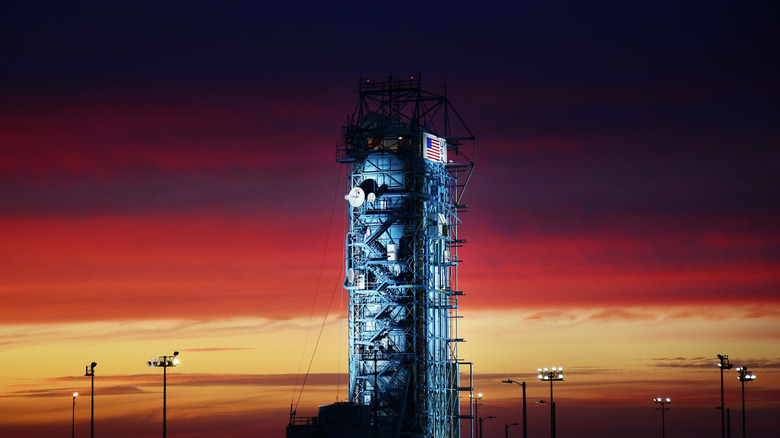
The United States might not have a rocket platform in every state due to the aforementioned threat to populated areas, but it still has more launch sites than most countries. Not only does this redundancy give agencies like NASA backup sites in case, say, a launch platform is accidentally destroyed, but some locations are actually more preferable for certain missions.
While the Earth is supposed to rotate at a constant speed, locations at or near the equator technically move faster relative to locations further away. This increased speed gives rockets that launch near the equator a boost in speed, which lets them save on rocket fuel, especially when hauling heavy cargo — or reach their destination faster when time is of the essence. The location is also determined by the intended orbit, especially when delivering satellites. Anything meant for a low inclination orbit (i.e., the angle of its orbit in relation to the equator is low), such as a geostationary weather satellite, is launched in Florida since it is closer to the equator. Meanwhile, satellites bound for high inclination orbits (the angle of its orbit in relation to the equator is high), including mapping satellites, typically shoot up from California.
Technically speaking, since rockets carrying high-inclination orbit equipment can launch from virtually any latitude outside of the equator, NASA can shoot these rockets from any of their existing launch sites and get the same effect. Setting up a rocket platform in the middle of the U.S. would just be superfluous.