

Why It Takes So Much Water To Put Out An Electric Car Fire
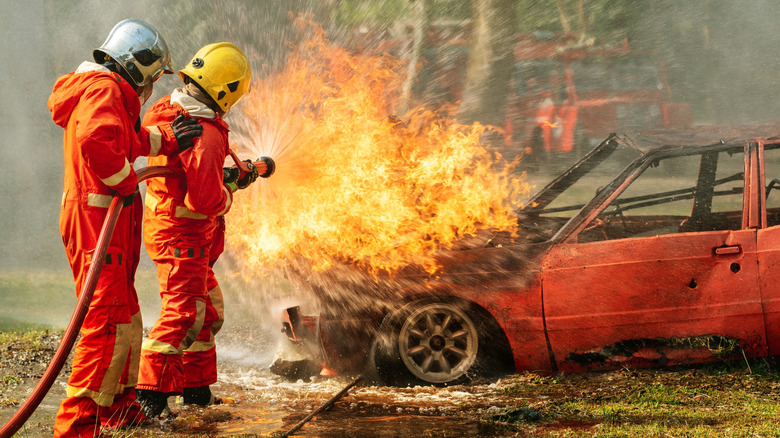
The battery of even the best electric vehicle (EV) can overheat if it malfunctions and experiences a thermal runaway. It can then result in the release of toxic gases and a sustained fire that may be more difficult to contain than an internal combustion car fire. When thermal runaway occurs, the battery cells can continue to overheat inside the car's larger battery pack even if a fire isn't apparent. The chemical reaction releases toxic gases and continues fueling the fire, causing it to last longer. Firefighters may need thousands of gallons of water, and they may employ different strategies to ensure the battery is cooled down, reducing the risk of reignition.
An electric car fire can reignite even after it's been put out, as the battery may still contain stranded energy. In addition to water, some first responders may use fire blankets to try to prevent oxygen from reaching a damaged EV battery that's burning. However, experiments have shown that fire blankets have a side effect. They inevitably collect the dangerous gases coming out of the battery. If exposed to oxygen, which can happen when firefighters handle the blanket, an explosion can occur caused by the combination of oxygen with the existing gases.
Australia's EV FireSafe warns against the use of fire blankets because they can be heavy and difficult to operate, potentially endangering the lives of firefighters. Also, they may occupy additional space in the fire truck, which isn't warranted, given that electric car fires are still rare.
How much water is needed to put out an EV fire?
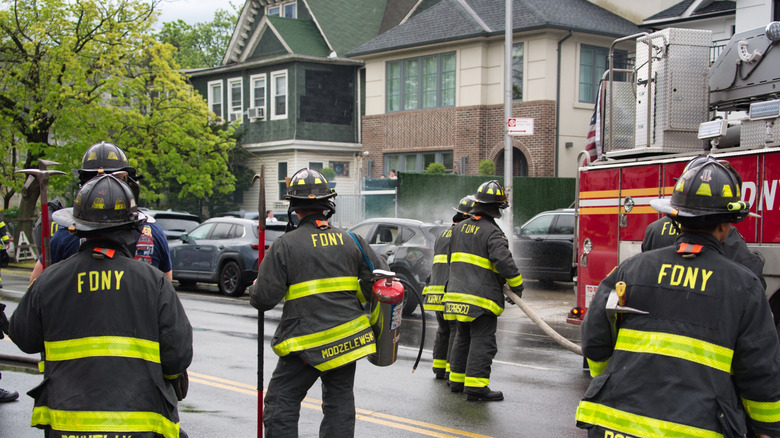
The International Association of Fire & Rescue Services (CTIF) showed that a U.S. fire service spent about 90,000 liters (24,000 gallons) to put out a battery fire involving a Tesla car, at a rate of 2,200 liters (600 gallons) per minute, over 40 minutes. The same report cited a 2021 article from The Hill that said an EV fire may use up to 40 times more water than a petrol car fire. Separately, EV FireSafe estimates that water usage may exceed 10,000 liters (2,200 gallons) for cooling the battery. It offers the same estimate for submerging an electric car in liquid, which can be another way to extinguish the fire.
Cooling the battery is the first responders' main goal, because an overheating battery leads to a fire, though that's easier said than done. The battery pack is usually placed on the bottom of the car, enclosed in a solid container meant to shield it from damage and prevent thermal runaways leading to fire. Electric car battery packs may also be water-resistant, further complicating things.
Also, due to the location of the battery, exposing the pack to water may be difficult in some cases, especially if the car can't be moved for better access to the battery pack. Firefighters may spend a longer time trying to contain an electric car fire, and they may consume significant amounts of water, partly because an EV lithium battery can burn at up to 1,200 degrees Celsius (2,192 degrees Fahrenheit).
Electric car fires still under study
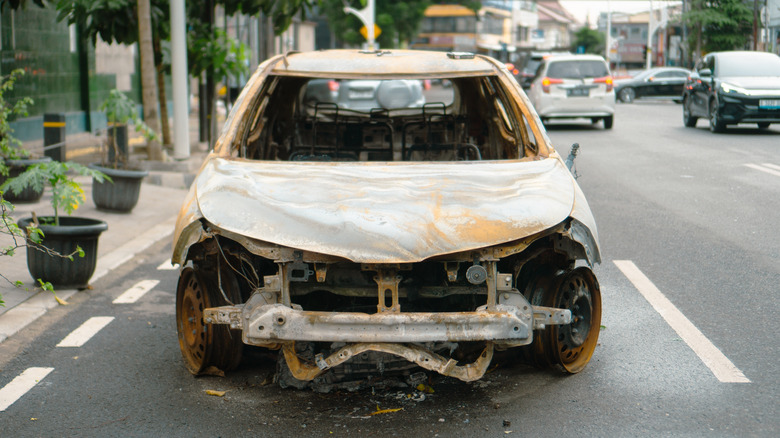
Exposing an electric component like the electric car battery to water during a fire isn't a risk. Electrocution will be a problem during a battery fire where the battery is still connected to a power source, but that won't be the case for an electric car fire ignited on the highway, following a collision. National Fire Protection Association (NFPA) experiments in 2025 have shown that exposing the battery to multiple water sources at the same time can improve cooling. Firefighters observed that using several hose lines with water hitting the battery pack at different angles can improve effectiveness.
Another important finding concerns access to the battery. The same NFPA tests showed that equipment used for vehicle rescue and extraction operations allows them to lift an electric car and tip it on its side to improve access to the battery compartment. Tipping over the burning EV allowed the firefighters to see the points of damage and better direct the streams. In this instance, the firefighters needed 24 minutes and over 14,500 liters (3,200 gallons) of water from three lines to suppress the fire.
That said, EV fires are rarer than you might think, though they receive more press coverage when they happen. A 2023 report from Sweden's Authority for Social Protection and Preparedness (via Edmunds) showed an average of 20 fires per year in the previous three years for EVs, out of a total of 611,000 vehicles. Petrol cars registered about 3,400 fires during the same period, out of 4.4 million vehicles.