

Paratrooper Found An Issue With Drones - His Solution Won The Military's 'Shark Tank'
The U.S. military is constantly searching for ways to stay ahead of the technology curve, particularly as drones, robotics, and artificial intelligence continue to revolutionize warfare at an astounding rate. One recent innovation comes thanks to a military competition that resembles a popular reality show rather than a government request for proposal (RFP). The brainchild of Secretary of the Army Daniel Driscoll, Dragon's Lair is an annual competition that sees soldiers pitch solutions for common battlefield problems to a panel of judges, much like "Shark Tank." Started by the U.S. Army, and opened to all U.S. military services and units in 2021, the competition's judges are comprised of civilian and military experts.
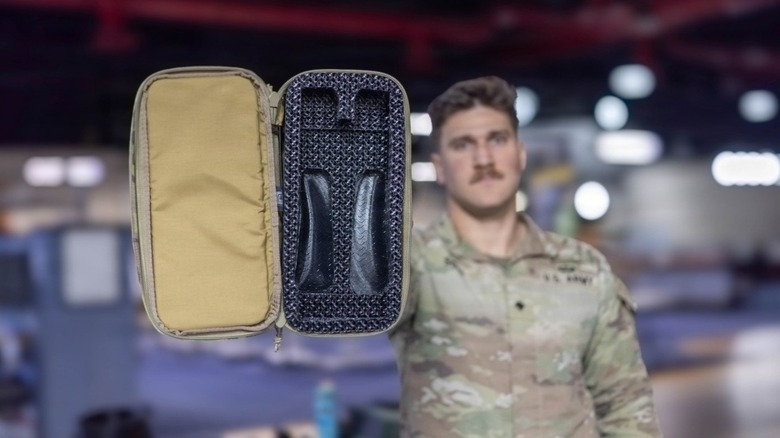
Dragon's Lair gave the U.S. Army a means of carrying its rapid deployment Unmanned Armed Vehicles (UAVs). Dubbed the Modular Drone Case, the case is a lightweight, durable container designed to carry a variety of drones to air and land missions. Designed by Spc. Alexander Soto and Sgt. Talen Valerio of the 82nd Airborne Division, the case won second prize at Dragon's Lair XI, the June 2025 iteration of the U.S. Army's Shark Tank-style competition.
The case exemplifies the production cycle central to the Army's Transformation Initiative. According to an open letter by Driscoll, the push looks to reimagine how the military will "fight, train, organize, and buy equipment." Instituted in May 2025, the Army hopes to "deliver critical warfighting capabilities, optimize our force structure, and eliminate waste and obsolete programs." Although not a revolutionary product on its surface, the Modular Drone Case shows the initiative's mobilization of soldier-led innovation efforts. To date, the Army has yet to announce whether the case will be fielded at the DOD's new drone testing facility anytime soon.
From pitch to production
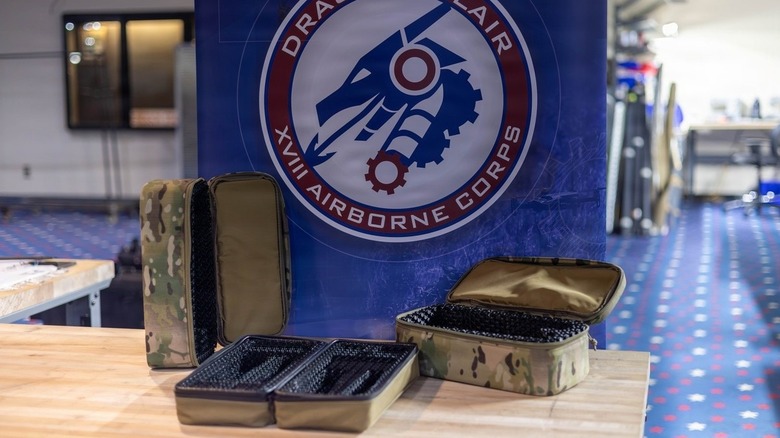
The idea behind the modular drone case came from Spc. Alexander Soto's experience watching drones break during deployment. A paratrooper, Soto noted that drones were often damaged during airborne drops or field exercises. Notably, he found that soldiers needed a means to safely carry the delicate equipment in a durable, mobile case small enough to fit in a backpack. According to an announcement praising Soto and Valerio's pitch, the case allows for rapid deployment during foot, vehicle, and airborne missions, serving as a "versatile, field-adapted solution" optimized for "maximum payload efficiency and field mobility."
When the case garnered second prize at the June 2025 summit, the design team collaborated with Staff Sgt. Larry Dockins from the Airborne Innovation Lab to develop the prototype for the carrying case. The result was a lightweight, durable product compatible with a variety of UAVs. As Dockins described it, the case's impact on the military's drone operations could be major. "Any solution that makes a warfighter more lethal is a winning solution for us," Dockins said in the U.S. Army press release announcing the case's production. "Creating a device that cuts weight could mean winning or losing on the battlefield."
The winners of the competition, U.S. Army SFC Jesus Naranjo and 1LT William Rambin, pitched an 81mm Mortar Quick Emplacement Mount, allowing soldiers to store and deploy mortars from Infantry Squad Vehicles. Previously, infantrymen largely relied on improvised methods to rapidly deploy mortars in a high-octane, variable environments. Another notable product pitched at the event was a headset capable of viewing electromagnetic frequencies.
The Army's innovation forward approach
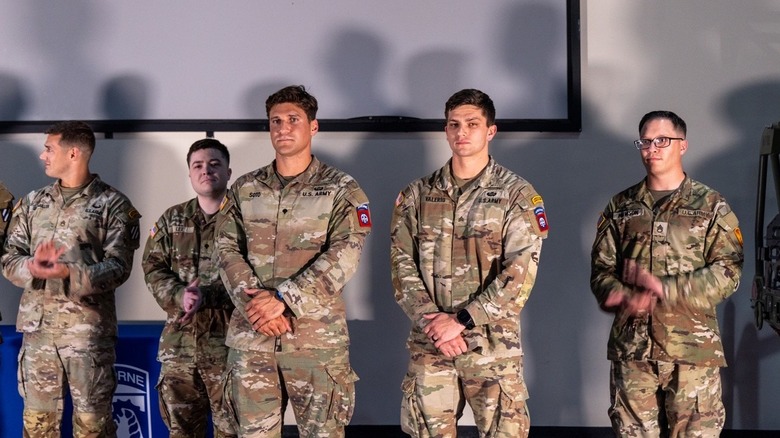
Although its potential on the battlefield is notable, the real success of the Modular Drone Case is in its accelerated development program. More than just the fruits of the military's Shark Tank spinoff, the case is a successful pilot initiative of the Joint Innovation Outposts' new rapid procurement model. Founded in January of this year, the JIOP is intended to fast-track the Pentagon's procurement processes, giving key partners an accelerated timeline in the run up to production manufacturing. Headed by Lt. Gen. James Gavin, JIOP was responsible for bringing the modular case from ideation to production in just three months.
Such programs are the military's attempt to expedite internal innovation timelines to stay ahead in a time of extraordinary change. As technological leaps in artificial intelligence and robotics change the scale, scope, and shape of the battlefield, the Pentagon must adopt new methods to keep pace with a variety of challenges. Reforms of the Army's Acquisition Program and the initiation of the branch's "flagship innovation engine," dubbed FUZE, further underscore the approach.
How the Modular Drone Case compares with flashier drone-forward innovations, like converting Apache helicopters into drone-killing machines, remains to be seen. For its part, the case showcases the Army's ability to address challenges quickly and shows Dragon's Lair's success. Who knows the challenges facing the Army better than the soldiers?