

The Current US Military Laser Weapons Are Nothing Compared To What's In Store
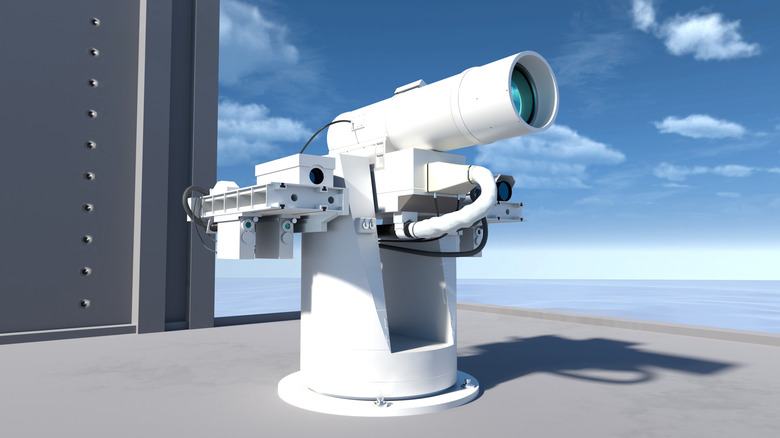
Laser weapons are such an entrenched sci-fi trope that it's easy to forget just how real this tech can be (and is). While we're not exactly close to seeing real-life "Star Wars" space battles, the U.S. military and others have already used laser-based weaponry for a variety of purposes. For example, as The Atlantic reports, it's not unheard of for the military to take out drones with lasers.
Today's "ray guns" aren't exactly the type you'd see in a sci-fi epic. Some of them, like the Apollo, are essentially "soft kill" lasers, serving primarily to render threats like drones harmless by interfering with their sensors. Even laser weapons that bring drones down from out of the sky do so invisibly. No "pew pew" sound effects, no red hot death ray beams.
That's not to say the technology isn't advancing. To the contrary, military investment in laser weapon tech is consistently yielding innovations that are transforming the face of war and defense. There may even come a day when we have weapons so strong they can literally take out ICBMs.
Lockheed Martin is developing laser weapons five-times stronger than current systems
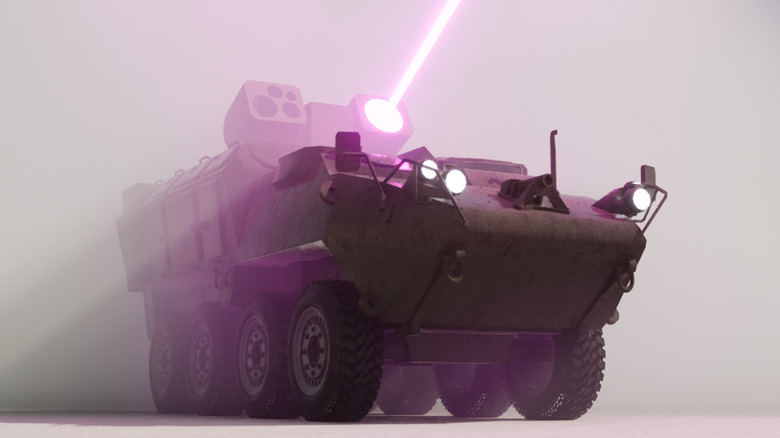
Lockheed Martin's High Energy Laser with Integrated Optical-dazzler and Surveillance (HELIOS) is an example of one of the strongest laser weapons currently in use. After being awarded the initial contract to develop and implement the technology in 2018, Lockheed Martin began working toward a laser weapon for warships, aircraft carriers, and other such U.S. Navy vessels. The Navy recently announced it used HELIOS to take out drones during a training exercise involving the USS Preble. According to a report from the New York Post, the Navy has since used HELIOS in a real-world scenario, downing Iranian weapons as part of Operation Epic Fury, although these reports currently remain unconfirmed.
Lockheed Martin describes HELIOS as an "Integrated Weapon System" boasting a 60+ kW laser. That's an important number. Back in 2023, Lockheed Martin reported it had been awarded another contract, this time to equip the U.S. Army with as many as four 300kW laser weapon systems. In other words, these laser weapons would be about five times stronger than HELIOS. They're part of the Indirect Fire Protection Capability-High Energy Laser (IFPC-HEL) program, an Army program with the goal of protecting soldiers on the battlefield from threats ranging from drones to various types of aircraft.
In the meantime, per the National Security Journal, Israel has potentially begun using 100kW laser weapons to down projectiles launched from Lebanon. However, this is another instance in which early reports remain unconfirmed. Regardless, the existence of these systems is not up for debate.
Future laser defense systems may target ICBMs
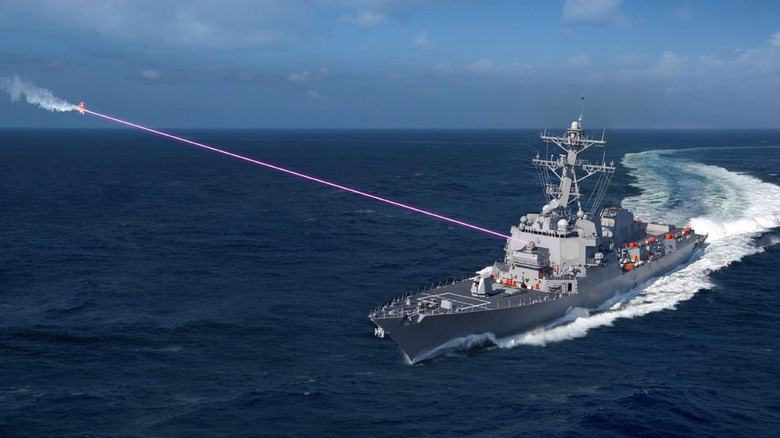
We might not know for sure the full extent to which the U.S., Israel, or anyone else is actively using laser defense systems and similar weapons in actual wars. What we do know is that militaries across the globe have been consistently developing and improving upon these systems, and are likely to continue doing so. Currently, laser defense systems might not be capable of guarding against ICBMs, but as The National Interest reported back in 2019, creating such systems has been a goal of the U.S. military.
None of this means modern warfare is about to resemble the post-apocalyptic flashback (or were they flash-forward?) scenes from the "Terminator" movies. However, it does mean that laser weapon technology isn't just stronger and more effective than many assume — it's also likely to become even stronger sooner rather than later. Just maybe don't expect plans for a Death Star anytime in the next few years.