

5 Reasons To Ditch Earbuds For Headphones (Besides Audio Quality)
Whether for gaming, for use when watching a movie, or for casual listening while out and about, wireless earbuds have become one of the most popular personal audio choices. They can produce high-quality audio playback, they can often pair with multiple devices at a time, and their portable nature makes them easy to keep on hand wherever one may go. Popular tech brands like Apple, Sony, Bose, Samsung, and Google each have their own models of quality wireless earbuds, and there are even cheap wireless earbuds on the market for those who have a more modest budget.
But when it comes to portable listening options, what can get lost in the conversation is the fact that over-the-ear headphones haven't gone anywhere. They're as capable as ever, and while they may tend to take a back seat to the smaller, less obtrusive design of earbuds, in many ways, a set of headphones has more to offer than its in-ear counterparts. Audio quality is a given, as the general design of over-ear headphones allows for bigger and better hardware. But there are even more reasons to ditch your earbuds for a set of headphones, and we've singled out the most prominent.
Longer battery life

Battery life is one of the most noticeable practical differences between earbuds and over-ear headphones. Earbuds are limited by their size, as there's only so much battery you can physically squeeze into such a small piece of tech. The popular Apple AirPods 4 can reach five hours of battery life between charges. Samsung's Galaxy Buds 4 can reach up to six hours. The Google Pixel Buds Pro 2 can be used for up to 12 hours before needing to charge back up. More playback time is available with included charging cases, but that requires stopping the music and putting the earbuds away for a little while.
But that doesn't have to be the case when you want to tune into some audio. Wireless headphones are an opportunity to stay in touch with your favorite media for longer stretches of time. While many earbuds struggle to reach eight hours of playback between charges, headphone options like the Apple AirPods Max 2 deliver around 20 hours, and the flagship Sony WH-1000XM5 headphones last up to 40 hours on a single charge. A pair of wireless headphones can last through the entirety of multiple work days, while a set of wireless earbuds could have you watching the status light on their charging case for multiple stretches of the day.
Lower risk of hearing damage
While earbuds like the Apple AirPods Pro offer impressive hearing aid features, the general design of earbuds poses a risk of doing damage to your hearing abilities. Any kind of loud audio is a risk, of course, as it's easy to return home from a concert or noisy night out with some ringing in the ears. But the concern with earbuds is how close the speakers get to your eardrums. Audio levels above 70 decibels can cause permanent hearing damage, and with earbuds placing the audio so close to your ear, there's nowhere for it to go but directly into your ear's inner workings.
Listening volumes are entirely subjective, and you can push things too far with headphones as well. But with headphones, the speakers sit outside the ear canal rather than inside it, and the extra physical space between the audio source and the eardrum means the same perceived volume requires less actual input. The intrusive nature of earbuds is also a factor, as they can push earwax deeper into your ears, requiring even louder volumes in order to hear. For casual listeners, the difference may be negligible. But for anyone who has earbuds in for several hours a day, over-ear headphones are a lower-risk option.
Comfort
Not only can the in-ear design of earbuds cause discomfort from a hearing perspective, but they can also be uncomfortable physically. Because they sit directly inside the ear canal, they apply pressure to the surrounding areas. This alone can be uncomfortable, but earbuds with noise-cancelling capabilities go even further. They depend on creating a seal in order to block out external sound, and the resulting pressure on the ear canal can cause a set of earbuds to wear out its welcome quickly. This design can also lead to listening fatigue, which is when the need to constantly process audio pushes the mind and body to a state of exhaustion.
Over-ear headphones handle the experience of wearing them differently. The speakers sit around the ear rather than inside of it, which eliminates the canal pressure problem entirely. Headphones can have comfort issues of their own, of course, particularly for those who wear glasses. The over-ear design can create a pinching sensation when the earpieces of a pair of glasses are set between the ears and the head. But overall, headphones offer designers an opportunity to compensate for such things. Headphones come with varying amounts of foam or rubber padding to make up for the squeeze-like nature of their design, and premium headphones often make comfort a top priority.
Better noise cancellation
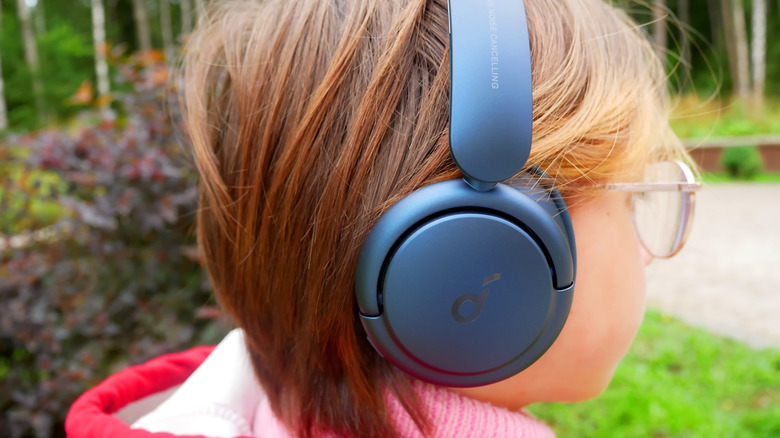
Active noise cancellation works by using microphones to detect external sounds and to then generate opposing sound waves that cancel them out before they reach your ear. This process is dependent upon the seal that a listening device is able to create with the ear. Earbuds use an ear tip to achieve a tight fit within the ear canal, and the quality of that seal can vary from person to person. If the ear tip is too small, outside noise can leak in before the ANC gets a chance to cancel it out. If it's too large, it can push the set of earbuds into the levels of discomfort we talked about above.
Many sets of earbuds come with numerous tip sizes to equip them with, but over-ear headphones work around the issue entirely. The ear cups cover the entire outer ear, leaving the ANC with less noise to cancel out in the first place. The larger design also gives manufacturers more room to work with. Noise-cancelling headphones offer the opportunity to include more microphones and more powerful hardware. This allows the onboard ANC to process noise more effectively and isolate the audio playback that users want to listen to.
They're easier to keep track of
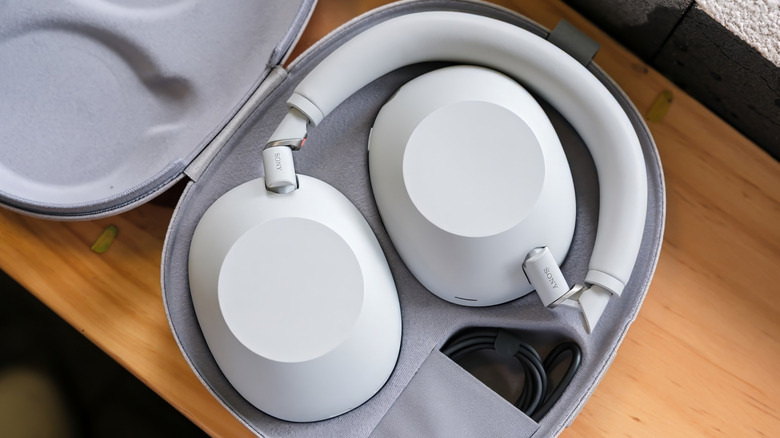
Of the reasons to ditch earbuds for headphones we've discussed, headphones have offered several advantages due primarily to their larger size. That's the case here as well, as the larger design makes them easier to keep track of. Even when they're stowed away in their charging case, earbuds can easily slip between couch cushions, get lost in blankets, and be difficult to find within backpack compartments. They can fall out of your ears while you're moving around the office, working out, or simply enjoying an evening hike. Earbuds can even be sneaky enough to disappear long before you realize it, making any hope of finding them thin.
Headphones, on the other hand, are much more difficult to lose or misplace. They aren't going to fall out of your ears during movement, nor are they likely to disappear between your driver's seat and front console. Much of the time, the processes of putting on and removing a set of headphones aren't quite as committed to muscle memory as with a set of earbuds, so you're typically more aware of where you place them when you're done listening. Headphones are, of course, much bulkier than earbuds, and while that may be a deterrent to listeners in search of ultimate portability, a lot of wireless headphones are designed to fold up and be placed into a carrying case of their own.