

If You Grew Up In The '80s, You Definitely Remember These TVs
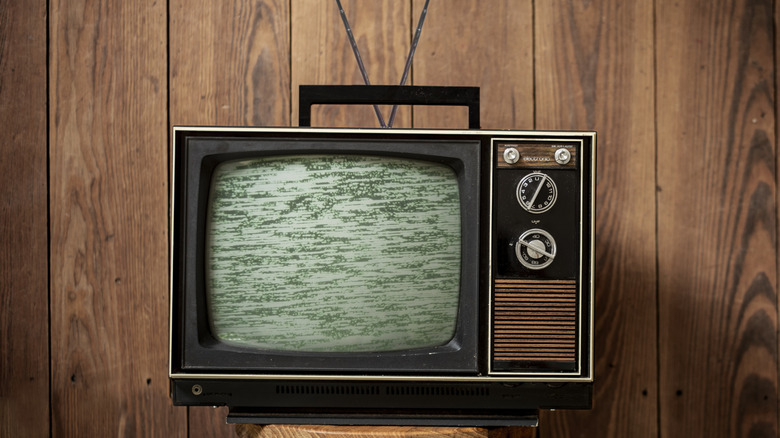
There's something about that old TV glow from the '80s. It hummed to you like Momma did while you were swaddled as a baby. Her tune, of course, was a gentle version of her favorite TV show; usually "M.A.S.H." or "Dallas." In the '80s, the TV was always on, much like the radio in previous eras, or the many different screens today. An article in the Christian Science Monitor shows that in 1984, Americans had their TVs on for more than seven hours a day. Sounds like a lot, but when you look back, it feels normal.
You'd watch "Inspector Gadget" before school and "Thundercats" in the afternoon before a quick video game on one gaming consoles that defined the 1980s. Your parents would keep the TV on through dinner, watching local and national news, game shows, and primetime television. Just look at the Spielberg classic "Poltergeist." The Freelings had three TVs in 1982. They were the typical American family, poltergeists notwithstanding.
The nostalgia still glows and hums in the back of people's heads as they try to relive their '80s TV days. The sets are hard to find, especially after the 2009 switch to digital. Thousands of analog televisions were seen as obsolete and trashed or recycled. Nostalgia is driving a resurgence in their popularity, especially cathode ray tube (CRT) TVs. Here are three of the most popular CRT '80s TV sets you can find at thrift stores, your parents' basement, or, for some of us, still in grandma's living room.
The film buff's '80s TV: Sony Trinitron
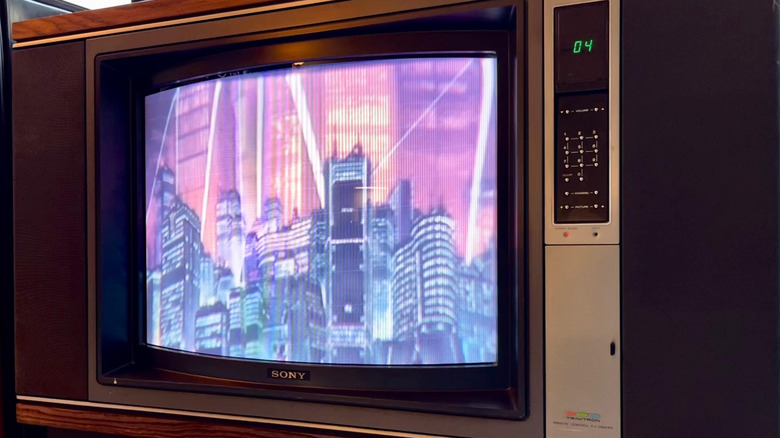
There's a reason the Sony Trinitron is in the Consumer Electronics Hall of Fame. It was a leap forward in high-quality tech that could also be mass-produced. Sony sold a wide range of Trinitrons, from four-inch portable sets to large living-room models, including the largest CRT television ever made, a professional model with a $40,000 price tag released only in Japan. It even wound up in Guinness World Records.
Many Trinitron televisions could connect to a hi-fi stereo system using RCA jacks, and all Trinitron models featured a picture tube considered the best of the era. Film fans often paired the Trinitron with LaserDisc and Betamax players for an affordable, high-end theater experience at home. Affordable is a relative term for many middle-class American households. A 27-inch Trinitron Designer Series set purchased in the late '80s would cost $850. That translates to about $2,500 if purchased today.
The gamer's '80s TV: Sharp Linytron
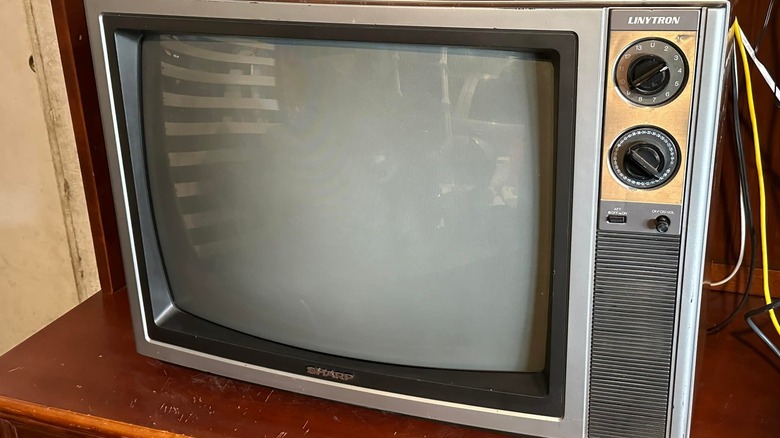
The Sharp Linytron used to grab your attention at the department store. Don't let the faded wood paneling or dials on some models fool you, because the Linytron's vivid picture popped among the rows of screens. Even today, you'll find retro gaming enthusiasts who love the quality. Though if you looked behind a Linytron television, you wouldn't expect that at all. In the early '80s, most Linytron sets didn't have RCA jacks, and, like many TVs back then, you hooked up an Atari 2600 using a switch box that you would screw into terminals on the backside of the TV. A small price to pay for getting near-arcade quality "Missile Command" at home.
By the mid- to late-80s, though, most Linytron TVs came with cable-ready coax inputs, along with remotes and digital channel displays. Despite the popularity of the Linytron, Sharp was looking to the future, when in 1988 the company unveiled the world's first 14-inch active-matrix color LCD. It's a breakthrough that helped kickstart the flat-screen revolution.
The gadget lover's '80s TV: Zenith System 3
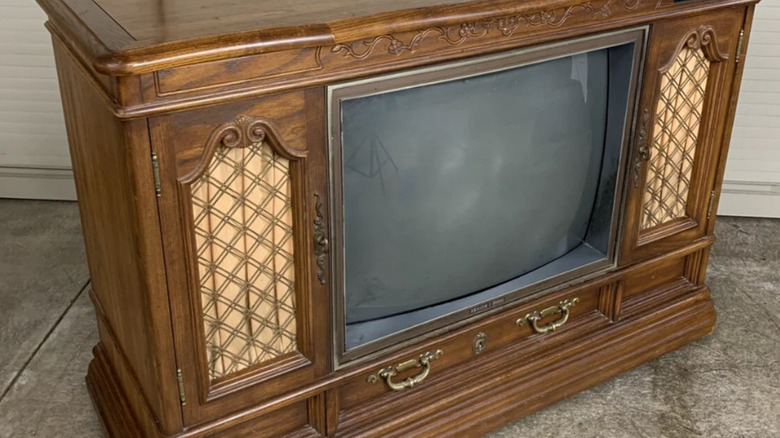
Sony improved picture quality in the '80s and Sharp brightened said picture. Zenith, however, wanted to expand on what your CRT could be when it introduced the System 3. These '80s TV sets included a self-adjusting picture, which Zenith pitched as "a TV control room inside your set." There were multiple speaker cabinets, which was a timely feature given the rise of music videos. In fact, the Multichannel Television Sound (MTS) that Zenith co-developed became the FCC standard.
MTS brought stereo sound to broadcast TV and allowed for alternative audio tracks such as Spanish-language channels. The System 3 also came with Space Command, the first ultrasonic remote you could point in any direction and still tune the TV. In the mid-'80s, the System 3 got another update: the Space Phone, letting you use your remote control to make phone calls from the couch. A couch you would never leave, because the TV supported up to 112 channels that you could flip through on your System 3 without a cable box.