

Studies Show That Ergonomic Keyboards Might Actually Be Misleading

The digital age has had a clear and undeniable impact on the nature of work. According to a study published in the International Journal of Occupational Safety and Ergonomics, the vast majority of office workers spend more than four hours a day using computers. This type of sedentary workday can pose health risks. It's no secret that sitting in front of a computer all day can promote everything from eye strain to heart disease.
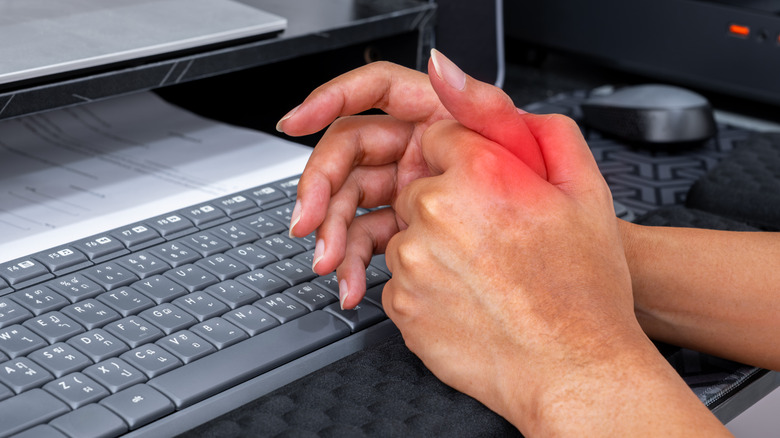
Spending a large chunk of your workday typing can also lead to typing-related discomfort or injuries. While jobs that require typing might not seem like the kind of professions that involve high injury risk, Alan Hedge, director of Cornell University's Human Factors and Ergonomics Laboratory, explained to The Seattle Times that the amount of typing an office worker may have to do in a typical week can add up in a big way. Hedge specifically pointed out that someone typing at an average speed for seven hours a day will, over the course of a five-day work week, expose their fingers to pressure equaling more than 20 tons of force. That's not to mention the strain that typing and using a computer can put on your wrists and joints.
Some try to prevent discomfort and injury by opting for ergonomic keyboards. However, these efforts might be in vain, according to a study by the University of Pittsburgh School of Health and Rehabilitation Sciences that indicates pricier ergonomic keyboards might not deliver the promised results.
Researcher finds ergonomic keyboards may not offer any special benefits

Dr. Nancy Baker is currently a professor at Tufts University, but she conducted a year-long study at the University of Pittsburgh comparing pain in subjects who used ergonomic keyboards and those who didn't. The study initially began with 85 subjects, all of whom reported experiencing some form of pain or discomfort potentially caused by typing on a computer.
When the study began, participants were randomly assigned either a traditional keyboard or an alternative ergonomic keyboard to use for six months. After six months, they switched to the other type (no pun intended). By the end of the study, 77 of the original subjects were still participating.
Dr. Baker's findings showed that after about five weeks, approximately 80% of participants reported no more pain in their hands. What's most interesting is that participants experienced these benefits regardless of whether they received a traditional keyboard or an alternative keyboard. At least one study participant also reported that using the alternative ergonomic keyboard was a little awkward, as she wasn't accustomed to it, causing her to decide to stick with her traditional keyboard going forward.
It's not entirely clear why most of the participants experienced significant pain reduction even when they began the study using a traditional keyboard. Dr. Baker suggested that making the decision to participate in a study of this sort resulted in a mental shift or change in perspective that caused them to make conscious choices to reduce their discomfort. She also pointed out that she didn't tell study participants "that one keyboard was better than the other."
A single study into ergonomic keyboards might not be conclusive
None of this is meant to suggest that Dr. Baker's study offers a definitive answer to the question of whether an ergonomic keyboard can deliver benefits. The study is from 2014, and newer ergonomic keyboards may be superior to those used in the study. Anecdotal evidence from some users also indicates that similar upgrades, like ergonomic mice, can reduce discomfort. Other factors, like the height of a worker's laptop or how they sit at their desk, could influence a worker's comfort and injury risk.
That said, it's worth keeping in mind that a higher price tag isn't a guarantee that an ergonomic keyboard will actually do what it claims. As with any upgrade, you should always do your research before investing your money. What all the experts cited in this article would agree on, though, is that you shouldn't ignore substantial discomfort resulting from typing and office work. What starts as a minor irritation can become a full injury if you assume it will just "fix itself."