

The Reason Airlines Still Use Obsolete '80s Printers
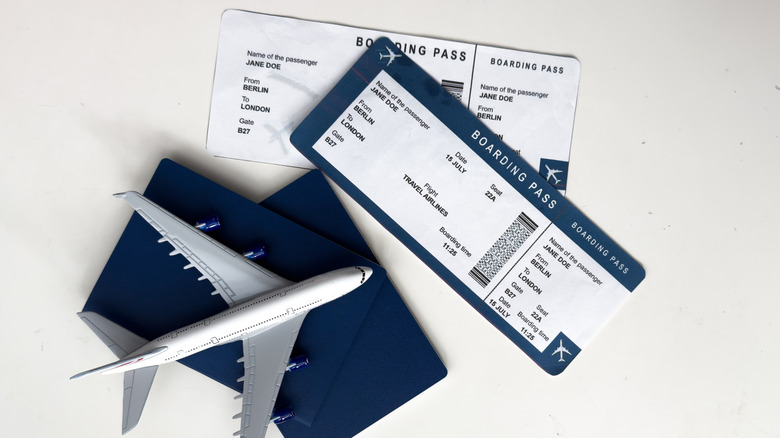
As technology has improved, so has airline travel. Nowadays, you can check in for your flight, choose your seats, and even pre-create onboard entertainment playlists via an app on your phone, before you even get to the airport. But while airlines have moved with the times, there are some aspects of their operations that remain surprisingly old school.
Despite printing technology advancing to the point that we can 3D-print objects to save ourselves money, airlines still use dot matrix printers, like the Fujitsu DL3100, for printing boarding passes, baggage tags, and even flight operation documents. These printers are impact devices that create images by physically striking an ink-soaked cloth ribbon against paper using pins.
While OKI introduced the first serial dot matrix printer in 1968, they became particularly popular in the '80s, but they're largely defunct now, having been replaced by newer, faster printing technologies like digital and inkjet printing. So, why are airlines still using these obsolete printers in their operations today?
Why airlines still use dot matrix printers
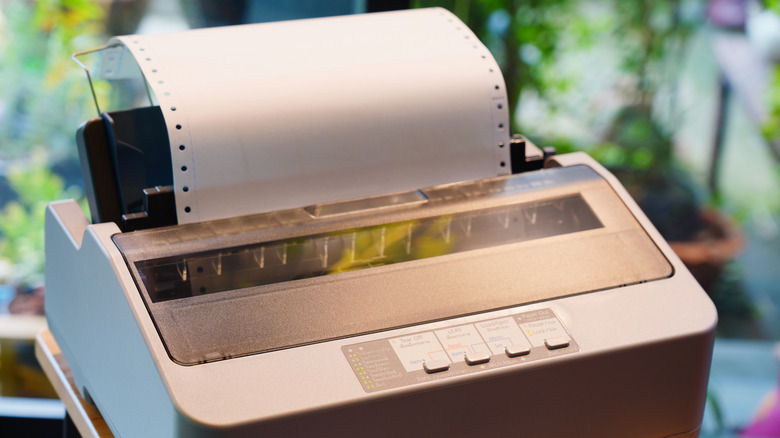
Modern airlines and airports need to function like well-oiled machines, meaning the systems they use have to be reliable and durable. Dot matrix printers are much more reliable than inkjet and laser printers — even the most reliable home printer brand. They're less sensitive to heat, dust, and dirt, and their simple mechanical design means they suffer fewer breakdowns while offering easier maintenance and longer lifespans. With proper maintenance, a dot matrix printer can last up to two decades, while the average lifespan of a modern printer is only two to seven years. This is important given how much printing airlines need to do, and it also explains why they can still be found in warehouses, manufacturing plants, and other harsh environments.
As dot matrix printers are impact printers, they can print through multiple layers at once, allowing them to create instant copies without the need for reprinting. In addition, they offer continuous paper handling, reducing jams and interruptions while managing long print jobs. This is useful for airlines, as they often need to print multiple copies at once and longer documents like passenger lists and cargo manifests, but it also makes them useful for industries like banking, government, and healthcare.
Dot matrix printers are generally more cost effective. Their ink ribbons are cheaper and longer-lasting than inkjet cartridges or laser toners, making them ideal for high-volume printing. What's more, many dot matrix printers feature universal drivers, making them compatible with legacy systems. As many airline systems were established decades ago, they may not be compatible with modern printers — and upgrading them would be costly — making dot matrix printers a more appealing option. It's also another reason these old-school printers are often found in long-running institutions, like banks and government offices.