

What Happens When Your Electric Car Battery Dies?
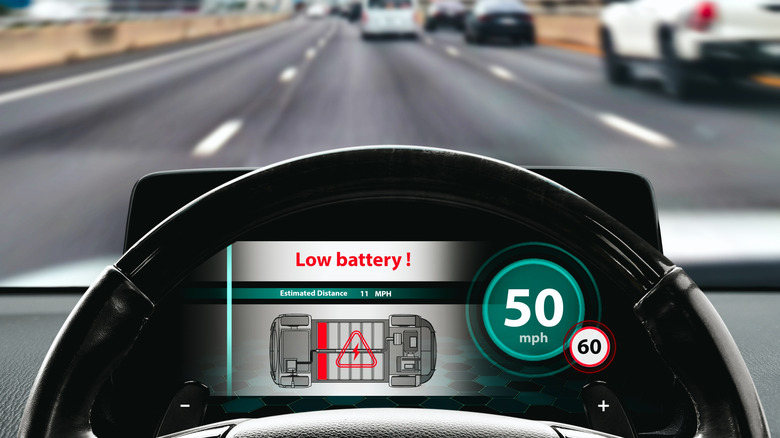
If you've ever had the misfortune of being in a car that runs out of gas, you know it's a fairly distinctive experience, especially dealing with the lack of power steering after the engine has sputtered out. With EVs becoming more prominent, it's fair to wonder what goes on with one of these cars once the battery has been fully depleted. As it turns out, it's a little less dramatic than running out of gas, with the car gradually slowing to a stop, but that's only after ample warnings and power-saving modes attempt to delay the discharge for as long as possible.
There are many factors (both internal and external) that play into how quickly your EV battery is drained, but at the end of the day, if you don't recharge your battery in time, it's very likely you'll be left stranded on the side of the road. To help avoid that, EVs are equipped with a multitude of systems that will warn you rather insistently about the current state of the battery and redistribute the flow of power to prioritize movement to get you to a safe stopping point.
EVs are equipped with warning systems to prevent full discharges
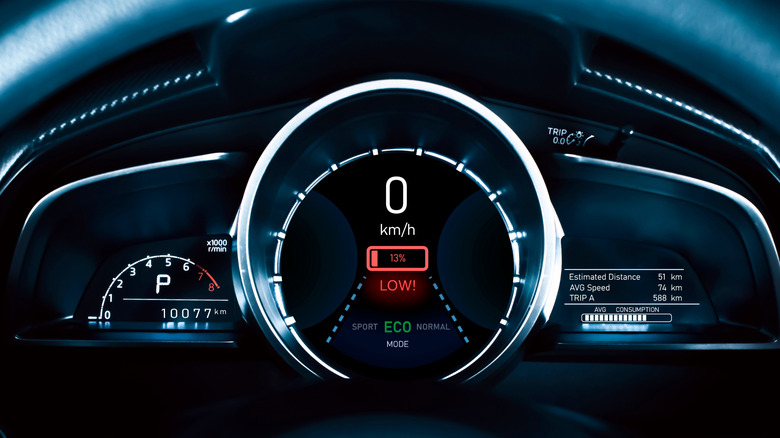
While there are procedures in place for an EV to reduce power output when the battery charge state is getting low, the vehicle is also loaded up with features and precautions to prevent such a scenario from even manifesting in the first place. The primary feature to prevent battery depletion is a tiered warning system. Similar to what happens when a gasoline-powered vehicle is close to running out of gas or when a hybrid car's battery dies, the first thing that will happen is a series of visual warnings alerting the driver. Most EVs, upon reaching around 15-20% remaining battery capacity, will begin flashing a warning symbol on the dash encouraging you to recharge. As the battery continues to trickle down, these warnings become more insistent and, hopefully, more noticeable, including flashing red symbols, audible warnings, and large messages displayed on the screen(s).
There are plenty of ways you can extend the range of your EV, but even if the battery gauge reaches 0% on the dash, there tends to be a little extra range left in reserve. This can give you a small window of time to pull over somewhere safe before the battery eventually does die.
The EV gradually slows to a complete stop
As the EV's battery continues to drain, it switches into what's colloquially known as "turtle mode," based on the turtle light that illuminates on the dash. When in turtle mode, the battery pack is very close to being depleted, so the vehicle attempts to maximize range and conserve power consumption by limiting the car's speed and reducing or shutting off the air conditioning. In the event that an EV's battery pack completely discharges, with absolutely no energy left to spare, the result is identical to a traditional car: The car won't be able to accelerate, the brakes and steering may work at a reduced capacity, and the vehicle will still be able to coast.
Unlike running out of gas, though, being stranded on the side of the road in an EV is more challenging since EV roadside assistance is more specialized and not in all areas. Stuck on the side of the road, a tow truck is needed to bring the EV to the nearest charging station. Even if the battery pack isn't able to propel the car, that doesn't mean the vehicle is completely dead, as the transmission can still be shifted to park and certain features, such as like exterior lights, power windows, and door locks, will continue to function.