

MIT Robotics Project Is Powered By Just A Wristband
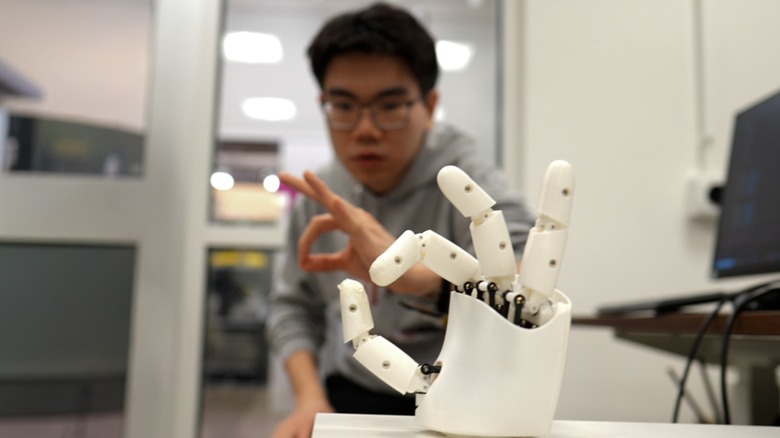
As technology improves, researchers slowly bridge the gap between prosthetics and human limbs: Scientists have developed a prosthetic hand that lets users feel temperatures and bionic legs that move through brain impulses. Now, a new development brings robotic hands one step closer to mimicking the intricate movements of the palm and fingers.
In March, a team of engineers at MIT revealed a special wristband that tracks the movements of muscles and transmit signals that make a robotic hand mirror the wearer's motions. The revolutionary device uses ultrasound technology to track muscles, tendons, and ligaments in the wrist and uses an AI algorithm to translate those signals for a robotic hand in under 120 milliseconds. This tech combo is reported to be apt enough for a human to make a commercially available robot prosthesis play the piano and learn the wearer's hand movements.
The wristband's functionality doesn't just stop at the physical world. According to researchers, this device can connect to a virtual environment and apply hand movements to in-app functions. For instance, a person can enlarge and shrink virtual objects by just pinching and releasing their fingers as if they were trying to zoom in and out of a tablet display. Imagine a future where instead of using controllers, you just slip on hi-tech wristbands and use them to navigate various VR apps and games. Sounds pretty immersive.
The wristband can serve as a training tool for robots
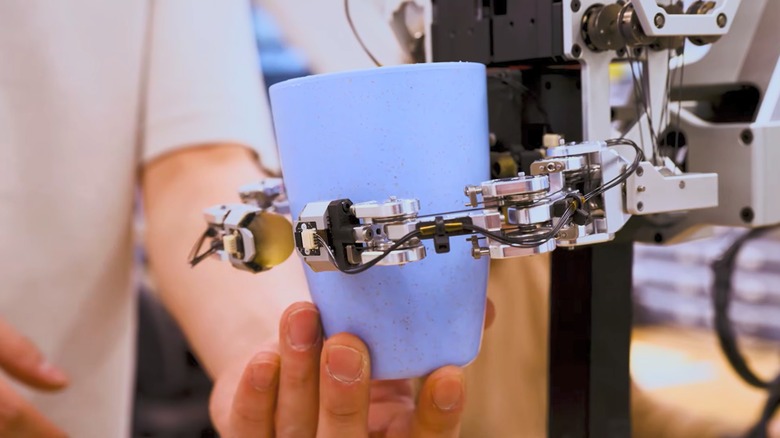
The ultrasound wristband that communicates with the robotic hand relies on technology that, while small, isn't weightless. Users must carry the combined weight of a smartwatch and smartphone on their wrist, and researchers hope to make the device smaller in the future. However, they also want to market it to more than just people who lost their hands or want a new way to interact with virtual objects.
The MIT team behind the wristband believes the device could serve as an invaluable tool in the humanoid robots' industry. They believe the AI and wristband could help train these robots in various tasks that require a high level of dexterity, such as surgical procedures. However, to achieve this goal, researchers would need to amass a sizable library of scans consisting of different hand sizes and finger shapes performing a variety of gestures.
Some people believe the future will bring us humanoid robots that integrate with our smart homes, and while many of them could be remotely piloted by strangers, MIT's wristband could serve an instrumental role in both scenarios. If the robots are autonomous, training data from the wristbands could ensure the caregiver androids handle your property with care, and if they're controlled remotely, the wristbands could deliver real-time hand precision.