

Sharks Do Bite Undersea Internet Cables – Just Not As Often As You Think
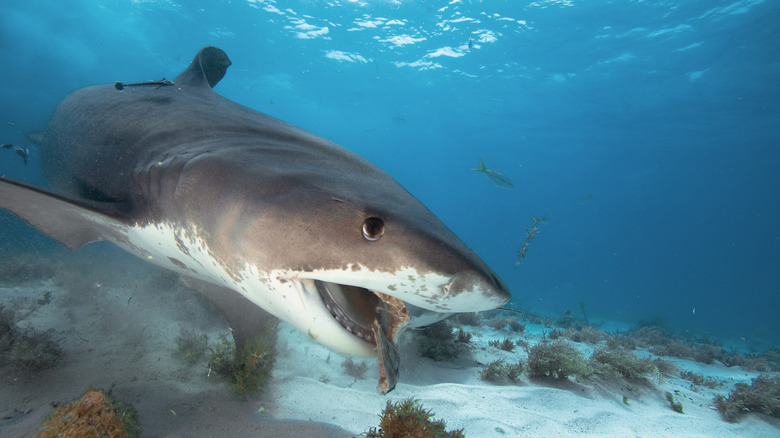
You may or may not know this, but about 99% of international internet traffic is made possible and flows through undersea cables. Basically, advanced fiber-optic cables make it possible to send and receive data from various countries around the globe. But like any type of wire, they can be damaged. One of the most common ways they're severed is attributed to maritime activities or specifically ship anchors. Anchors can sometimes make direct impact with the cables, are dragged along the seafloor and the cables themselves, or accidentally deployed around a cable. Believe it or not, intentional deployments happen, too, usually due to adverse weather. But there's another way those cables can be damaged that you probably wouldn't expect — shark bites.
There are reports of sharks biting, or rather chewing on, undersea cables stretching as far back as the late 1980's. Scientists don't actually know why this is. They suspect it's because the cables emit electromagnetic fields, which could make them appear as live prey to the underwater predators. It doesn't happen often compared to some of the other ways the cables are damaged. Only 1% of overall damage to deep-sea cables up until 2006 was because of sharks versus natural disasters, earthquakes, or even sabotage. From 2007 to 2014, no recorded cable faults were proven to be from sharks.
But even so, Google wrapped its trans-Pacific cables in a Kevlar-like protective sheath. That should, hopefully, protect against any future fish chomps or, potentially, other common forms of damage. It may not happen often, but Google felt it warranted the extra protection.
Why protect against sharks and other undersea mishaps?
Undersea cables are extremely expensive for several reasons, including complex manufacturing techniques, specialized installation processes, and, of course, the nature of the deep-sea environment, which can be quite harsh. Some of the cable designs can cost over $400 per foot. Meanwhile, faults or damage can cost upwards of $116 million to repair annually. Needless to say, that's a lot of money, and to make it worse, "faults" are much more common than you might expect. That helps to explain why, despite shark bites being a remarkably small percentage of those faults, Google opted to protect its trans-Pacific cables with tough, Kevlar-like material.
It's not actually Kevlar, but a similar protective yarn and steel wire armor makeup that's designed to protect the cables from cuts, bites, and other potential breakage.
Ultimately, the cables are so expensive, with some of the materials recoverable, that projects are underway to safely pull up old cables for recycling. In fact, the very first transatlantic fiber-optic internet cable is being removed by hand for that very purpose. Sure, you can buy a Wi-Fi router that keeps you online during power outages, but when the connection goes down because of a damaged undersea cable, there's nothing you can do but wait until it's fixed, although the primary lines are often rerouted through backups to prevent this.