

You Should Never Plug USB Hubs Into Your Power Bank - Here's Why
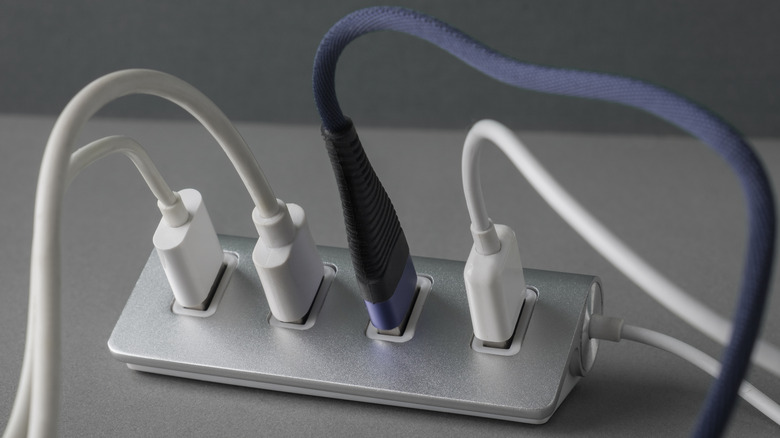
Power banks have been known to save the day, especially when there are no power outlets in sight and your phone is running out of juice. Considering their usefulness, it's worth taking care of them and not doing things that shorten their lifespan, such as charging power banks while using them without checking if they have a feature called passthrough charging. Another thing is plugging things into them that you shouldn't — like a USB hub.
Using a USB hub with a power bank can seem like a good idea when the devices outnumber the ports. Here's the thing, though — a power bank has a power delivery limit. Exceeding it means you're overdrawing the power bank's battery since the devices are pulling in more watts than the power bank can deliver. This can stress it out, leading to low voltage output (and slow charging or reduced device performance) at best or full-on combustion at worst. You're better off sticking to the power delivery limit as specified by the manufacturer to avoid problems.
What happens when a power bank is overdrawn?
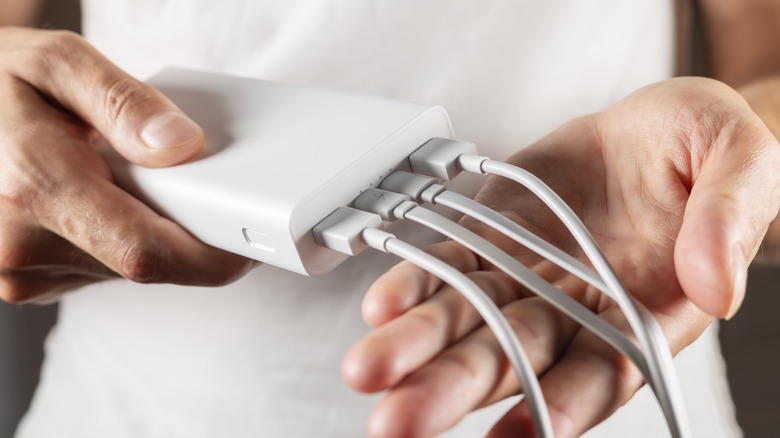
Most standard and affordable power banks have a power delivery rating of 18-30 watts. When you overdraw them, there are several things that can happen. For instance, the device will not charge or charges slowly, since the power bank is not providing enough power. This is a likely scenario in the case of a loaded USB hub because you are creating a daisy chain by plugging multiple devices into the hub, and then plugging that into the power bank. There might not be enough power to go around since the USB hub will act as a power splitter.
If the USB hub meets the minimum power input requirements of the devices, they will charge slowly. It will take longer to reach maximum capacity, which can cause delays if you're in a hurry. Using the device while it's charging can compound the problem, and you may even notice the battery level drop if it's using up more power than it's receiving in this low-wattage scenario.
The power bank can also overheat, at which point it can reduce power output or shut down temporarily. This depends on if the power bank has overcurrent protection (OCP), a feature that many units from reputable brands have and which maintains current flow at a level the bank can handle. The batteries of low-quality or counterfeit power banks, on the other hand, can degrade faster, considering heat (as produced by excessive current) is known to damage lithium-ion cells. If the heat stress is particularly high, you may notice signs that the lithium-ion battery is about to catch fire, such as leaking, swelling, bulging, noises, funny smells, and smoke.