

For All Mankind Has One Wildly Inaccurate Space Shuttle Detail (For A Good Reason)
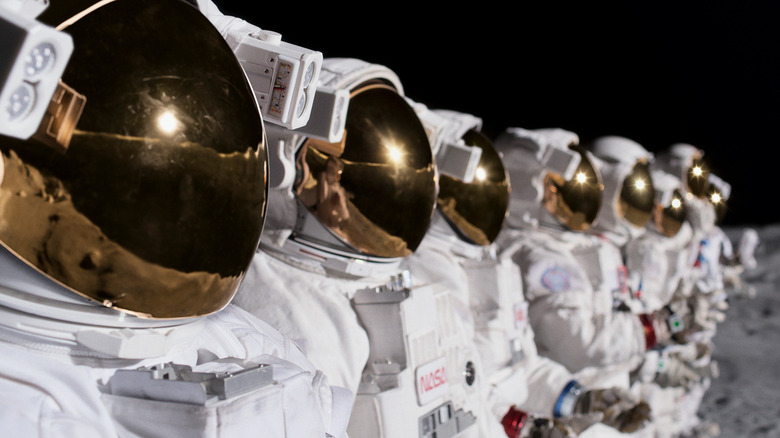
Like other shows that deal with science and history, Apple TV's sci-fi drama "For All Mankind" attempts to strike a balance between accuracy and creative freedom. While its alternate history story imagines a world where the Soviet Union landed on the moon first, and the Space Race continues for decades, the show does a decent job for the most part, using actual science to inspire plot points and taking inspiration from actual events. It even uses archival footage of astronauts, scientists, and political leaders for an extra layer of realism.
However, there is one glaring inaccuracy that's probably frustrated any viewers who know their astrodynamics. Starting in Season two, set in the 1980s, "For All Mankind" starts depicting space shuttles being used to travel to and from a lunar base. It's a technology synonymous with an era of space travel, but this groundbreaking reusable spacecraft was not built for trips to the moon, especially landing on it, and cannot actually make it there. With "For All Mankind" finally coming back for Season 5 after two years, it's worth discussing both why the show's use of space shuttles is inaccurate and why it makes sense for the series.
Why a space shuttle couldn't make it to the moon
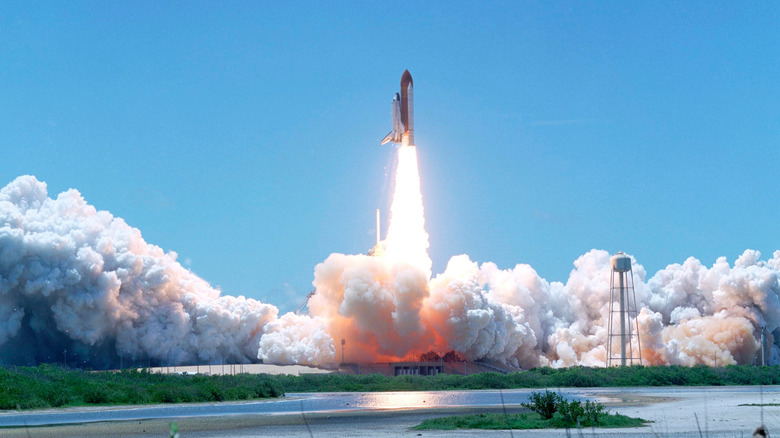
It's worth reiterating that space shuttles were never intended to go to the moon. The first one to launch was Columbia in 1981, nearly a decade after Apollo 17, the final manned lunar landing so far. The Apollo rockets were comprised of an orbiter (the part where the crew stays), two rocket boosters for lift off, and an external fuel tank; the orbiter and boosters can be reused, while the external tank burns up after launch.
Space shuttles aren't intended to go far from the Earth, instead they're used for orbital missions and transporting astronauts to the International Space Station. A shuttle wouldn't be able to get enough delta-v, which measures the change in velocity when the rocket burns its fuel, to make it all the way to the moon. As former astronaut and "For All Mankind" technical advisor Garrett Reisman explained to collectSPACE, "We even did calculations that showed if you filled up the payload bay with hydrazine and fed it to the [orbital maneuvering system] OMS engines, you still couldn't get to the moon and back without exceeding the payload mass of the orbiter."
The amount of fuel that would be necessary just to make a one-way trip is far more than a space shuttle is able to carry, so there wouldn't be enough to get all the way there. Plus, because they land like airplanes, they wouldn't be able to land on the moon due to its lack of gravity.
Why For All Mankind uses space shuttles anyway
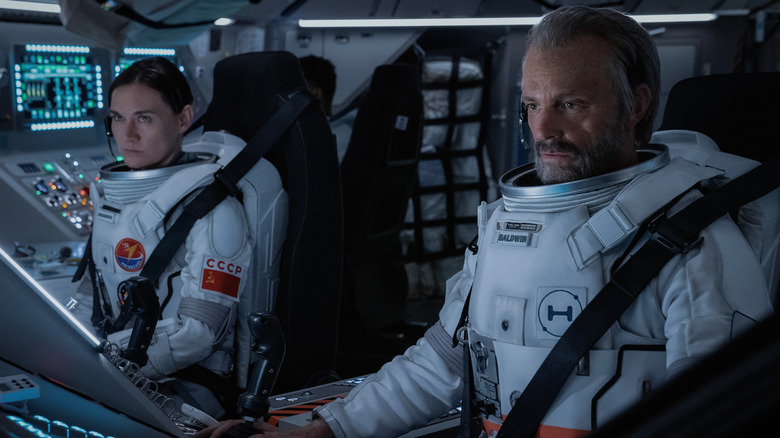
"For All Mankind" creator Ronald D. Moore was well aware of the scientific inaccuracy of using space shuttles for lunar travel, but he chose to use them for two understandable reasons that he also shared with collectSPACE. First is that, as mentioned earlier, space shuttles are iconic. NASA's Space Shuttle program ran for 30 years, ending with a 2011 Atlantis mission. Images of those spacecraft taking off and flying through space are burned into many Americans' collective memory, so it would feel like something was missing if they were excluded.
The other reason is more practical. Scrapping the space shuttle would require the production team behind "For All Mankind" to design and build an entirely new spacecraft set rather than using an existing one. That would be expensive, leaving less money to build Jamestown, the series' lunar base. On top of that, the show wouldn't be able to use archive footage of actual space shuttles. For those reasons, it makes sense for the show to put story and budget above fidelity to scientific fact.
There is one line in season 2, episode 9, titled "Triage," that attempts to explain away the inacuracy. A character says, "Our shuttles need to refuel before they burn for the moon," acknowledging that a space shuttle wouldn't be able to make it to its destination without making a pitstop. It's a small moment that probably won't satisfy anyone critical of scientific inaccuracies in media like TV shows, but it does prove that "For All Mankind" isn't making these kinds of mistakes due to carelessness or ignorance, but for budget and storytelling reasons.