

Here's How NASA Uses Star Wars TIE Fighter Technology In Real Life
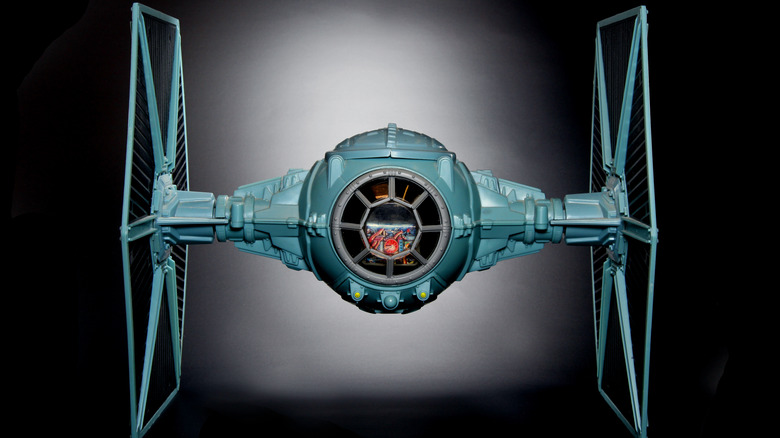
There's a ton of fandom overlap between the biggest sci-fi universe and the most storied space exploration agency, NASA. If you're unfamiliar with "Star Wars," now is a great time to dive into this franchise, considering how many exciting "Star Wars" movies and shows are coming soon. In "Star Wars," the recognizable TIE Fighter is one of the most iconic ships from the universe, participating in some of the biggest moments in the film franchise's storylines.
However, what may just seem like an imaginative design from the minds of the film's creators, the TIE fighter actually has some interesting basis in real, NASA-used science. From propulsion technology to the concept of lightspeed travel, these spacecraft pack a lot of real-life inspiration. Add that to the fact that NASA is already exploring what a permanent Moon base might mean, and real life is feeling quite fantastical. So before you write off these spaceships as pure science fiction, let's dive into the real science behind them.
Ion propulsion and lightspeed travel
One key similarity between real-world rocket science and the TIE fighter actually lives in the name. That iconic moniker is actually an acronym that stands for Twin Ion Engines, denoting the dual engine design of these spacecraft. While the technology was really first developed in some of NASA's 1990s jet propulsion explorations, possibly its most famous application is the interplanetary probe Dawn.
This deep-space craft uses the blue-colored propulsion technology to help it efficiently travel long distances. Dawn's 12-inch ion thrusters work by applying electrical energy to xenon-based fuel to allow for a massive increase in power and efficiency when compared to other comparable engine types. This allows for an impressive amount of thrust in a small package. That blue light will feel familiar if you've seen the space trails left by the fast-moving TIE fighters in "Star Wars" films.
Speaking of that fast movement, the entire concept of lightspeed travel that's employed by many "Star Wars" spaceships — including TIEs — isn't all made up either. While no actual craft has ever come even close to traveling as fast as the Millennium Falcon, astrophysicists from Göttingen University released a study in 2021 theorizing that even in light of modern physics studies, light speed travel could be real if we could harness the vacuum energy from space. It's theoretical, but all real science started with a theory, and anything that helps to bring us closer to real-life "Star Wars" is okay in our book. And since the movie industry has been attempting realistic space travel depiction for almost 100 years, it's clear we're fascinated by this stuff.