

Scientists Say This Expensive Home Theater Rule Might Be A Myth

When you build a home theater, bigger is supposed to be better. Why get a 32-inch TV when you can go for a 65-inch screen? Are you debating if an 8K TV is really worth it over a 4K set? They are supposed to provide crisper images, right? It turns out that, according to a recent study, depending on your TV and where you place it, your eyes might be too weak to even tell the difference.
In October 2025, researchers at the University of Cambridge and Meta published a study in Nature that tried to find the upper limit of screen resolutions that humans could perceive. The answer isn't a hard number, but instead determined by the size of the screen and its distance from the viewer's eye. The further away a screen is, the more its resolution becomes less noticeable for most people. To help demonstrate this effect, the researchers from University of Cambridge coded a display resolution calculator that determines the "effective resolution" most people can discern, determined by factors such as the screen size, display resolution, and viewing distance.
Let's say you do purchase a television set with 8K resolution. For the sake of argument, it's a 50" screen TV. It might be one of the most expensive TVs you can buy, so you'll want to enjoy every pixel. To do so, according to the study, you must place the set no more than 3 feet away, otherwise you will lose fidelity. Depending on the TV's size and distance, you might not be able to tell the difference between a 4K TV and a 1440p alternative — and 8K would be no different.
You don't need 20/20 vision to watch in 4K, but it helps
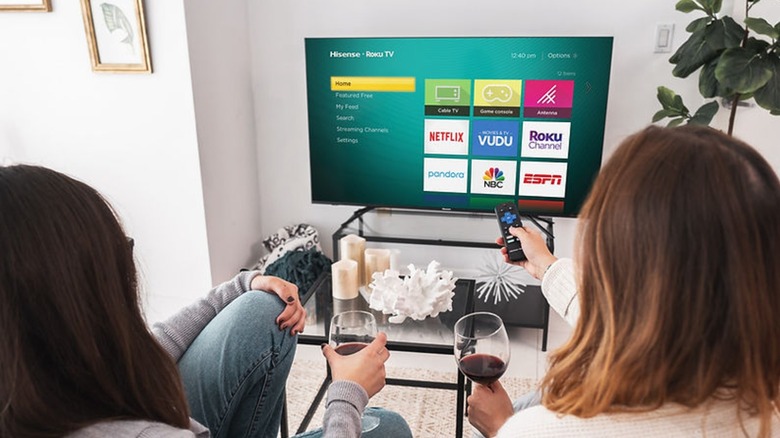
The researchers behind this study wanted to measure the upper limits of human perception (i.e., retinal resolution) and seemingly found that people can't tell the difference between certain TV resolutions at increasing distances. However, that only tells part of the story. Ultimately, the deciding factor is each individual.
This study found that the majority of people can't distinguish between 8K and 4K 50-inch TVs at a 3-foot distance. According to University of Cambridge's calculations, only about 5% of viewers actually can due to how their pupils diffract light. However, the more the TV moves further away and the more its screen size shrinks, the fewer people can differentiate between these resolutions. Age is another factor. Researchers claimed that younger audiences exceed base 20/20 vision measurements. This means that children can get more out of an 8K TV placed 10 feet away than you can because their eyes haven't degraded.
Ultimately, the study helps demonstrate that people who want to turn their TV space into a home cinema shouldn't fall for the hype of screen resolution. Do your research, and don't worry if another person's setup doesn't work for you; your eyes are probably just different. Even something as seemingly unimportant as viewing angle can throw off your ability to fully perceive screen resolution.