

5 Classic Sony Gadgets That Made The '80s So Much Cooler
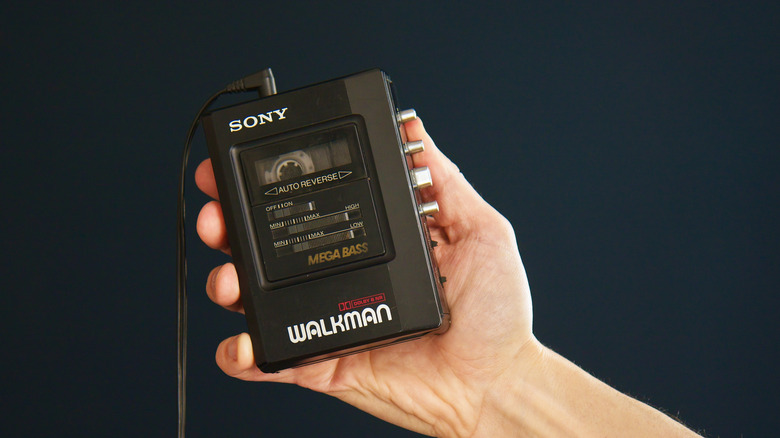
When it came to personal and home electronics in the 1980s, Sony was undoubtedly one of the kings of the scene. Not only were its offerings on the cutting edge of then-current tech, but its consumer-grade devices were emblematic of the decade's style and function. Classic devices like the Walkman and Handycam weren't just good electronics in a vacuum — they were sleek, user-friendly, and oh-so stylish to walk around with.
It's thanks in large part to Sony and its gadgets that the distinctive vibe of the '80s still lives on in our hearts, even if the hairspray and leg warmers don't. Not only that, but they also set the stage for advancements that would come later down the line, whether from Sony itself or other companies. It wouldn't be an exaggeration to say that Sony's moves in the '80s set the trajectory for personal, portable media in the decades to come, and that's just one part of these gadgets' enduring cool factor.
The Walkman
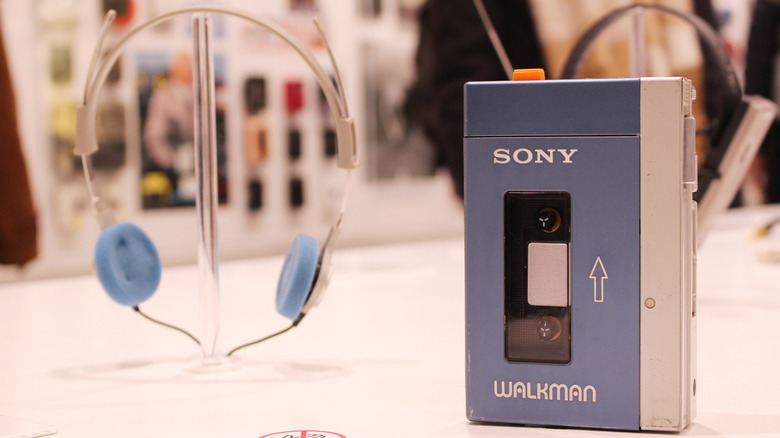
In the late '60s, Sony released the primordial cassette tape recorder, the TC-50. Rather than listening to music, though, the purpose of this device was to record, with its built-in microphone helping students and reporters document important events. You could imagine the confusion in 1979, then, when the very first Walkman was about to hit the scene without a recording function. There was doubt as to whether the device would appeal to users without that aspect, but as it turned out, it became one of the most legendary portable music players in history, making it a piece of '80s tech that has earned a permanent place in the hearts of boomers.
The Sony TPS-L2, better known as the Walkman, was a compact personal stereo device. Sony's co-founder, Masaru Ibuka, wanted an easy way to listen to music on cassette tapes while traveling around the world, so he requested a high-quality stereo listening device he could carry around with him. The Walkman was accompanied by a newly-developed pair of ultra-lightweight headphones, which in turn led to an advertising campaign focused on enjoying your music anywhere and everywhere. The hip teens of the '80s fell in love with the Walkman almost immediately, and soon enough, the little rectangles became a common sight on hips and in pockets the world over.
The CDP-101
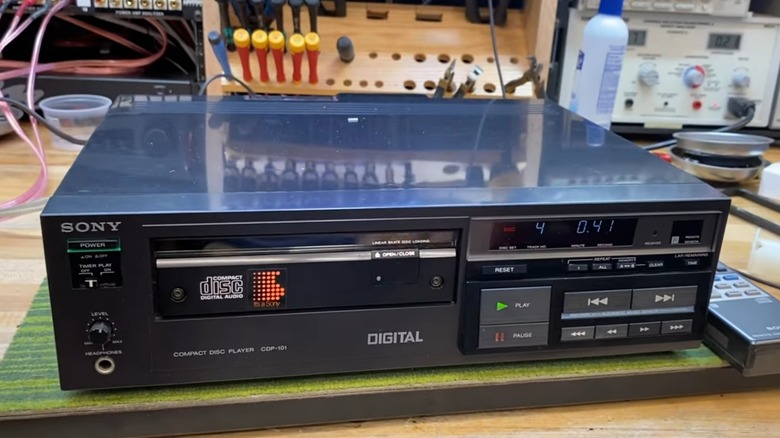
Cassette tapes and vinyl records were the primary means of music conveyance prior to the '80s, which is partly how the Walkman took off as well as it did. However, around this time, a secondary format, wholly different from the common cassette tape, had started to make waves: the digital compact disc, better known as the CD. While CDs are making a comeback these days, they were originally developed in tandem by Sony and Philips in the '70s — and as their storage capacity and quality improved, Sony knew people would be listening to music on them soon enough. To give users a way to experience the new format at home, Sony released the very first compact disc player, the CDP-101, in 1982.
The CDP-101 was made publicly available not long after CDs as a format had started to circulate in the public consciousness, offering a convenient way to play high-quality music from them. Because CDs were a digital format, the CDP-101 possessed all kinds of attractive features, from instant track-skipping instead of manual fast-forwarding to playback time on the device's display. The only downside to the CDP-101 was that it was prohibitively expensive, which is often the case with proprietary technologies. Even so, it was a vital test case for the viability of digital audio in the consumer market, and it set the stage for what came next.
The Discman
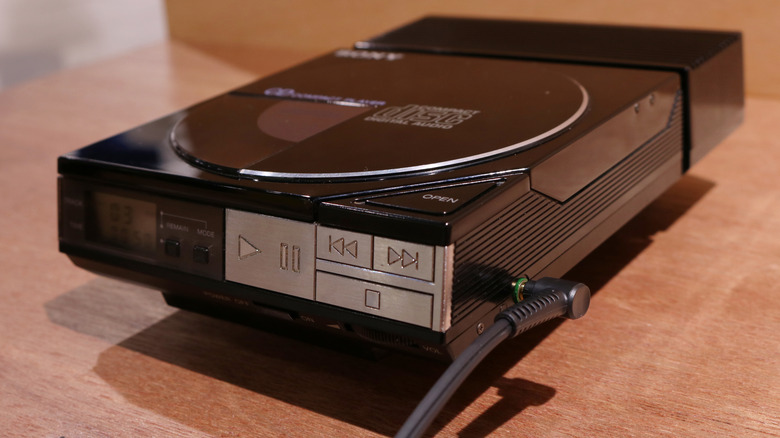
CDs started entering the consumer market around 1982, and quickly became a rival to cassettes' dominance over the portable music scene. The next step, naturally, was to provide a way for users to listen to their CDs on the go. To preemptively meet this need, in 1984, Sony released the D-50, also known as the Discman, the first portable CD player.
The Discman was the product of a concentrated effort from Sony engineers to create a CD player small enough to be carried around without sacrificing functionality. The result was roughly 4 cm thick, about the size of four CD jackets stacked on top of each other, so it was "portable" in the same way that a boombox is portable, rather than something you could carry in your pocket. Even so, it proved popular with the music-loving crowd, bolstered by a more reasonable introductory price, and it helped to really cement the CD's place in the format wars.
MDR-R10
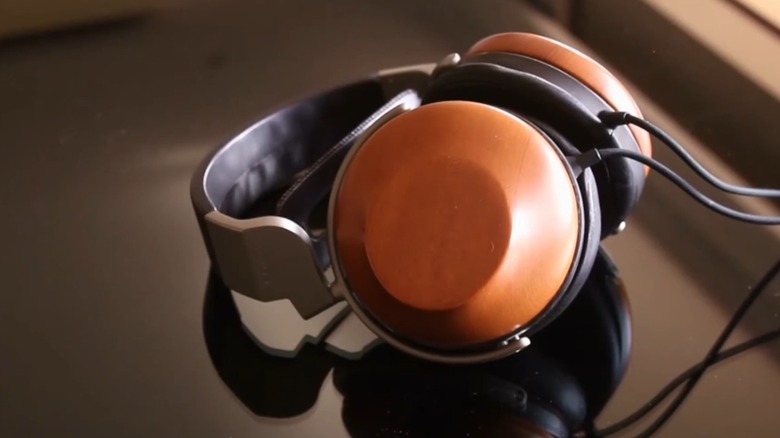
The ultra-lightweight headphones included with the Walkman were naturally a very popular gadget, thanks to their compact, unobtrusive design. Much like with the Walkman itself, Sony was always looking for new ways to make its devices even smaller, doubling down on the chic element of true portability. However, in 1988, Sony released a new pair of headphones that took things in the polar-opposite direction: the MDR-R10.
The meteoric success of the Walkman and greater presence of music-listening in the cultural zeitgeist of the '80s gave rise to the first wave of true audiophiles, those who wanted to experience their music in the highest fidelity possible and wanted equipment to facilitate that, including the best wired headphones. The MDR-R10 was one of the first consumer-grade headphones to employ a bio-cellulose diaphragm in its design. As opposed to the simple speakers and thin foam padding of the basic Walkman headphones, the MDR-R10 employed specialized materials with rigidity on par with solid aluminum, which allows them to resonate at a much wider band of audible frequencies. In simpler terms, where the Walkman headphones let you listen to songs, the MDR-R10s let you experience music, soaking in the full breadth of its sound waves. They ran for 360,000 yen, which wasn't exactly cheap, but if you wanted to really appreciate your music to the fullest, they were top-shelf.
The Handycam
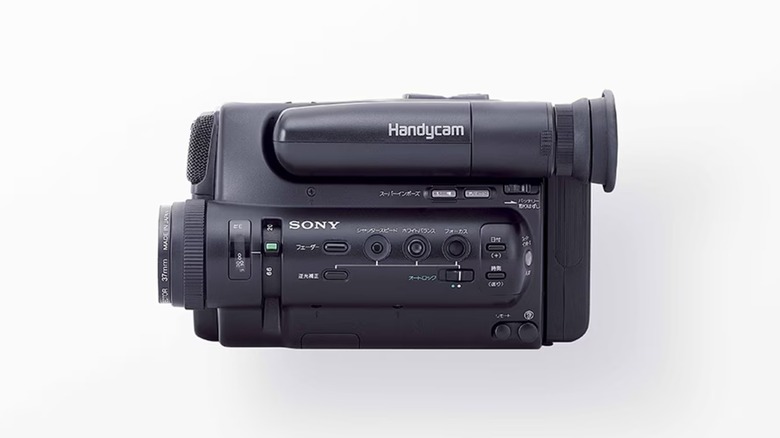
Sony's work in the '80s wasn't just about music — it was also about video. Sony released its very first handheld video camera, the HVC-F1, in 1981, which offered impressive quality in a relatively compact package for semi-professional camerawork. Sony would release several more camcorders throughout the '80s, but the one that really brought home the proverbial bacon came to us in 1989, once again cribbing the Walkman's philosophy of portability over all. That camera was the CCD-TR55, but to its users, it was better known as the "Handycam."
The Sony Handycam was the smallest and lightest personal camcorder of its era, capable of both recording and playback via an integrated 8 mm tape deck. Unlike some of Sony's other camcorders, whose microphones and camera lenses manifested as unsightly, unwieldy protrusions, the Handycam had all of its components strategically flattened, allowing it to fit comfortably in a travel bag. It only weighed 790 grams, less than 2 pounds, and was beloved for having around the same footprint as a passport. As international travel and vacationing became more popular in the '80s, the Handycam became the de facto means of recording memories for friends and family.