

This 3D Printed Suitcase Is Surprisingly Useful
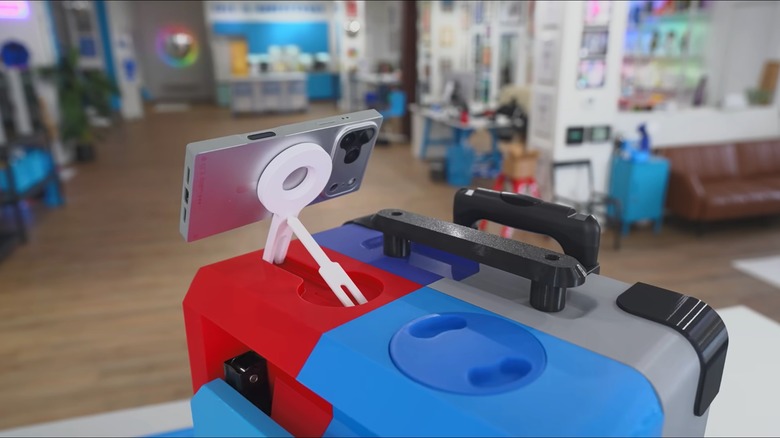
Traveling by plane is often an annoying but necessary part of many people's lives. Large power banks are one of the electronics you're not allowed to pack in your carry-ons, but you can use smart luggage bags with location tracking. When you shop for suitcases, you are limited by what retailers provide (and their prices), but what if you could make your own with features you don't normally see in luggage?
Recently, Unnecessary Inventions — a YouTube channel run by Matty Benedetto where he showcases inventions that "solve problems that don't exist" — unveiled his latest creation: a 3D-printed suitcase. Benedetto was inspired to create this piece of luggage due to his experience with Rimowa suitcases. Even with a price of $2,000 and a solid aluminum body, these suitcases can dent and scuff way too easily. So Benedetto set about constructing his own suitcase.
While the whole 3D printing was his project's main draw, he wanted to add as many features as he could to the suitcase. He added a MagSafe phone mount, a snack container, a gimballed cup holder, a fold-out table to rest his laptop, and screw-on feet that could hide Apple AirTags. He even added a smart dial that displays pertinent information, such as the weather at an airport destination. While Benedetto calls all these features "unnecessary," who wouldn't love a suitcase that doubled as a table and gave you quick access to snacks?
How the suitcase was made
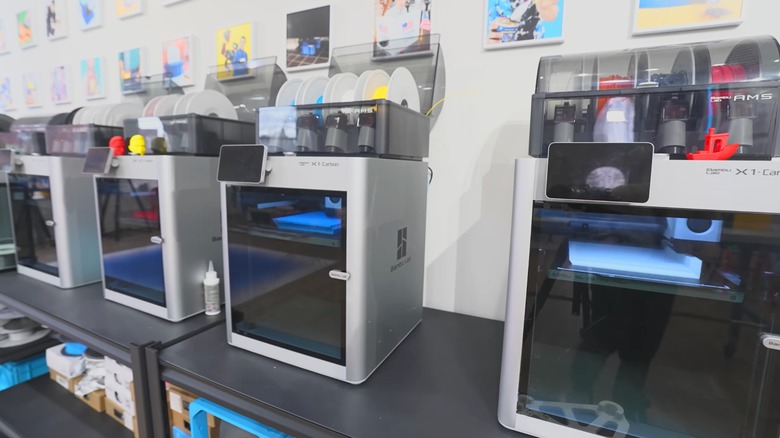
For this project, Benedetto used a Bambu Lab H2C printer, which can print in multiple colors and is available for $2,399 on the Bambu Lab store. While that's more expensive than the suitcase that inspired this build, the H2C is more of an investment than anything else. You can use it for 3D-printing fun projects such as whistles and action figures, as well as more practical items. For materials, Benedetto used TPU filament to give the corners more impact resistance, and he also used PLA filaments for areas such as the insides of the wheels.
While most of the suitcase was 3D-printed, not all components were. The outer shell, wheels, and useful add-ons such as the snack bin and table were all printed, but many of the components that made these functions work were stock. These include metal latches, metal hinges for the fold-out table, and a telescoping handle rod. Benedetto also paused the wheels mid-print to insert ball bearings to make the wheels roll smoothly. The MagSafe mount and AirTag were also existing components that couldn't be 3D-printed for obvious reasons.
To assemble the suitcase, Benedetto printed it in sections with metal dowels to add strength. He secured pieces of the shell together with Gloop glue. For all the metal parts, he just screwed them in.
The aftermath of this suitcase experiment
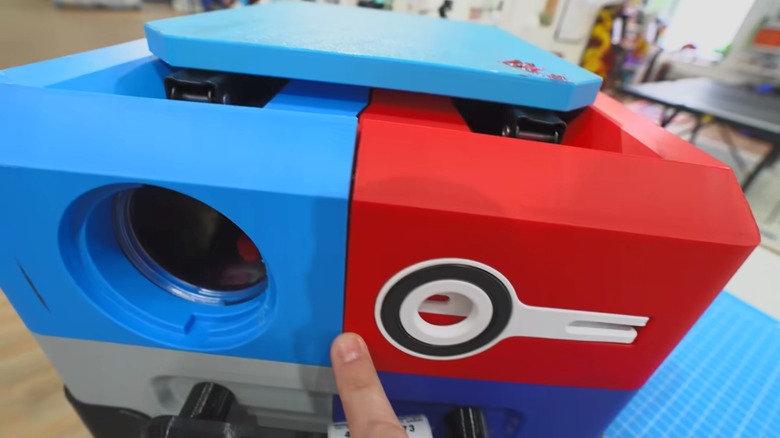
To test his invention, Benedetto ran his 3D-printed suitcase through the wringer by taking it on two flights — one in the overhead compartment and one in checked storage — and seeing how it held up. When Benedetto tried to store the suitcase in an overhead bin, he ran into an unforeseen issue: The overhead bin was smaller than anticipated. While he managed to store his suitcase in another area, a wheel popped off, which gave him the opportunity to test how easily he could repair wheel damage. It was very easy to do, as the wheel slotted back on without any issue. This knowledge let Benedetto pop off the wheels so he wouldn't accidentally lose them while the suitcase was stored in the main luggage compartment during the return trip. But this precaution didn't prevent additional damage.
Between checking the suitcase at the gate and retrieving it after the flight, Benedetto's luggage lost the lid to the snack container and its gimballed cup holder. A hairline fracture formed around the main seam, and some sections got scuffed up. However, the suitcase remained overall intact. Plus, the AirTag stayed secure in one of the feet — AirTags aren't as reliable as many would like to believe, so retrieving it would have been an extra hassle.
Overall, Benedetto ruled that the 3D-printed suitcase "wasn't a total loss" but it was far from "the best way to do things." He could have readily replaced many of the missing parts. But is the ability to use the suitcase as a table for your laptop worth the cost of frequently replacing the fold-out table after it snaps off during the flight?