

This German-Ukrainian Plant Claims It Will Build Over 10,000 Drones A Year
Several European countries are pushing to bolster Ukraine's military procurement systems. Four years into its current conflict with Russia, the eastern European nation has rapidly developed into a global leader in drone development and production. NATO allies are taking notice, and they're investing in Ukraine's efforts to not only beat back Russian forces but also galvanize European security capabilities for the next era of warfare. Ukraine also hopes to ratchet up its annual drone production to an astounding 7 million by the end of 2026. Fulfilling such technological needs is no easy task — but one German factory, Quantum Systems, is committed to supporting the European-Ukrainian war effort by supplying Ukraine with 10,000 drones annually.
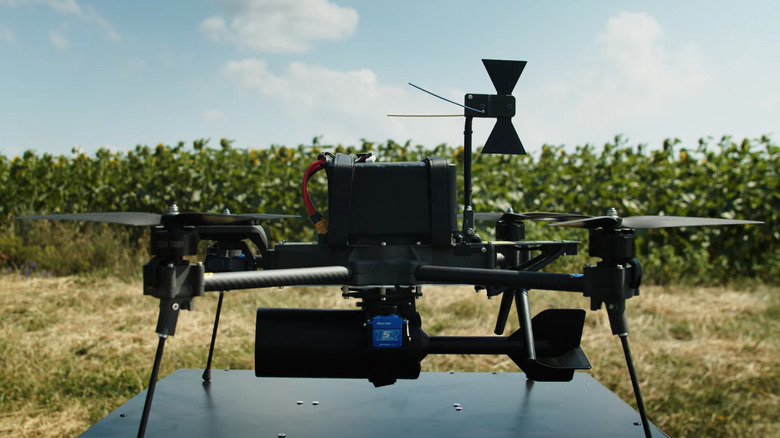
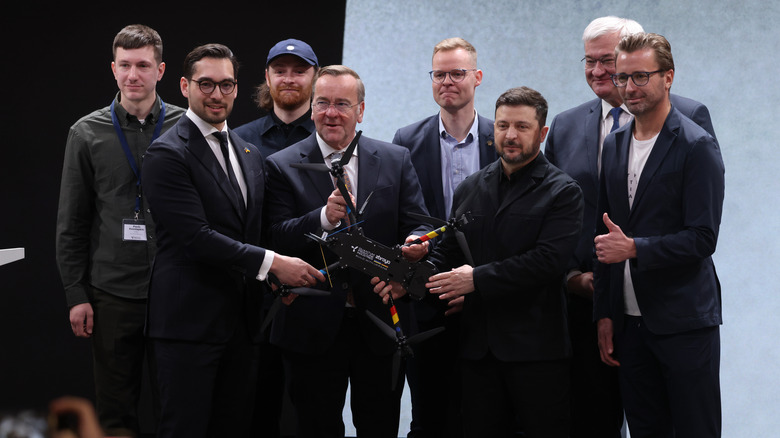
In partnership with Ukrainian drone manufacturer Frontline Robotics, Quantum Systems is part of an initiative dubbed Quantum Frontline Industries. The joint venture will produce Ukraine's Linza drone, a logistical military device capable of carrying small packages to front lines, among other things. This collaboration is part of a broader German government-backed project known as Build With Ukraine, which was announced at a ribbon-cutting ceremony attended by Ukrainian President Volodymyr Zelenskyy and German Defense Minister Boris Pistorius in February 2026. Funded by a $2.3 billion subsidy from the German government, Build With Ukraine aims to increase the two countries' defense manufacturing in tandem. The fruits of Quantum Frontline Industries come following other previously pledged support, including Patriot defense systems, UAVs, and 200 self-propelled Bohdana howitzer systems.
The Quantum-Frontline partnership's impact is likely to go beyond Ukraine's logistics networks. Ultimately, it represents a new era of technology development exports, in which nation states and military contractors must adjust — at scale — to AI-driven transformations in military tech, as well as advances in robotics and other emerging technologies.
What is the Linza drone?
Located in Gilching, just outside Munich, Quantum Frontline Industries' factory employs roughly five dozen people and plans to scale to 200 employees by 2027. A majority of its workers are Ukrainian, many of whom are refugees. One challenge of producing these German-made drones is procuring enough materials locally; although Ukrainian drones contain both domestic and internationally sourced components, roughly 75% of those components come from local contractors (via Ukrainska Pravda). That said, the partnership has proven successful thus far, with Quantum Systems having shipped its first batch of Linza drones to Ukraine in March. Eventually, it hopes to expand its supply lines to Germany and other allied militaries.
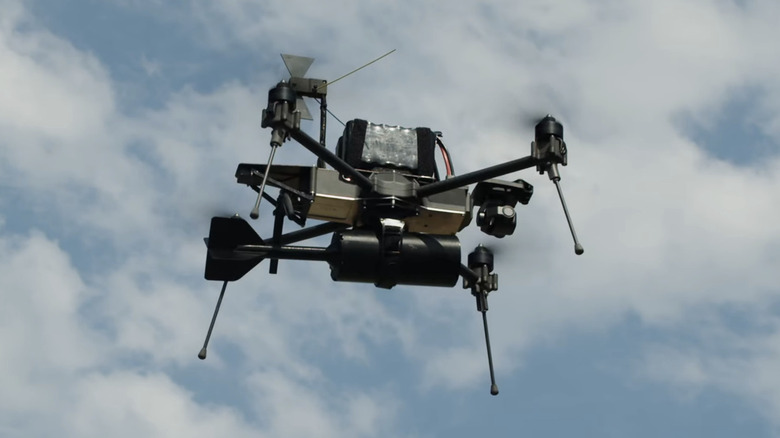
Named for the Ukrainian word for lens, Frontline's Linza UAV is a "multifunctional logistic drone" capable of carrying nearly 4.5 pounds of goods up to 6.2 miles away, making it an effective means of delivering lightweight essentials to the front, including water, mobile phones, batteries, and first-aid kits. According to Frontline (via RadioFreeEurope), the Linza can also function as a "drone bomber" that can drop small explosives behind enemy lines. One advantage the Linza brings to Ukraine's supply lines is its reusability. Using a proprietary, encrypted, and frequency-hopping communications platform and encrypted one-way video transmission, the drones can not only return to operators after every mission and operate in scaled logistics operations, but they can resist techniques like signal jamming.
Frontline's Linza drones address an acute need for the Ukrainian military. With the rise of attack drones being deployed in the war, resupplying the front has become exceptionally dangerous. The Ukrainian military has already begun using unmanned ground robots to supply operators and retrieve dead or wounded soldiers from the front lines, but mass-produced Linza drones could further assist in these efforts.
Linzas have set the stage for drone manufacturing across Europe
Company executives tout the factory as representing a shift in Ukrainian defense production. The war has forced Ukraine to become a leader in emerging military technologies by deploying an expedited, dispersed procurement structure to quickly deliver innovations to the battlefield, ranging from anti-drone laser guns to futuristic exoskeletons that look like they're from a sci-fi movie. Meanwhile, allied nations are turning to Kyiv for its hard-won expertise. Ongoing conflicts in the Middle East have underscored this paradigm, as several Gulf states have sought Ukrainian assistance and drone exports to help defend against Iran's cheap Shahed drones.
This demand has put Ukrainian officials and executives in a bind. For manufacturers, exporting Ukrainian drones could be a massive economic boon. However, Ukrainian military planners must weigh such economic windfalls against maximizing domestic supplies, political gains, and technical advantages. In launching its latest factory, Quantum Frontline Industries highlights the difficulty of balancing Ukraine's political, military, and economic interests. As Frontline's business development director Mykyta Rozhkov told Ukrainska Pravda, the deal "is like a wedding after which the couple moves in with the parents. Because there's our relationship as two industrial players, and then there is a higher level above us — two governments, two ministries, which also have to agree on everything between themselves." The Quantum-Frontline partnership could become a blueprint for overcoming such hurdles.
As it stands, the project is just one of several Ukrainian-European production partnerships in the early stages of development, although it's notable as being the first of its kind. Earlier this year, Quantum Systems struck a deal with Ukrainian manufacturer WIY Drones to produce 15,000 anti-UAV drones. Ukraine has also agreed to partner with Romania and the United Kingdom for collaborative defense manufacturing, and it's set to open at least 10 export centers across the Baltics and Northern Europe. The E.U., for its part, has made funding Ukrainian defense production partners a key pillar of its latest defense package.