

Laptops Vs. Notebooks: What's The Difference?
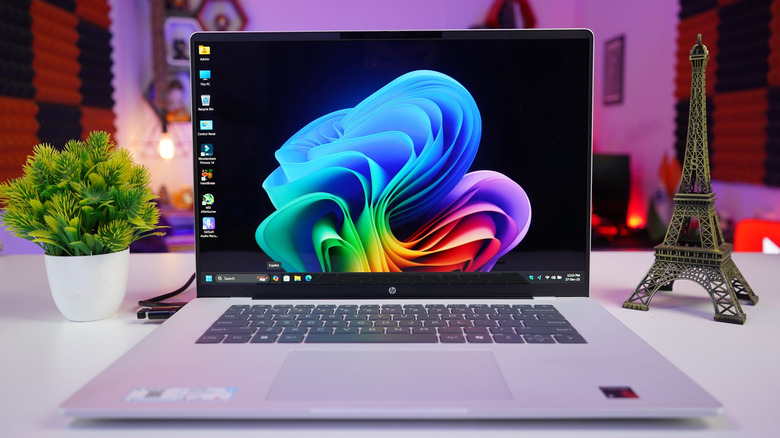
Computers have shrunk by a considerable amount ever since their inception. Originally, computers were so big that their hard drives were the size of modern-day washing machines, but now you can slip computers into backpacks. While these machines are colloquially known as laptops, some go by another name that causes no shortage of confusion: notebooks. This is no mere synonym.
The term laptop is used to describe a computer you can take on the go and rest on your lap (hence the name), whereas the label notebook is generally reserved for ultra-thin laptops. They are even more compact and weigh about as much as a paper notebook. This difference in size should be your first hint that a notebook has smaller, fewer, and generally weaker components. Critical pieces of hardware, such as RAM, CPUs, and storage drives in notebooks, typically can't measure up to those you find in laptops. Plus, notebooks often have fewer ports that can connect to peripherals and other devices.
The difference in size and power also affects battery life. Laptops generally provide more energy capacity because they just have so much more room for bigger batteries. However, the flipside of that coin is that the beefier hardware inside laptops requires more energy and thus drains batteries faster. Meanwhile, notebooks are more frugal with their energy requirements, thanks to their weaker components. Since their CPUs and displays require less power, notebooks last far longer unplugged than most laptops.
Notebooks aren't always suited to the task at hand

As mentioned above, laptops ship with stronger components because they have so much more room. This gulf in power restricts what notebooks can do and the services they can provide, relative to their laptop counterparts.
While laptops usually don't quite measure up to dedicated desktop workstations, most are still suited for a variety of tasks. You can use laptops to edit videos, develop software, and play video games. Heck, plenty of laptops outperform consoles like the PlayStation 5, and depending on the laptop model, you will have plenty of ports to upgrade your setup with additional monitors, external keyboards, and dongles for wireless devices such as headphones. Notebooks, on the other hand, only have enough power for lightweight tasks like writing emails, editing documents, and watching YouTube. If you want to play games on a notebook, you are better off using a cloud gaming service or streaming console titles to the device.
If you need to develop a presentation for work, you might want to do all the heavy lifting on a laptop or even a more powerful desktop. But when it comes time to actually show your coworkers the fruits of your labor, feel free to convert everything to Microsoft PowerPoint and store it on a notebook. The battery won't give out mid-proposal, and the sleeker form factor gives you more flexibility in where and how you present.
You get what you pay for
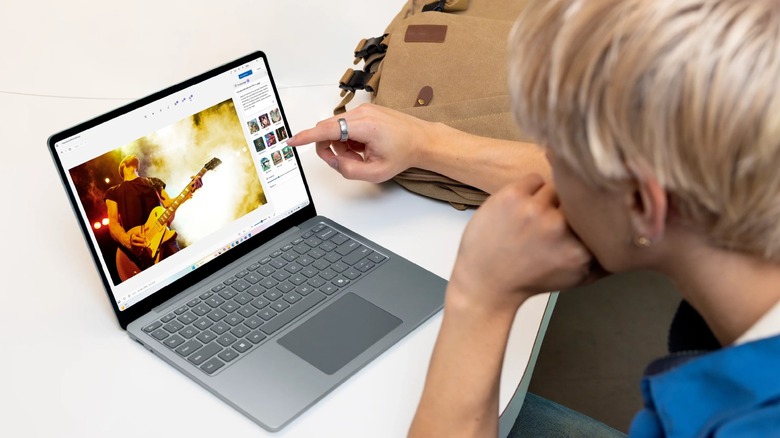
Laptops, like desktops, come in a variety of price points. The more powerful the hardware, the larger the price tag. You don't need to break the bank to purchase a truly worthwhile laptop, so you can always opt for a cheaper model.
More often than not, notebooks are more affordable than laptops. This general rule is directly tied to their components and performance. Let's look at Asus — a Taiwanese manufacturer with middling reliability scores but more positive user reviews. One of their most powerful gaming laptops, the ROG Strix Scar 18, starts at $2,699.99 and can go as high as $4,499.99 if you pick the model that includes an RTX 5090 GPU, Intel Core Ultra 9 275HX CPU, and 2 TB SSD. Meanwhile, one of Asus' best notebooks, the Asus Vivobook S14, is a quarter of that price at only $1,199.99, but it also only includes a comparatively paltry AMD Radeon 880M GPU, AMD Ryzen AI 9 365 CPU, and 512 GB SSD. Even the weakest Asus gaming laptop — the ROG Strix G16 — is more expensive at $1,499.99.
Of course, this pricing rule isn't set in stone. Costs can vary from day to day depending on the individual retailers. You can easily find a proper laptop that is cheaper than a notebook if you know where to look (and take advantage of sales and discounts). However, most of the time, you will need to spend more money on a laptop. If you want a computer that is portable and doesn't skimp on performance, it will be money well spent, but if you want to go all-in on the cloud computing revolution, a notebook is often the better — and cheaper — option.