

Blue Or Black: Which Solar Panel Is Better?
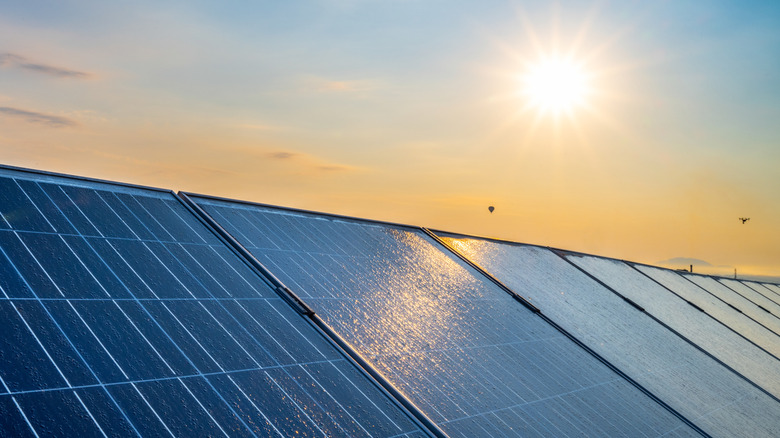
If you've seen a house with solar panels, you've likely noticed most are either blue or black. Anyone thinking about installing solar panels on their home may be wondering what the difference is. Which is more efficient, cheaper, and better? The answer, today, is almost always black solar panels. In fact, Consumer Reports' three top picks for solar panels are all black. There are several reasons why, including how they're made. Black solar panels are typically monocrystalline, meaning each solar cell is a single crystal. The crystals are created using the Czochralski process, which pulls a single seed crystal out of molten silicon to form one continuous lattice.
Silicon is naturally dark in color and its crystalline structure absorbs nearly all light, with little reflection, contributing to the black appearance. Blue solar panels, on the other hand are polycrystalline. They're formed by melting silicon crystals together that solidifies as it cools and results in the glimmering blue color. Blue panels have a lower efficiency of 15% to 17% versus up to 24% for blue solar panels. However, they're cheaper to manufacture because the process wastes less silicon during production.
Why black solar panels are worth the extra cost
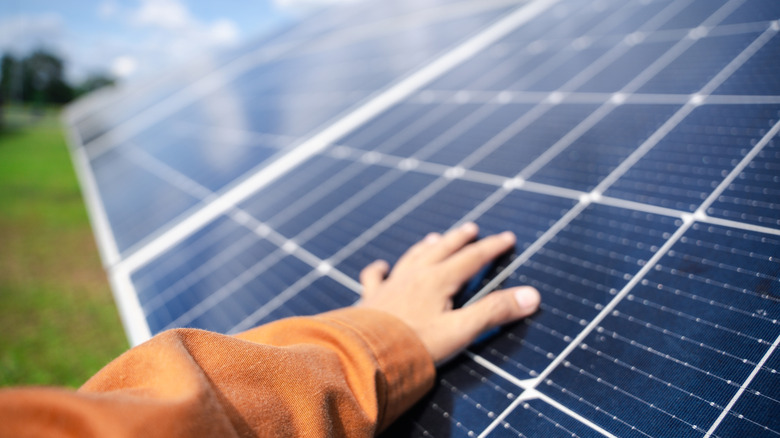
Most solar installations you see today will use monocrystalline black panels. Blue panels have historically been cheaper, but the gap is closing. Monocrystalline panels now cost around $0.90 to $1.20 per watt, while polycrystalline blue panels are in the $0.70 to $0.95 range. For a typical 8-kW home installation, going with blue panels can be thousands of dollars cheaper. However, because black panels produce more power from the same footprint, they will save money in the long run.
Of course, it takes years for solar panels to pay for themselves either way. Black panels offer more than value. The higher efficiency makes them popular on smaller roofs and mobile setups, which have limited space. Black solar panels also last up to 10 years longer than blue panels, and hold their efficiency better in high heat, making them a better choice in hot climates. Don't forget the color itself. Homeowners, designers, and HOAs tend to like that black panels blend in better with dark roofs.
But blue solar panels haven't entirely disappeared. They're cheaper to sell because they're cheaper to make. Legacy factories have been built, the supply chain is established, and workers have been trained. Polycrystalline panels still have value for projects with tight budgets, but overall, black solar panels are better in almost every way.