

Scientists Have Created A Polish That Lets You Type On Touchscreens With Long Nails
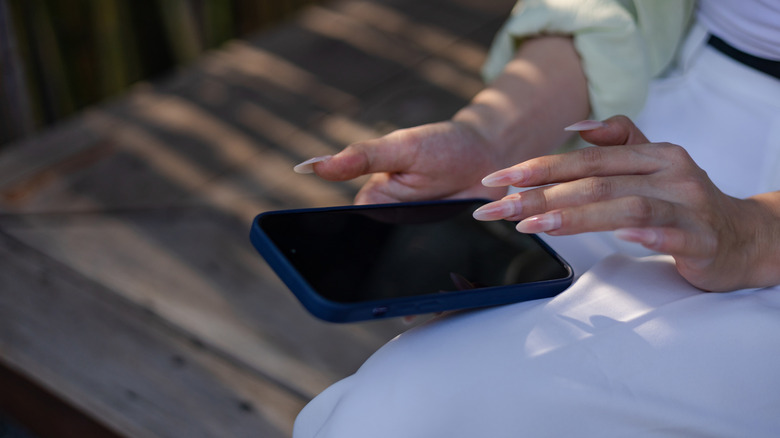
If you have ever worn fake nails or let your nails grow out, you know the struggle of interacting with a touchscreen. They don't work well with the technology, making it difficult to do even normal tasks. Of course, those used to the experience learn to compensate. But what if nails could be modified so they're recognized by a touchscreen? Better yet, what if you could use them as a makeshift stylus? That may be possible thanks to an innovative polish that disrupts the screen's electric field, as reported by researchers at an American Chemical Society meeting.
The way it works is simple. Touchscreen devices are engineered with a thin layer of conductive material, protected by a layer of transparent glass. The conductive layer creates an electric field that persists across the top surface of the device. When you press a stylus against the glass, or your finger, it disrupts the field — creating a unique electric signal. The device converts that interaction into a digital reaction like gestures and controls. Conventional nails are not conductive like your fingers and thus do nothing to that field. But through experimentation, scientists formulated unique polish mixtures that can, in fact, disrupt it. That's good news considering many of the best smart home gadgets out there for minimalists now include touchscreens or touch panels.
Manasi Desai, a chemistry and biology student at Centenary College of Louisiana in Shreveport, and Joshua Lawrence — an organometallic chemist — worked together to introduce additives to commercially available clear nail polish. The goal was to keep the formula clear so you can apply it over bare nails or any manicure.
As a nail polish, it isn't quite ready yet
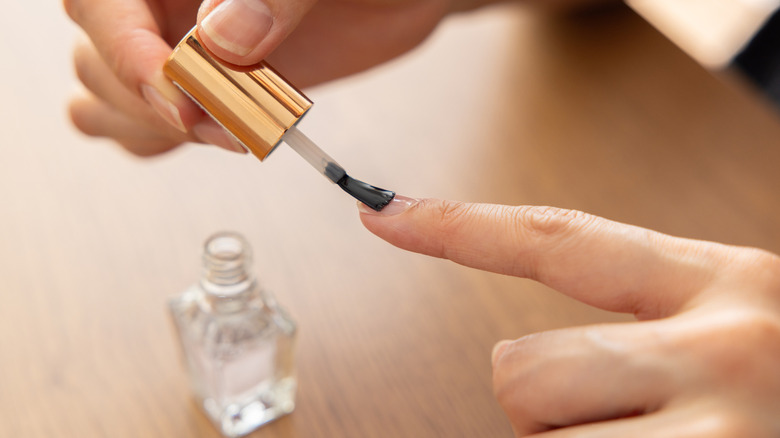
Two of the additives the team merged with the polish were ethanolamine and taurine, which essentially employ natural acid-base chemistry to disrupt the energy field and interact with the touchscreen. At least, that's what the team posits; more research will be needed to better understand the process. The issue currently is that there isn't enough additive in the polish to activate the screen when it's painted on nails. They had to glob the material with tweezers to make it work. The team plans to improve the formula with more concentrated amounts. Even so, it's not difficult to fathom this being available relatively soon. We do already have "Total Recall"-esque color changing nails, shown off as new tech at CES 2026.
Unfortunately, as a functional nail polish the material isn't quite ready for primetime. There's the concentration problem already mentioned, but the slight toxicity of ethanolamine (one of the additives) could be an issue. More aptly, the mixture wears off rather quickly, and so researchers need to find a way to boost its longevity, especially if its going to be used in a consumer-grade product later down the line. It does seem a worthwhile effort, though, and has never been more relevant, with Apple planning to incorporate a touchscreen in MacBooks a la a beloved iOS feature that's finally coming to the Mac platform. Point is, touchscreens are everywhere; we could use a few new ways to reliably interact with them.