

The US Navy Uses These Unmanned Robots To Clear Dangerous Sea Mines
Amongst other revelations, the crisis in Iran has shone a fresh spotlight on the U.S.'s depleted minesweeping capabilities. As part of its effort to blockade the Strait of Hormuz, a waterway through which a fifth of the world's oil supply passes, Iran has begun laying underwater mines. The U.S. has responded by blocking Iranian ports and attempting to clear passageways through the strait, but according to reporting in the Wall Street Journal, the U.S. Navy hasn't had significant mine clearing capabilities in decades (focusing its resources and budget on other projects, like a new class of supercarrier).
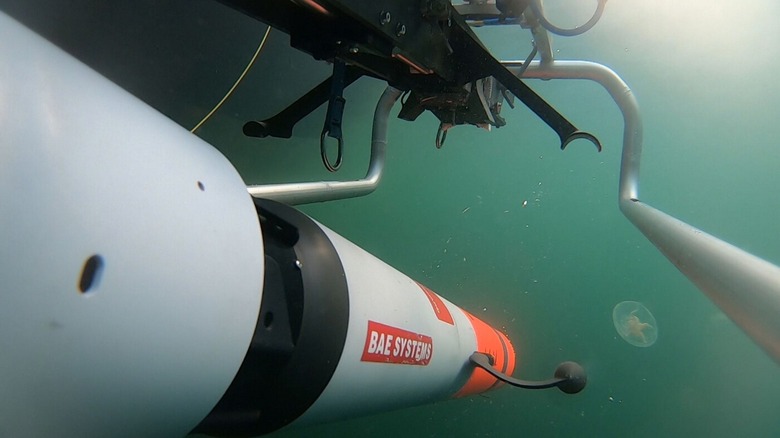
In place of its traditional, specialized minesweeping craft and helicopters, the U.S. has begun experimenting with unmanned craft. Part of this next generation arsenal is a remote-controlled underwater mine neutralizer dubbed the Archerfish, which works in concert with sonar mine-hunting systems to locate and destroy mines before they can pose a threat to surface or submerged vessels. It allows the Navy to find and detonate mines with unmanned craft, without putting its personnel (or more valuable vehicles) at risk. Here's how it works.
Next-gen mine detection
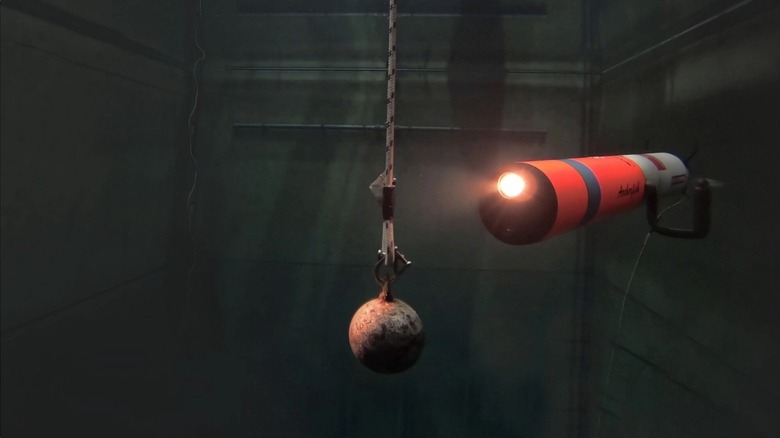
The Archerfish is a component of the Navy's Airborne Mine Neutralization System, which is deployed using helicopters (the Sikorsky MH-60S), surface vessels, or unmanned underwater vehicles (UUVs). The Archerfish includes high-frequency sonar and low-light video capabilities for discovering and identifying mines, and it relays information back to an operator by way of a fiberoptic data link. When a mine has been identified, it launches a shaped charge warhead to destroy it.
The Navy has other systems at its disposal to help locate mines, including the AN/AQS-20C mine-hunting sonar system. This device is an underwater towed body, which, like the Archerfish, can be deployed from helicopters, surface vessels, and drone boats (Common Uncrewed Surface Vessel), and it makes use of four sophisticated, high-resolution sonars along with electro-optical laser imaging. Attached to its launch vehicle by way of a small-diameter electromechanical cable, operators "fly" the device underwater, analyzing the terrain of the ocean floor and scanning for mines. When a threat is detected, the Archerfish can be deployed to perform the actual neutralization.
Other tools in the minesweeping arsenal
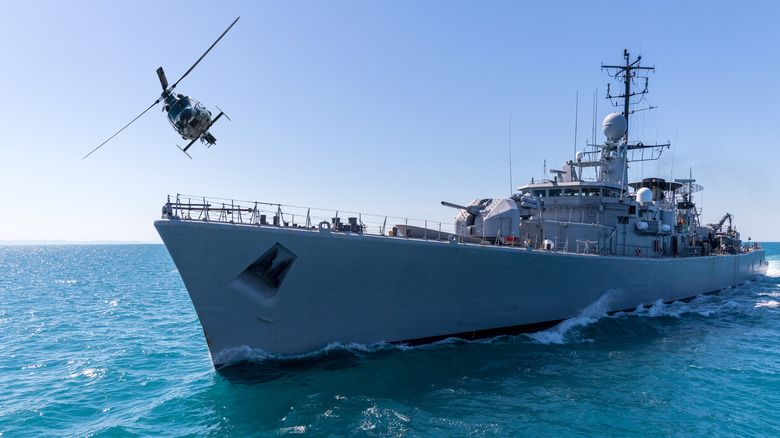
The Archerfish and AN/AQS-20C are two examples of a broad number of mine countermeasures the Navy has been experimenting with, among other wildly expensive projects like the $8 billion sci-fi-looking, Zumwalt-class destroyer. This new-age experimentation includes a growing focus on artificial intelligence, drones, and unmanned military vehicles. One such system is the Mine Countermeasures Unmanned Surface Vehicle, which tows a module that creates noise and generates magnetic fields to force mines to detonate.
There are also submarine drones manufactured by General Dynamics called the MK18 Mod 2 Kingfish and the Knifefish, which sweep an underwater area in a pattern seeking out active mines. Northrop Grumman, the U.S. aerospace and defense company, has developed technology that uses lasers attached to helicopters to find mines while safely airborne, and the European defense firm Thales is manufacturing AI-powered drones capable of detecting mines more quickly using sonar.