

Floppy Disks Aren't Floppy – So Where Did The Name Come From?
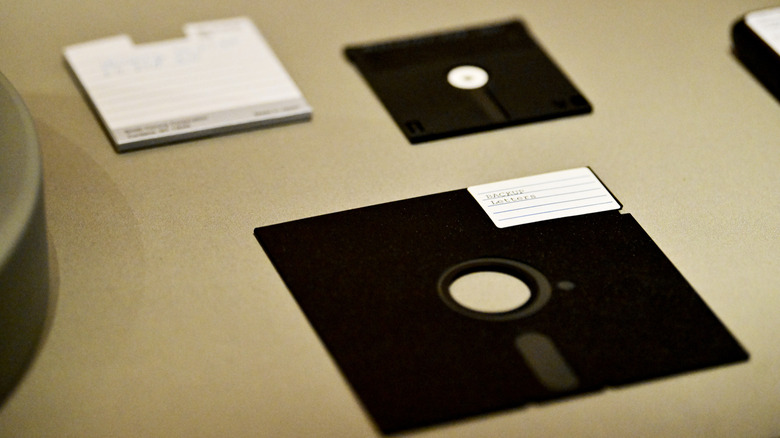
If you're a member of Gen A, there's a good chance you've never seen anything called a "floppy disk." If you're Gen Z or older, you've almost certainly handled floppies (and you may even be collecting them now, on a wave of nostalgia), but they most certainly didn't flop. In fact, video games and programs in the 1990s and early 2000s were stored in colorful, 3.5-inch, rectangular "floppies" that were actually rigid and tough. The reality is that, unless you're a Boomer, you may never have experienced floppy disks that really flop.
Floppy disks have a complex and fascinating history. The originals were very large and very floppy, and their invention made it easy to record and share code, even for non-computer scientists. Over time, floppies of various sizes and degrees of floppiness became standard office tools and expanded into households across the country. Then, as streaming and downloads became common, the need for a storage device for games and commonly used programs disappeared.
Today, it's unlikely you'll come across a floppy disk unless you're using legacy computers or certain types of medical machines. A few government agencies may also still use floppies, as do some airplanes. The sad truth is that even the most up-to-date floppies hold no more than 2.8 megabytes (MB), and most hold 1.44 MB—far too little storage for today's programs, files, and games. Even a standard iPhone photo would barely fit on a typical 3.5-inch floppy!
The original floppies
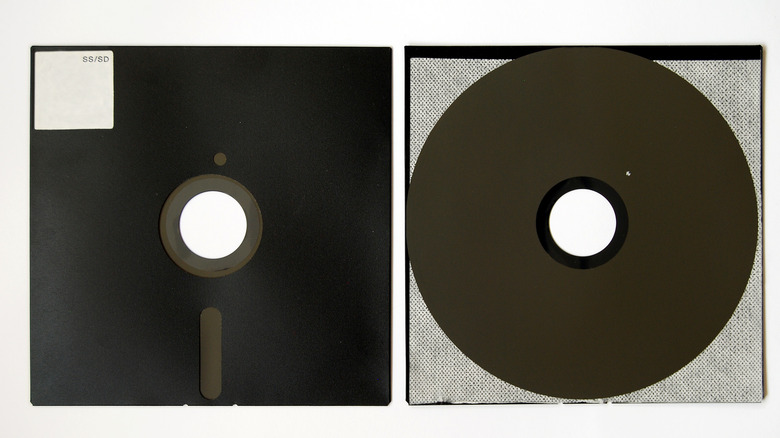
The first floppies were created by IBM and made available to the public in 1971. These round, eight-inch-wide disks had a small hole in the middle and were extremely floppy. In fact, they were too floppy to handle easily, so they were packaged in self-cleaning envelopes.
The original floppies stored 80,000 bytes, a tiny amount of data by today's standards. But the ability to easily transfer programs and information from one location to another was key to the successful introduction of smaller business and personal computers. Made from Mylar and coated with magnetic material, the disk spun in place on a spindle much like a record on a platter. As it spun, it passed over the drive's heads, enabling it to read and write data.
Within a few years, the personal desktop computer became an ever-present part of office life. 1977's Apple Two and 1981's IBM PC were both dual-disk drives, requiring users to have two disks: one for the program they were using and the other for the information they were saving "to disk." Floppy disks for these smaller personal computers measured just 5 ¼ inches in diameter and were housed in stiff plastic sleeves, though you could still see the "floppy" disk inside.
Hard drives were introduced at about the same time, eventually allowing for single-disk drives. Users could store programs in their computers' memories and use their disks to record data. By the late 1980s, hard drives could store up to 100 MB of data.
More data, less flop
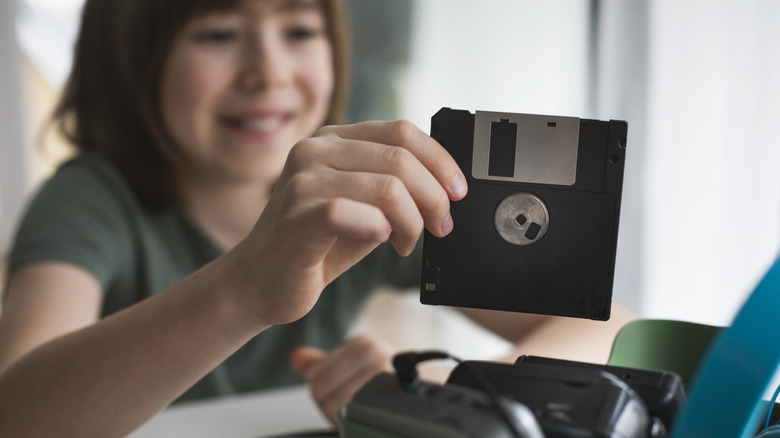
The colorful, rigid 3.5-inch "floppy" disks with which most of us are familiar were introduced in 1986. No surprise, they were another IBM innovation. In fact, IBM dominated the PC market until 2004. IBM's updated floppy disks, which stored up to 1.44 megabytes of information, were easy to store and harder to break or demagnetize.
Not only could parents now safely hand a floppy disk to their kids, but corporations could now safely mail programs and games to PC owners. Lee Felsenstein, who helped invent PCs, actually stated that the 3 ½-inch floppy made it possible to launch the software industry.
The 1990s saw the invention of new technologies that started to make floppies less attractive. For example, CD-ROMs allowed convenient storage of much larger amounts of data. And, with the invention of the World Wide Web, information could be easily shared in digital form.
Oddly enough, however, floppy disks are not dead. Not only are they still used in certain medical machines and required when older computers are in use, but they're also coveted by collectors. In fact, retro games for older computers are easy to find on eBay and sell for up to $100 depending on the game!