

5 Clever Ways To Hide Your TV In Any Room
We may receive a commission on purchases made from links.
For about as long as consumer-grade televisions have been around, they've been a continuous presence in living rooms, bedrooms, and just about any other room in your home. While it's not unusual for a TV to be in any room, though, not everyone wants their TV to be the centerpiece of a room, whether for design purposes or just because they don't want guests to think all they do is watch TV. Luckily, as both TVs and home decor have become more advanced, it's become much easier to conceal displays, whether by stashing them behind covers or using displays designed to be hidden.
With a little bit of creative thinking, and perhaps a flexible spending budget and D.I.Y. skills, you can hide, conceal, and disguise TVs just about anywhere in your home. Using this approach, you can turn your living room into a transforming entertainment center, have a TV greet you at the foot of your bed in the morning, or even make a display seemingly pop right out of your wall.
Mount a display in a lift
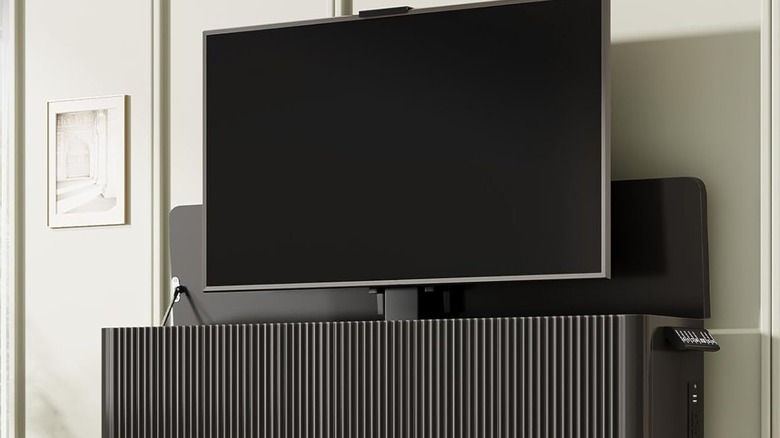
There's a distinct chance that the first thing you do upon waking up in the morning is look at a screen, whether you're getting your news from a TV or turning off the alarm on your iPhone. Admittedly, it's not the healthiest way you could start your day, but if you're going to do it, you might as well do it with a bit of futuristic style. Specifically, you can mount a flat-screen TV on a lifting mechanism that pops out at the foot of your bed to greet you in the morning, then retracts out of sight when it's time for bed in the evening.
You can find various cabinets on Amazon that have a lift mechanism built into their centers, with a cavity sized for flat-screen displays up to around 60 inches. Just mount the TV in that cavity and place the cabinet either at the foot of your bed or on the far wall, press a button, and the TV pops out for your enjoyment. It would be easiest to use a pre-made cabinet for this approach, but if you're feeling industrious, you could create a custom mount and install it directly into your bedframe. All you really need is a motor mechanism, a wireless receiver, and some wood. You could also use a similar approach to hide a TV in a kitchen island, for example.
Roll up a projector screen
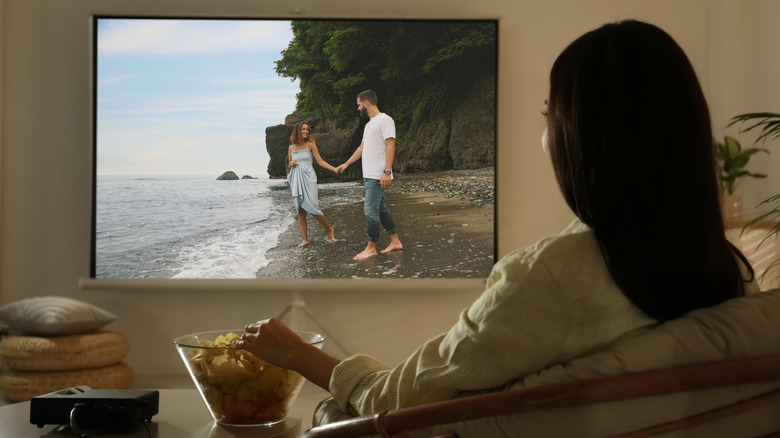
Alongside TVs, projection devices have also become both smarter and more compact. Many modern projectors from major brands are either compatible with smart streaming sticks or have those functions built in, allowing them to essentially supplant your TV entirely. All you need to make this work is a projector screen, and thanks to their soft, pliable designs, projector screens are very easy to store out of sight.
You can discreetly place a projector on a high shelf on one side of the room, then place a rolled-up projector screen on the opposite side, hiding its casing amongst ordinary shelving or molding. When it's TV time, just pull out the screen and power on the projector, and you've got cinema-style entertainment. It's a great approach if you don't have much space for a large TV or just don't want your living room walls to look cluttered. It would be easiest to use a simple pull-down projector screen, school classroom-style, but you could also opt for a motorized screen that unfurls with a press of a button.
Hide a frame TV amongst artwork

The desire for more discrete TVs isn't consumer-exclusive; electronics brands know that some users want something that can be integrated into existing decor for stylistic purposes. It's for this particular approach that frame TVs have appeared on the scene, specialized flat-screen, wall-mounted models designed to resemble a fine piece of modern art while concealing their actual screens.
If you want a discrete TV setup for your living room, den, or any other room where you're regularly entertaining, a frame TV, such as Samsung's Frame TV or a cheaper alternative like the HiSense CanvasTV, is a sound selection. Just power on the TV and switch it to Art Mode, and it'll show a lovely piece of modern artwork. Surround your TV with other pieces of artwork on the wall of various shapes and sizes, and the whole thing will look like a stylish home gallery to the casual observer. Not only is this a great way to inject a little culture into any room in your home, but it's also quite fun to surprise a guest by pulling out the remote and revealing that the artwork they had been admiring was actually a flat-screen TV.
Disguise it as a decorative mirror
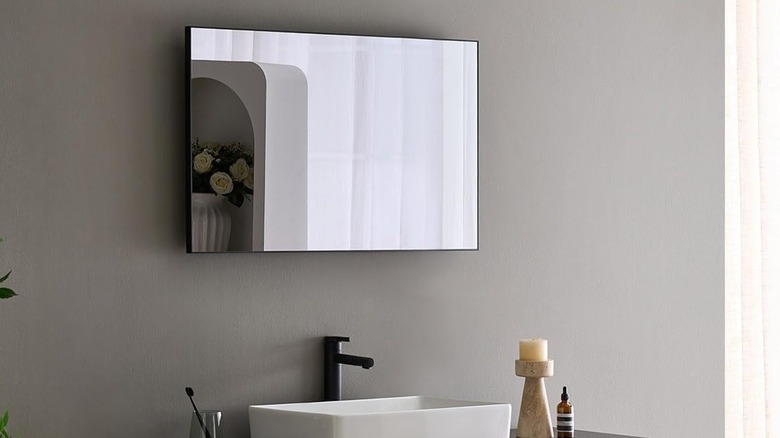
In a similar vein to frame TVs, electronics brands have tinkered with other ways to make your displays a little less obvious, not to mention more adaptable to other rooms in your home. You might think, for example, that it would be pretty difficult to hide a TV in a bathroom or dressing room. A decade ago, perhaps, but today, mirror TVs exist, allowing you to hide a TV in even the most seemingly obvious spots as a mere decorative mirror.
Mirror TVs are exactly what they sound like: TVs with an optical mirror panel that can be disabled or enabled with a push of a button. When the TV is inactive, and assuming you've done a good job of hiding its wires, it's nothing more than a regular mirror you can look into while combing your hair in the morning. With another press, though, the mirrored veneer falls away, revealing a proper TV display to get your morning news from or enjoy in the bathtub. A mirror TV can find a happy spot anywhere you'd normally put a decorative mirror, though some mirror TVs are also waterproof, like the Elecsung Smart Mirror, so a bathroom would probably be the first place to consider.
Create your own sliding wall cover
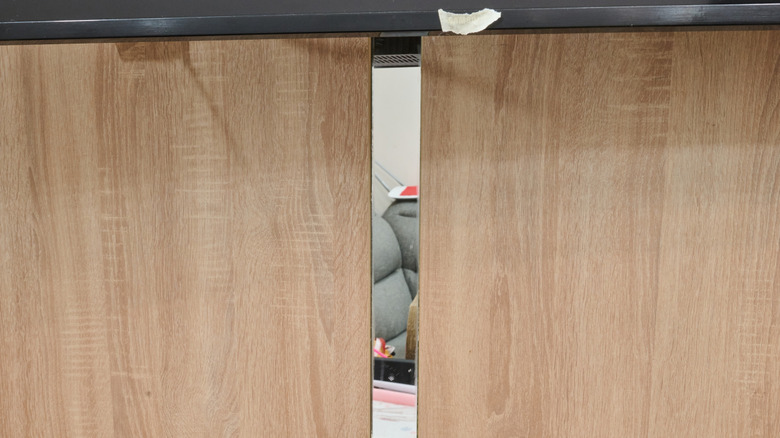
There's no such thing as a one-size-fits-all solution for hiding a TV in your home. Maybe you'd prefer to have a specific TV that won't fit with pre-made cabinets, or perhaps more advanced, self-hiding models are outside your price range. If you can't purchase a pre-built TV or motorized cabinet, then it may be time to roll up your sleeves and make up the difference with pure elbow grease.
The simplest homemade way to hide a TV is to create a wall-mounted sliding cover, tailored to your preferred TV's dimensions. In actuality, making something like that wouldn't be all that difficult, so long as you know your way around a power drill and wall-mounting techniques. In fact, this approach offers a lot of flexibility, as you can make your sliding cover from a wide range of materials, from fiber art to slatted wood to woven cane. Whatever you make the cover out of, just mount it to a sliding rail, and move it out of the way when you want to watch TV. You could also build a cover directly into your wall and have it pop open to reveal an internal cavity, though this would require some specialized skills and knowledge that you shouldn't attempt casually.