

5 Underrated Monitor Brands That Can Compete With Samsung
We may receive a commission on purchases made from links.
When most people think of a TV or monitor brand, they'll usually think of Samsung first, but it's not the only good choice when it comes to finding a great display. It's no secret that Samsung dominates the gaming monitor market with its Odyssey line, but there's a handful of underrated monitor brands that are either offering more value for money, better specifications, or both. Paying the "brand tax" for a recognizable brand is a common mistake while buying a monitor, but that could mean overpaying or missing out on better panel technology and larger screens.
For users looking to seriously upgrade their gaming setups without paying Samsung's prices, there's plenty of alternative manufacturers to choose from. Underrated brands like Z-Edge, Sceptre, and KTC can save gamers hundreds of dollars without sacrificing the performance and specifications needed for smooth gaming and productivity tasks. We're going to break down five specific monitor brands you've likely never heard of to see how their products stack up against their Samsung counterparts.
Z-Edge
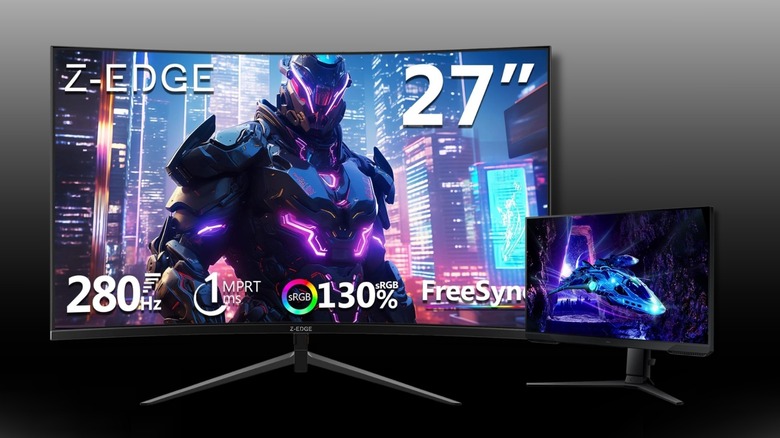
When it comes to entry-level gaming monitors, Samsung's 24-inch Odyssey G3 is a solid pick for $149.99. It features a 180Hz refresh rate and offers a 1ms response time on a flat 24-inch screen. These are great specs for the money for basic competitive play, but Z-Edge has a 27-inch curved panel for $10 less at $139.99.
For this price range, Z-Edge is a better play thanks to its larger screen with a 1500R curve. This means the curve will fill a user's peripheral vision more effectively than a flat display, resulting in great immersion. More importantly for competitive play, the Z-Edge can offer a 280Hz refresh rate – 100Hz more than the Samsung Odyssey G3 for less money. This translates to smoother motion during intense gameplay, while the 1ms response time ensures minimal input lag.
The Z-Edge also outcompetes Odyssey G3 in utility, offering two HDMI and two DisplayPort inputs compared to one of each in Samsung's case. The only advantage Samsung's panel offers is an ergonomic stand that swivels and pivots, which in this case doesn't warrant the bigger price tag or lower specifications. Apart from the 27-inch model, Z-Edge also sells a 34-inch curved WQHD panel at $229, while a similar sized Samsung Odyssey G5 costs $60 more. Overall, Z-Edge competes well with Samsung's offerings for a lower price in most cases.
AOC
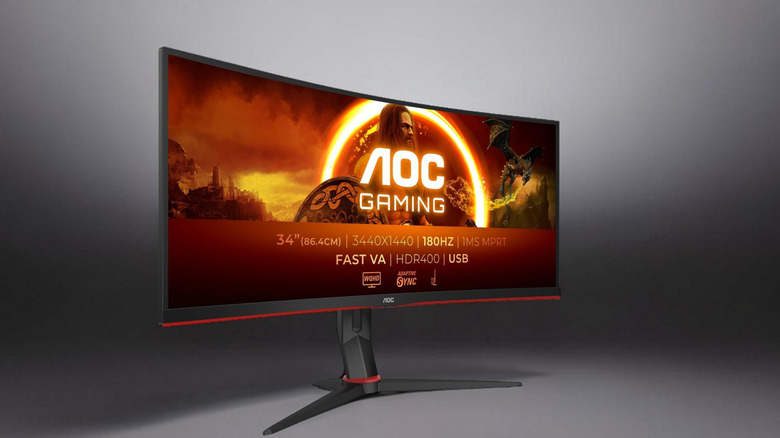
Gamers usually want to go for a Samsung 34-inch Odyssey G5 that we mentioned earlier when it comes to budget-friendly ultrawide panels. The display offers good value for money with 165Hz refresh rate, HDR10 support, and a 1000R curve for $289.99 (MSRP $399.99). But once again, there's other lesser-known monitor brands that deliver more on the dollar than Samsung.
It's not a small brand by any means, but newcomers to PC gaming might not know of AOC. The 34-inch CU34GV4 is more or less made to compete with Samsung's Odyssey G5 in every way. It offers a faster 180Hz refresh rate at $229.99. Even compared to Samsung's discounted price, users can save over $60 while also getting a fast 0.5ms response time.
Apart from this model, AOC makes a range of monitors from ultra-budget ones like the $89 27B35H3 targeted towards casual gamers to the Q27G4ZD that features a 240Hz QD OLED panel and targets power users. Moreover, you can find a refurbished AOC CU34G2XP monitor on Amazon, sporting a 34-inch curved LED panel, for between $179 and $189 on Amazon.
KTC
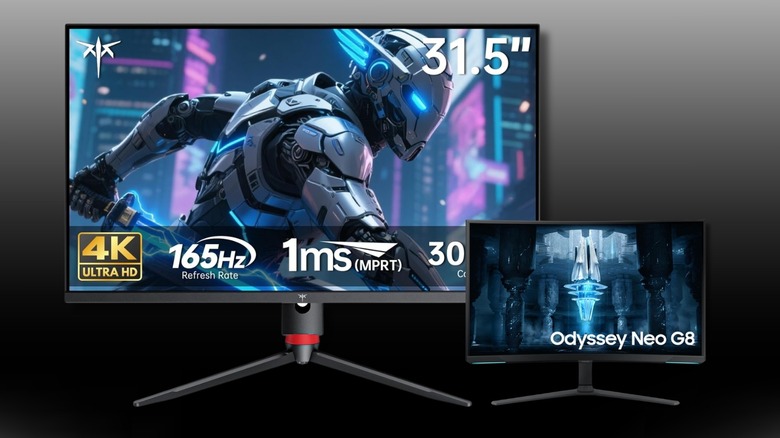
The Samsung 32-inch Odyssey Neo G8 is a technical powerhouse with a 4K panel sporting a 240Hz refresh rate, but it also carries a hefty $749.99 price tag. It uses Quantum Mini LEDs to achieve 2,000 nits of peak brightness and is a great choice for a standard 16:9 gaming monitor, but there's another affordable option from a fairly unknown brand, KTC, that still has great specifications. The KTC 32-inch 4K gaming monitor is a solid alternative for its price tag of $449.99, which is a much smaller burden on a user's setup budget.
Granted, the KTC is a fast IPS panel, so there are some sacrifices to be made, but the savings outweigh losing a Quantum LED panel. It still provides a respectable 165Hz refresh rate and a 1ms response time, which is more than enough for most users pushing their PC rig to output to 4K. The panel covers 121% of the sRGB color gamut area and is capable of 1.07 billion colors, which is going to produce a vibrant and realistic image in any game.
Additionally, KTC offers a wide range of curved and ultrawide displays under its gaming monitor vertical that undercut Samsung. The brand also sells business monitors, such as the KTC 32-inch computer monitor that offers 1440p resolution and a 120Hz refresh rate — ideal for home and office use.
Deco Gear
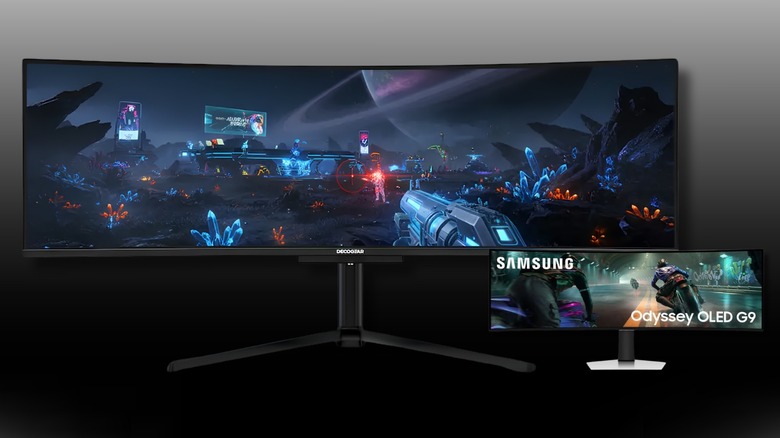
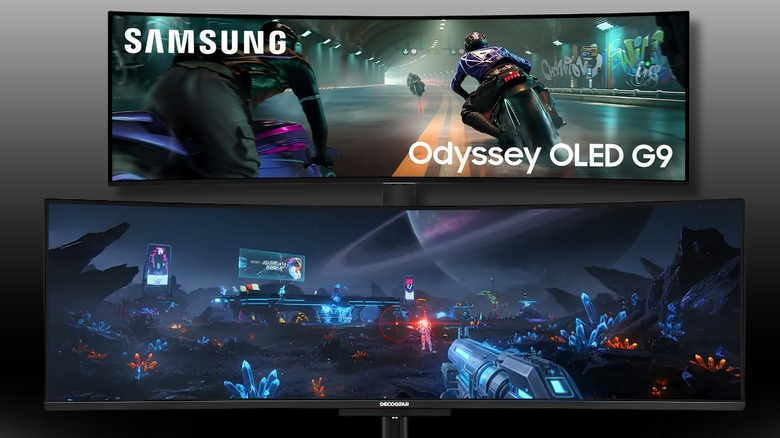
The Samsung 49-inch Odyssey G9 dual QD-OLED is a massive and immersive display that commands a price tag of $1,099.99. It features a 144Hz refresh rate, a 0.03ms response time, and Dual QHD resolution. These specifications are great, but the Deco Gear 49-inch QD-LED is the faster and cheaper choice at $1,000. Deco Gear's panel has a significantly higher 240Hz refresh rate compared to the Samsung Odyssey G9's 144Hz, and it costs $100 less.
Both monitors use QD-OLED panels, which are capable of infinite contrast and inky blacks with HDR400 True Black certification. Both have 0.03ms response times that more or less eliminate motion blur and ghosting. For users looking for a work and play monitor, the Deco Gear option features a USB-C port with 90W power delivery that's capable of charging a laptop while sending over data and video with a single cable. To top it off, it has KVM support, allowing users to control two separate computers with one keyboard and mouse. Deco Gear also offers professional-grade color accuracy, with a DeltaE < 2 and 112% sRGB coverage.
Koorui
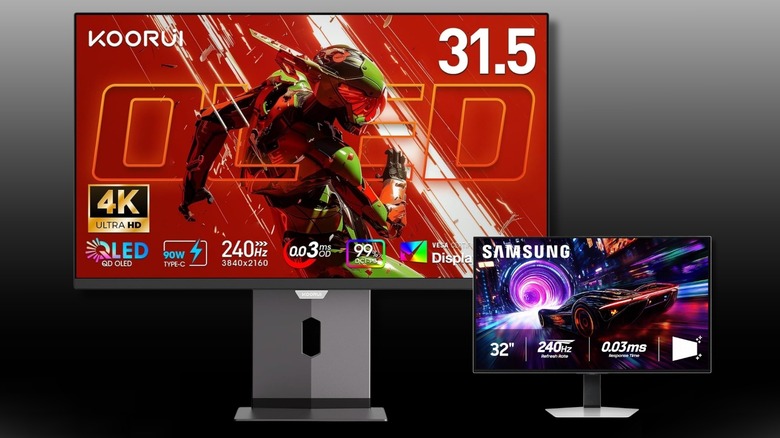
If you want to avoid ultra-wide monitors, the Samsung Odyssey QD-OLED G8 (G81SF) is usually a top-tier choice for gamers who can afford the $850 price tag. It has a 240Hz refresh rate, 0.03ms response time, and a glare-free panel. But of course, there's a solid and lesser-known alternative. The Koorui 32-inch 4K OLED gaming monitor has nearly identical specifications and high-end panel quality for $799.99. That's a saving of $50 without missing out on the most important features found in the Odyssey G8.
The Koorui option matches Samsung's 4K UHD resolution, 240Hz refresh rate, and 0.03ms response time. It features a 99% DCI-P3 color gamut and a 1,500,000:1 infinite contrast ratio. This specification dump means users can experience the same inky blacks and precision as Odyssey G8. To top it off, it also includes AdaptiveSync technology for tear-free gameplay. The Koorui option has dual HDMI 2.1 ports, a DisplayPort 1.4, and USB-C ports, so this panel will handle a gaming PC and a couple of consoles all plugged in at the same time.
Koorui also makes a host of affordable curved gaming monitors in the $120 to $220 price range. Similarly, Koorui's flat budget computer monitors also punch above their price bracket.
Methodology
We specifically targeted brands that offered monitors with identical or superior refresh rates, response times, and panel technologies such as QD-OLED, Fast IPS, or LED, compared to Samsung's lineup. While talking about the brands, we made sure to at least compare one monitor to its Samsung rival. Our primary goal was to find displays that deliver similar or better user benefits such as smoother motion, bigger screen real estate, or significant savings, exposing the brand tax often associated with household names. We also looked at customer reviews to make sure a monitor's specifications and build quality actually hold up in real-world use.
We analyzed product listings, specifications, and verified merchant pricing from major retailers. We prioritized brands such as AOC, Z-Edge, and KTC because they consistently provide high-performance hardware at prices that undercut Samsung by $30 to over $300 depending on the category. We also considered features that impact long-term value, including warranties, port variety (such as HDMI 2.1, DisplayPort 1.4, and 90W USB-C), and ergonomic adjustability. Each selected monitor has been judged based on how its raw performance per dollar compares to its nearest Samsung offering, making sure our recommendations have tangible savings without compromising on visual quality.