

What A Cyberdeck Is (And Why You Might Want One)
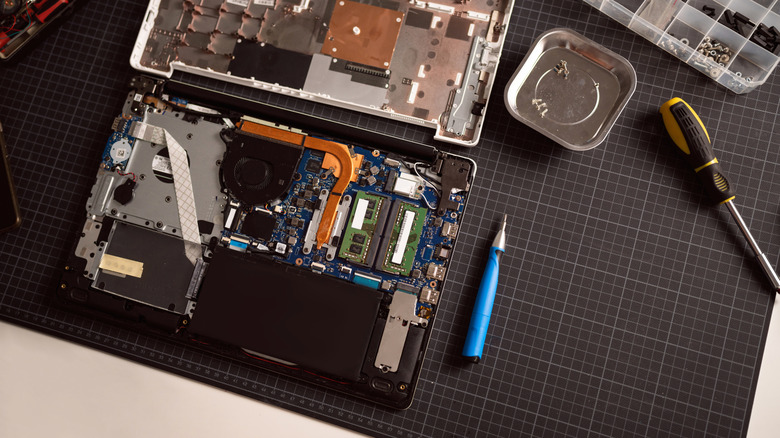
We may receive a commission on purchases made from links.
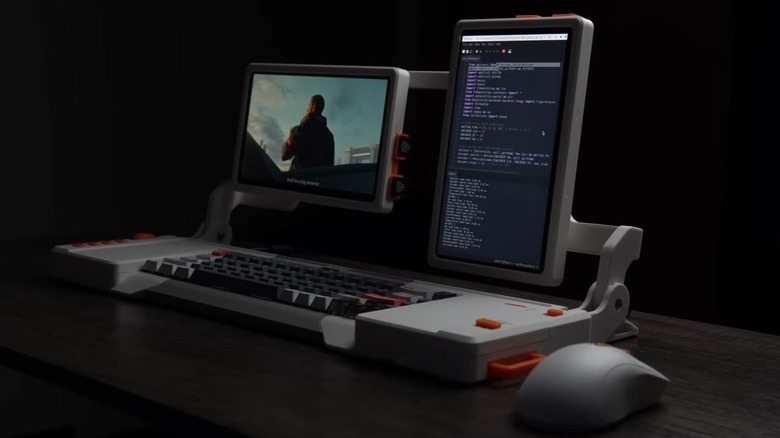
Somewhere in the multiverse, there's an alternate timeline where bulky 80's and late 90's computers never quite evolved into what we have today. Instead of going slimmer, powerful, and more portable, they stayed practical and somewhat unruly. Think retro-futuristic portable computers like you'd see in dystopian cyberpunk games and fiction. That's pretty much the design concept behind cyberdecks, custom personal computers that offer their best impression of a bygone era. Fantastical storytelling aside, some resourceful tinkerers are making cyberdecks of their own using modern components, resulting in examples like the Hackberry Pi or the πTar, with the latter being a dope keytar-styled cyberdeck.
The phrase "cyberdeck" was born in a novel by William Gibson called "Neuromancer." Real-world cyberdecks are nothing more than custom-assembled computers often employing a single-board setup like a Raspberry Pi. They can be as weird and zany as the creator wants, or as simple as a custom-built Blackberry or repurposed Android phone. The prevailing theme seems to be usefulness, beyond the custom designs. Creators engineer them to achieve specific use-cases, like an MP3 or audio-focused cyberdeck, a more stylish and personalized laptop, a handheld game console or a smartphone or tablet alternative with a keyboard for hacking. Many quick and easy Raspberry Pi projects are simple versions of cyberdecks.
There are also a growing number of loose tutorials to make your own, complete with parts lists, assembly details and even programming or OS support. As for why you might want one, well, everyone has their own motivations, but it's a custom computer tailored to your interests. What's cooler than that? It's also a way to stick it to big tech and escape all that creepy data-harvesting nonsense.
How do I make my own cyberdeck?
Step one for any project, building a cyberdeck included, is to find your inspiration and motivation. Why do you want to build one? Would you like a portable writing machine to pen your novel? How about an impromptu hacking tool to test compromised apps? Knowing this will help you focus on the design. Sure, a computer at heart can do many things, but you'll still want to specialize. You could seek out community inspiration, too; sites like Reddit can be helpful here.
From there, decide what components you'll use, particularly what single-board computer (SBC), such as a Raspberry Pi, NanoPC-T4, or an Odroid. Also, consider additional hardware like Wi-Fi modules, data storage, a display, and audio sources. Choose components that are compatible with the SBC you install. Moreover, you'll need to decide the software you'll use. If you go with community software instead of coding yourself, you'll need to choose one. Kali Linux seems like a popular option. Otherwise, you may need to learn some coding.
Finally, you need the shell or case. You can choose your own, using objects you already have like boxes, storage cases, or other gear. You can design a custom one with a 3D printer. You even can order cases online through places like Amazon, Etsy, or beyond. The case of a mini PC designed to replace your TV's streaming devices could be a good start. When choosing a case, pick something that fits all the components you need, including the display. You can also find pre-built cyberdecks. Or, take an old computer or device and repurpose it. One of the best uses for your Steam Deck is turning it into a pseudo cyberdeck by taking out components and installing new ones.