

This Groundbreaking Hydrogen Engine Could Rival Diesel Power Without The Emissions
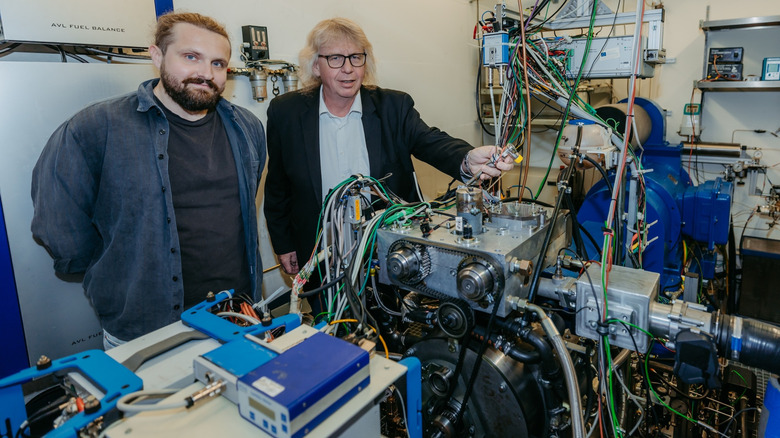
A German research team at the Otto von Guericke University Magdeburg has showcased a hydrogen engine that might soon replace traditional diesel power. The study is helmed by Hermann Rottengruber in collaboration with WTZ Roßlau. The researchers at WTZ Roßlau proved the concept of a closed-loop argon power cycle (APC) engine back in 2022, but Rottengruber's team is now touting it as a viable solution that can be used for high-load applications in the real world.
Traditional diesel engines release multiple pollutants, largely due to the formation of nitrogen oxides and the reaction of the fuel's carbon with oxygen during combustion. In the argon power cycle, argon acts as a replacement for the nitrogen component of air, which eliminates nitrogen oxide creation and increases thermal efficiency. The injection of hydrogen and oxygen into the argon power cycle engine provides a fuel that can combust cleanly.
Rottengruber and his team assessed this engine and found it to be more economical in real-life scenarios. Much of the argon gas mixture remains within the closed system and is fed back into the cycle, allowing for a highly efficient process that does not rely on costly exhaust treatment systems. The result is a theoretical efficiency above 60% with no emissions besides water. By comparison, modern diesel engines max out at around 50% thermal efficiency while producing as many as 22 pounds of carbon dioxide emissions per gallon burned. Hybrid engines using renewable fuel are preferable to diesels, but even so, experts believe that innovations in hydrogen energy are necessary for a sustainable future.
The green impact of a hydrogen cycle engine

There is an ongoing global effort to achieve net-zero emissions by 2050. Research institutions and government entities are proceeding apace with sustainability projects and funding beneficial infrastructure changes. Many of these initiatives are paying off; offshore windfarms have positive effects on local wildlife, in addition to generating clean electricity for the grid. Innovations in hydrogen engine technology are a natural step in weaning society off its fossil fuel reliance.
Hydrogen is a clean energy source, but currently, hydrogen fuel is not popular because manufacturing hydrogen creates approximately the same amount of emissions you would save by using it as fuel. An extraordinarily efficient hydrogen cycle engine might finally allow widespread use of hydrogen fuel with a net improvement to our carbon footprint.
However, the hydrogen cycle engine discussed by Rottengruber is not a finished product as of yet. The engine is currently limited by the amount of hydrogen that can be injected during each cycle, which means that it cannot achieve the level of power density required for practical industrial use. Rottengruber also noted an issue in which carbon dioxide would accumulate within the closed circuit. The good news is that the team has access to plenty of resources to help solve these issues. The research is backed by Germany's Federal Ministry for Economic Affairs and Energy, and Rottengruber indicated that prominent manufacturers have already expressed interest in his team's work.