

The Next Apple Watch Might Not Have Touch ID, But Apple Has A Good Reason
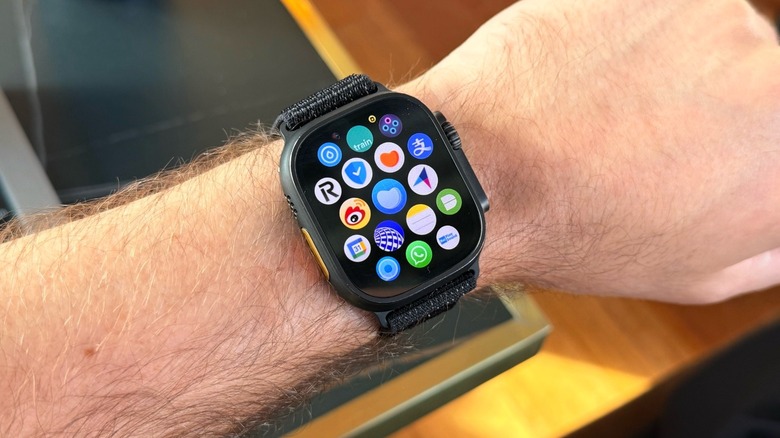
Last year, unreleased code suggested that Touch ID could be coming to a future iteration of the Apple Watch. As spotted by Macworld's Filipe Espósito, the company was experimenting with a biometric unlocking mechanism to supplement the current passcode-based authentication system. While the journalist said that this was still in the early days of testing, MacRumors subsequently reported that the change could come as soon as this year.
Now, Weibo leaker Instant Digital is pushing back against both of these reports, saying that Apple doesn't plan to make a radical change to how users unlock their watches since the hardware required for this authentication method could take away precious battery space. In the post, Instant Digital suggests that Apple doesn't like the idea of losing battery life in exchange for Touch ID, nor does it find the extra costs associated with adding this technology palatable. Still, other rumors suggest that the company is planning an all-new chip for its next wearable, with MacRumors having spotted its "T8320" identifier, which appears to be an iterative update to the "T8310" used in the Apple Watch Series 9, Apple Watch Series 10, and Apple Watch Series 11.
Battery life has been a focus of Apple Watch marketing materials lately
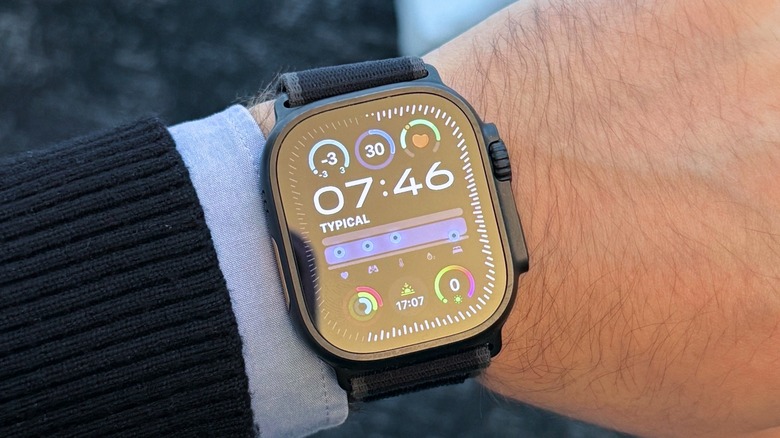
For several generations, Apple promised around 18 hours of battery life with the Apple Watch, which represented about a day of usage. With the Apple Watch Series 11, the company now promises 24 hours, while also promoting up to 38 hours with Low Power Mode on. While MacRumors notes that this is largely due to Apple altering its battery testing methodology, the change in marketing claims reveals that battery life may have become a bigger concern for the company as Apple Watch competitors now offer multiple days of battery life.
According to Apple, an Apple Watch Series 11 can last 24 hours if the user checks the display 300 times, gets 90 notifications, uses an app for 15 minutes, has a 60-minute workout with music playback, and records six hours of sleep tracking data. That said, Apple's new battery-testing conditions might not be indicative of how many users experience the Apple Watch, and the company doesn't say how much each activity drains the battery. With the latest generation, Apple also promotes faster charging capabilities, noting that 15 minutes on the charger can provide up to eight hours of battery life, further supporting the notion that Apple is concerned about how prospective buyers view the battery life situation around Apple Watch models.
What's next for the Apple Watch?
With battery life apparently being such a big focus, it seems Touch ID might not be in the cards for the Apple Watch — at least, not in the near future. No design overhauls or major feature additions have been rumored for the Apple Watch Series 12, even though its all-new processor suggests it's going to represent a new generation of Apple Watch — one that moves on from the chip used in Apple Watch Series 9, Series 10, and Series 11 models.
It seems the next breakthrough change for Apple Watch users is still at least a couple of years away, when Apple might be able to introduce blood glucose monitoring technology. In 2023, Bloomberg's Mark Gurman reported that this technology was at its "proof-of-concept" stage, meaning the underlying tech exists, but it now needs to be condensed to fit into a wearable.
Reports suggest that Apple has been working on glucose monitoring since as early as 2010, and if the company succeeds in adding this technology to the Apple Watch, it would be a breakthrough advancement. In the meantime, however, Apple seems to be focused on an iterative approach to its flagship wearable — after all, the Apple Watch Series 11 and Series 10 are almost identical — so it might be best to temper any expectations of groundbreaking changes coming to the Apple Watch Series 12.