

How Star Trek Tried To Redefine The Way Sci-Fi Treated Its Monsters
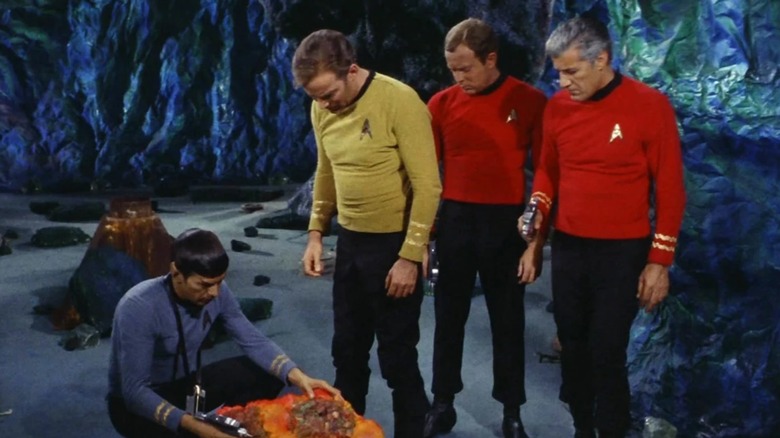
Before the starship Enterprise headed off into space in 1966, other shows and films had already gone there, and the encounters they depicted weren't necessarily friendly. Aliens in various forms were often portrayed as villains and threats to humanity, which wasn't the direction Gene Roddenberry, the creator of "Star Trek," intended for his television show. Instead, the aim wasn't all about introducing new civilizations, but encountering otherworldly beings that would eventually become characters the viewer could relate to, regardless of how they might have looked.
In "The Making of Star Trek" by Stephen E. Whitfield and Gene Roddenberry, the latter was fully aware of how science fiction was handling alien characters and determined to break away from the norm. "What's been wrong with science fiction in television and in motion pictures for years is that whenever a monster was used, the tendency was to say, 'Ah ha! Let's have a big one that comes out, attacks, and kills everyone.'"
It was a trope that didn't sit right with the great mind behind the adventures of the Enterprise. "Nobody ever asked 'why?' In any other story, if something attacks (a bear, a man, or whatever), the author is expected to explain, 'Here is why it is the way it is, here are the things that led it to this, here is what it wants.'" Never one to merely talk the talk, Roddenberry applied this method of storytelling to "Star Trek" and even had a shining example that delivered just such a message.
The Devil in the Dark, a Star Trek episode, proved that not all monsters are evil
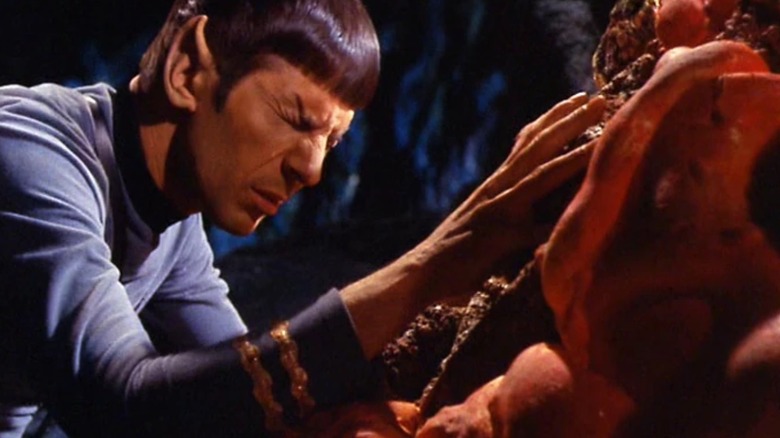
One such installment that provided a brilliant display of Roddenberry's push for empathy and understanding was in season 1, episode 26, "The Devil in the Dark." Touching down on the planet of Janus VI, the Enterprise crew comes to the aid of a group of miners who were being attacked by a cave-dwelling creature known as the Horta. Thankfully, after a quick mind-meld from Spock (Leonard Nimoy), it was discovered that the Horta was in fact defending its eggs, which the miners had mistaken for minerals.
"With this understood, the Horta suddenly became understandable, too. It wasn't just a monster – it was someone," explained Roddenberry. "And the audience could put themselves in the place of the Horta...identify...feel! That's what drama is all about. And that's its importance, too. If you can learn to feel for a Horta, you may be learning to understand and feel for other humans of different colors, ways, and beliefs."
Now, while there were undoubtedly villains throughout the "Star Trek" franchise, Roddenberry made sure that, more often than not, alien lifeforms had a purpose beyond mindless killing. Over time, long-time foes became allies in the ever-expanding universe, proving that there was space for understanding. With that, Roddenberry's daring show about a crew of explorers was giving a glimpse of what humanity could be, and we may not have had to wait light-years to get there, either.