

Why Do Submarines Use Red Lights At Night?
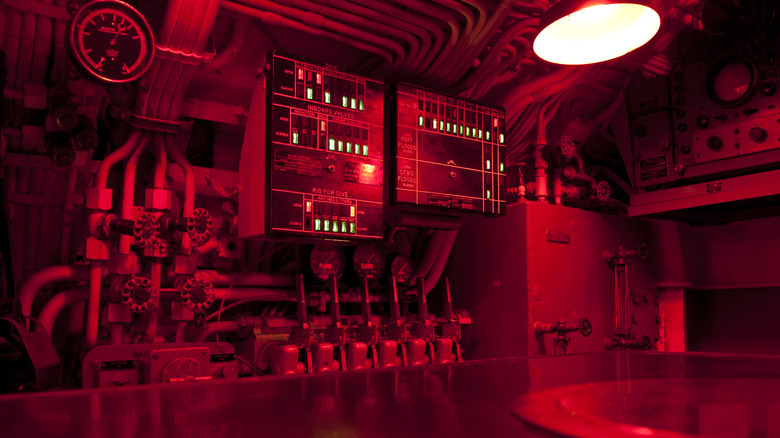
Submarines are fascinating pieces of military technology that play a major role in national defense, with nuclear submarines able to stay underwater for months and navigate without GPS as they carry out stealth missions. If you've watched any TV shows or movies featuring submarines, you've probably noticed that intense scenes are often bathed in red light. These aren't just for dramatic effect; submarines actually do use red light, as it's easier on the eyes.
To understand why submarines use red lights at night, it's important to know how the eyes work and how light and color impact night vision. Eyes are made up of cones and rods. Cones are located in the center and are used for daytime and color vision, while rods are meant to detect peripheral movement and threats, seeing in black and white. Human eyes can see light with wavelengths between 400 and 700 nanometers, interpreting that as colors ranging from violet to red. Since red light has the longest wavelength, the eye is less sensitive to and has an easier time adjusting to it than traditional white light.
As such, red light is also useful for maximizing your night vision. After around 20 minutes in low light, the eyes begin to produce a chemical called rhodopsin that activates the rods. It takes another 20 to 40 minutes for night vision to really set in, but even a small amount of bright light causes the rhodopsin to break down, which restarts the entire process. Dim red light doesn't have the same impact, allowing your night vision to kick in (and persist) as intended.
Red light is more useful than you may think
Since red light is less harsh on the eyes and doesn't disturb night vision activation, its a great fit for submarines. It still illuminates the space enough for the crew to see what they're doing while also helping those on board distinguish between day and night while underwater without daylight. That's important for maintaining healthy sleep patterns and avoiding interruptions in the body's natural circadian rhythm; different colors of light impact the circadian rhythm, and red has little to no impact. Studies have shown positive signs that red light could help improve sleep quality, though far more research needs to be done. At the very least, it doesn't have the same negative impact blue and white light have, making it healthier to use before bed.
Red light has plenty of other applications beyond submarines, too. You may have also heard about red light therapy from the many influencers and celebrities on social media who swear by it for everything from anti-aging to hair growth. There's science and history to back up these claims, though the results are generally less dramatic than users expect.
Additionally, red light has environmental benefits. Places like Denmark have installed red street lights that are less harsh on local bat species, as traditional street lights have been shown to impact their behavior, sometimes leading them into danger. Other places have installed red lights to lessen the impact of traditional white street lights on turtles. These creative, science-backed solutions are a great use of red light that helps the local ecosystem while still providing visibility for drivers.