

3 Ways Screens Can Harm Your Eyes (And How To Avoid It)

We may receive a commission on purchases made from links.
The dangers of screen time have become exaggerated over the years, to the point where one can wonder if it can cause permanent damage to the eyes. For adults, the simple answer is no. However, this does not mean that one is free from its temporary harmful effects, especially when it comes to staring at smartphones and computers. Staring at them too long can cause digital eye strain (DES) or dry eyes. Luckily, these symptoms are reversible. Besides giving your eyes a break, there are a few things you can do to find both short-term and long-term relief.
With that said, screen time has been linked to an increased risk of myopia (nearsightedness) development and progression in children. This means that cutting back on the little one's exposure to digital screens might be crucial to preventing them from needing corrective lenses. On top of that, the more time the kids spend outside, the better it will be for their eyes.
In the end, screen time is not harmful in and of itself. The problems appear when screen time becomes excessive, which can be hard to avoid for people who do a lot of remote work or busy parents who need their kids to be entertained without disturbing them. But the harmful effects cannot be ignored, even if they may not be permanent.
Digital eye strain
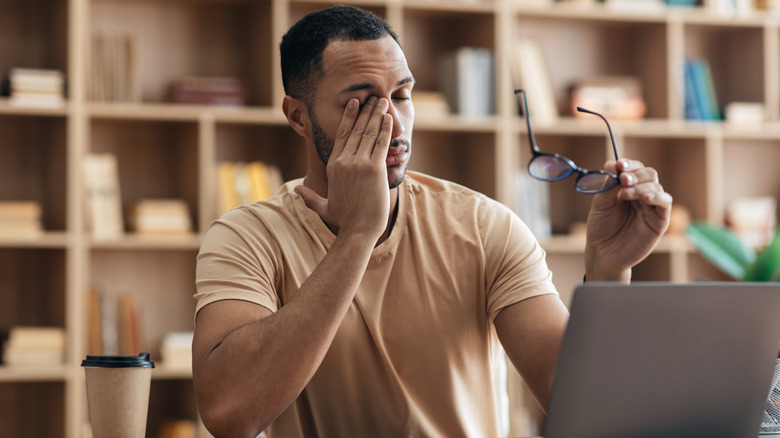
Digital eye strain is the most common harmful effect of prolonged screen usage. You don't just feel one thing with DES, but a cluster of symptoms that arise from the intense focusing (usually when staring at a monitor) that tires out your ciliary ("focus") muscles. You know you have DES, also known as computer vision syndrome, when your eyes start feeling tired, your vision becomes blurry, or you start seeing double. Your eyes can become sensitive to light (photophobia), and you may have trouble refocusing. You might even feel the effects of DES in other parts of the body, manifesting as headaches or neck and shoulder pain from poor posture.
When you experience DES, the best thing you can do is rest your eyes to give your ciliary muscles a break. While many recommend the 20-20-20 rule, it doesn't always work to stick to such a rigid schedule. You just need to ensure your eyes get enough rest through regular breaks.
You should also decrease the amount of brightness to match the light conditions around you so there isn't too much contrast between the screen and the room's ambient lighting. This makes it so your eyes don't work so hard to focus. You can also try minimizing the brightness by switching to dark mode in poorly lit rooms. Just be aware that if you have astigmatism, the text might look blurry or have halos around it (halation), forcing the eyes to work harder.
Dry eyes

Often related to digital eye strain is the feeling of dryness. This can be extremely uncomfortable since it is usually accompanied by a feeling of scratchiness. Sometimes the eyes can even sting, burn, or turn red if they get too dry. Your eyes get this way because focusing too much on a screen can reduce your blink rate. Blinking is the primary way we lubricate the eyes' surface by coating it with tears. According to the Canadian Association of Optometrists, we blink about 17 times a minute, but staring at a screen can reduce that number to four. Even if you blink, the blink might be incomplete.
This combination of reduced and low-quality blinks is not enough to keep the eyes' surface moist. It will dry out if it continues for a prolonged period of time, leading to dry eyes. If you're going to stare at a screen for a long time, you should make the conscious effort to blink completely. If you need help, use a blink reminder app like BlinkBlink for iOS, EyeD for Android, or BlinkBuddy for Windows. Just keep in mind that these are just wellness tools, not medical devices.
If your eyes start to feel dry, you can use artificial tears to lubricate them. The drops are formulated with ingredients that restore your tear film and help it function more efficiently to retain moisture. They are available over the counter and can usually be found at your local pharmacy.
Increased risk of myopia development in children

Myopia is an eye condition where you can see things close to you clearly, but objects at a certain distance appear blurry. Someone with myopia is commonly referred to as nearsighted or short-sighted. This happens when the eyeball elongates, causing focus in front of the retina instead of on it. It can happen at any moment in life, but it usually happens in childhood and adolescence (periods when the body is still growing and maturing).
This period is when studies have shown that excessive screen time increases the onset of myopia or makes it worse if already present. A study published in BMC Public Health found that there was a significant association between screen time and myopia in children and adolescents. The researchers noted that computer screens may have the most impact.
There are several contributing factors as to why this happens. One explanation is that eye strain caused by the prolonged intense focus promotes the elongation of the eyeball. Another one is that children don't get the protective benefits of natural light that comes from playing outside. According to a study published in Ophthalmology, exposure to sunlight reduced rapid myopia progression in children by 54%. This benefit was observed in both myopic and non-myopic children. Eye experts recommend that children spend at least two hours a day outdoors to prevent or delay the onset and progression of myopia.