

4 Things You Need To Know Before Buying A Google Fitbit Air

The Google Fitbit Air is a lightweight fitness tracker with no built-in screen that looks and feels more like a bracelet than anything else. But what's special is that it uses Google's Gemini AI to empower Google Health and fitness tracking from the device and provide guided coaching. It resembles something like Whoop fitness trackers, another low-profile, bracelet-first series of wearables.
The actual device portion is a small, removable module engineered in a puck or slight oval shape that fits in the palm of your hand. That core device can be swapped out with different bands, allowing you to personalize your style pretty much any way you want. There's even a limited-edition Stephen Curry-inspired version with unique coloring.
Meanwhile, all the functionality and features are delivered not just through the device but also the Fitbit app. A Fitbit app that completely changed with a new redesign, by the way. But as stylish and attractive as they are, before you run out and buy a Fitbit Air from Google, there are definitely several things you'll want to know. Here are some of those major points laid out and explained in full.
1. There's no screen at all, not even a small one

It may seem obvious looking at the front of the device or some of the eccentric styles, but there's no display or screen whatsoever on the Google Fitbit Air, not even a small one for notifications. That's certainly not a problem for everyone, it can be nice swapping to a more minimalistic design without a large, bright display. It won't need to be charged every night because of a power-hungry AMOLED, and lasts for seven days on a single charge. But the screen absence is still something to keep in mind. This isn't a smartwatch.
All the information provided, and tracked, by the device will be accessible through the Fitbit app. So, you'll need your phone connected. It doesn't provide real-time data of any kind on its own, but it's designed to passively collect and analyze your health stats — you're really not meant to take it off and can even wear it in your sleep.
Another thing to note is that it doesn't have a built-in GPS sensor. Location data is tracked through the phone, again via the app. These are not deal-breakers per se, but it offers perspective as to how Google intends this device to be used.
2. Not all of Fitbit Air's features are free
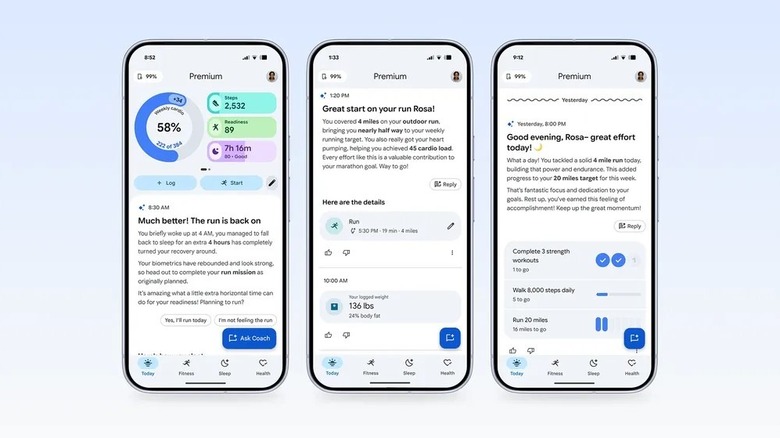
For the most part, you don't need a subscription or have to pay anything extra to access Google Fitbit Air's health tracking functionality and basic features within the app. Almost everything is available for free with a Google account, including if you're using the device with an iPhone — and yes, the Fitbit Air plays nice with both Android and iOS.
However, anything related to the Google Health Premium service, Fitbit's new premium offering, formerly Fitbit Premium, will require a subscription. That's mainly tied to the personalized Google Health Coach. Other premium features include more detailed health insights, basic sleep tracking and sleep scores for free, proactive fitness insights, access to a huge workout library and mindfulness sessions for meditation, breathing exercises, and more.
To provide context around Google Health Coach, it's an AI-powered personal health assistant that gives you direct tips, training plans, and wellness guidance based on your own health data. You can also chat with the tool to do things like share your fitness goals, set up a workout plan, and more. If you want access to that, you'll need to pay $10 ($9.99) per month or $100 ($99.99) annually. Alternatively, if you're a Google AI Pro or Ultra tier subscriber, Health Premium bundles are included. Google's AI Health Coach is also available for iOS Fitbit users, as well.
3. There are three different band types to choose from
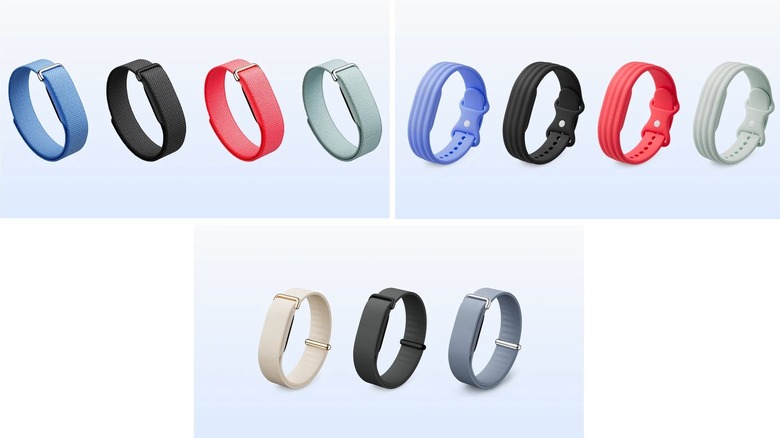
It may not be immediately apparent, but the Google Fitbit Air doesn't just come in different colorways, there are also three band versions, outside of the limited-edition variants. Those are sold as accessories that you can easily swap around.
There's a Performance Loop Band, the stock band the Fitbit Air comes with that's also sold for $35 separately, made from recycled materials and sporting a flexible, breathable fit. The Active Band for $35 is silicone-based, with sweat-proof and moisture-proof properties meant for rugged and high-intensity training. Finally, the Elevated Modern Band for $50 embraces modern style and fashion to deliver a blend of form and function.
It's not hard to imagine Google or third-parties releasing other band options for the Fitbit Air, further expanding the level of customization available to everyone. There are a ton of unique bands available for Fitbit's other devices on Amazon, like the Charge or Inspire series. The same is probably going to happen with the Air.
4. Google's AI health coach is hallucinating in early previews

There have been several reports of Google's AI health coach hallucinating, by making up workouts that don't really exist, and possibly delivering advice that's not very helpful. As reported by 9to5Google, the virtual coach is mostly available through an in-app chatbot that's prone to giving the wrong guidance or referencing the wrong information, like a miles-long run that didn't happen.
This suggests that the new service may not be ready for primetime, and you may want to hold off on the premium subscription if you're thinking about getting a Fitbit Air early. While it's a different platform, Google's Gemini AI overviews have also suffered from silly hallucinations that went viral, and they're known to happen with LLM or large-language model tools.
The hang-up here is that it's all tied to health guidance and insights. Don't let it hold you back completely if you're made up your mind, just be wary that it's happened and it's something you may encounter yourself.