

Europe's Supercomputer Just Broke A World Record You've Probably Never Heard Of
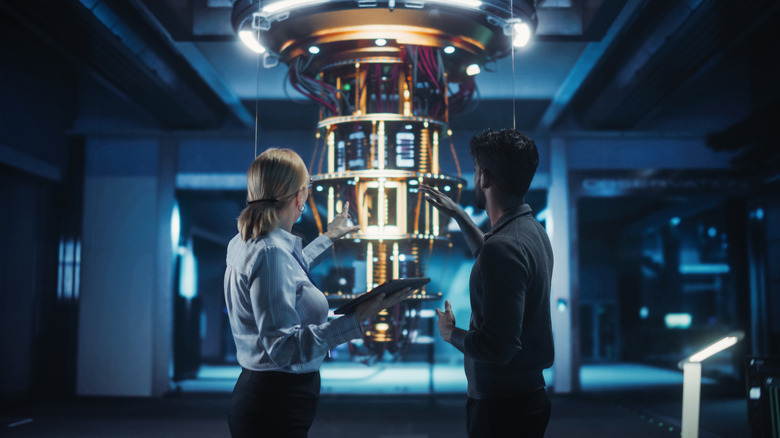
In league with experts from Nvidia, researchers from the Jülich Supercomputing Centre have broken a quantum simulation world record. The feat? For the first time ever, a computer has fully and successfully simulated 50 qubit demands. The previous world record, 48 qubits, was established back in 2019 by another team of Jülich researchers using the Japanese K computer. This time they used the recently-launched JUPITER, Europe's exascale supercomputer.
Why is this a big deal and what does it even mean? First, we must establish that quantum research, or quantum information science, uses a combination of quantum mechanics and computer and information theory to better understand quantum phenomena. At its most basic, it involves using quantum concepts such as superposition and entanglement to advance technology and achieve more powerful computers.
Quantum simulations, like those used to break the world record, are a critical part of that research allowing scientists to test and validate various theories, potential findings, and algorithms, similar to Google's development of a futuristic quantum algorithm. The simulations allow scientists to explore what true quantum computers might achieve without access to the tangible machines, which are very expensive and limited in availability. This new record expands the capabilities of those simulations, so teams can test more powerful and more advanced computers.
The researchers are using conventional computers to test
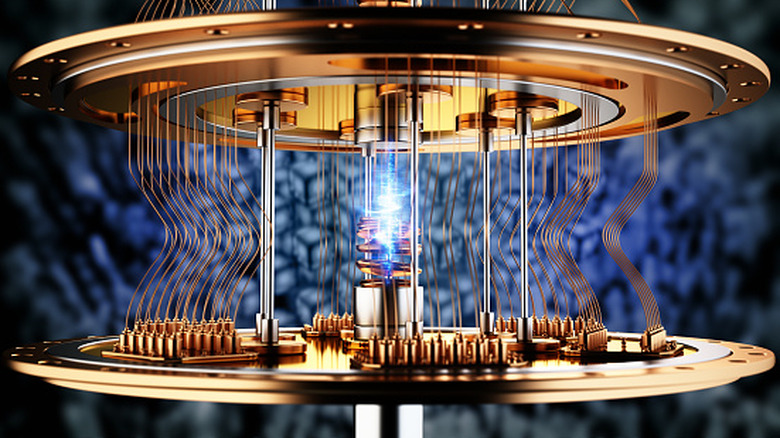
It's important to remember that the teams are using conventional computers, albeit much more powerful than your average consumer device, to test future quantum computing solutions. JUPITER, for example, is a supercomputer, not a quantum computer. Inside, CPUs are coupled with Nvidia's GH200 Superchips, each with up to 624GB of fast-access memory. The researchers and experts also enhanced the simulation software, Jülich Universal Quantum Computer Simulator (JUQCS), to build a new version, JUQCS-50, to support the higher processing power.
Every additional qubit doubles the computing and memory required to simulate it. Simulating 50 qubits of quantum power requires nearly 2 petabytes of memory, an enormous demand for a conventional machine. By comparison, 30 qubits could be simulated on a conventional laptop. Professor Kristel Michielsen, Director at the Jülich Supercomputing Centre, says "only the world's largest supercomputers currently offer that much." The research "illustrates how closely progress in high-performance computing and quantum research are intertwined." It's also worth noting that, just as each additional simulated qubit requires a doubling of processing power, each qubit added to a true quantum computer would double its processing power as well.
New breakthroughs in hardware performance and quantum computing are allowing for some very unique opportunities. For example, one new breakthrough could completely change how costly quantum computers are. Other research teams have successfully achieved data teleportation using quantum supercomputers. Each discovery informs us more about not just how powerful this technology truly is, but also what it can be used to achieve. A cornerstone of that is understanding what quantum computers are capable of, hence the simulations.