

Solid-State Battery Power Banks Are Here – And They Could Change Everything About Safety
We may receive a commission on purchases made from links.
Power banks are an indispensable tool for many people, whether you're using the portable battery to inflate your tires or charge your phone after a lengthy session of playing "Pokémon Go." The problem is that most modern power banks run on lithium-ion technology, which can burst into flames if not managed properly — just look at the recent Veektomx VT103 recall. The good news here is that companies such as SolidSafe and Kuxia have started rolling out solid-state battery power banks.
Unlike traditional rechargeable batteries, which rely on liquid and gel electrolytes to transfer electrons between electrodes, solid-state batteries utilize a solid matrix consisting of composite compounds, hence their name. These materials can include ceramics, sulfides and polymers that are significantly less flammable than traditional lithium-ion electrolyte gels. Plus, they are less likely to swell, which means solid-state batteries last longer, are less likely to fail, and, most importantly, they should be a much safer form of battery for public use.
The upsides don't end with just safety concerns. Solid-state batteries charge faster than lithium-ion alternatives, and since solid-state power banks have a higher capacity density than normal batteries, manufacturers can deliver longer charging from smaller devices.
There's always a cost
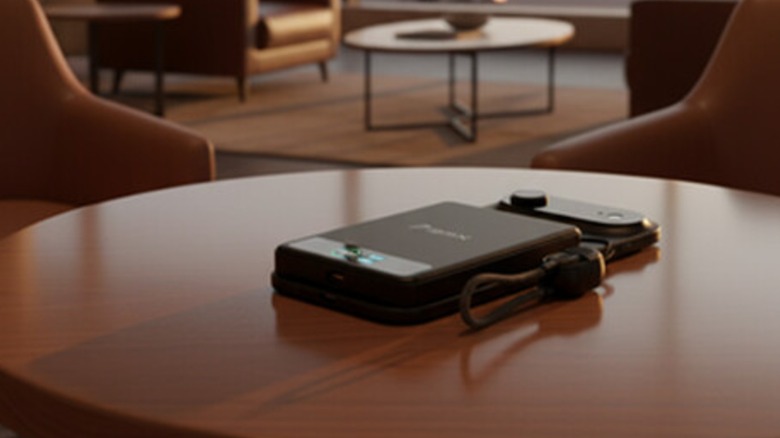
When it comes to charging speed and safety, solid-state batteries mostly surpass standard lithium-ion batteries. However, these improvements come at a cost. If you want to buy a solid-state battery power bank, you will have to spend way more money than you would on a comparable device.
For instance, the SolidSafe comes in two varieties: a 5,000 maH model that retails for $59.99 on Amazon and a 10,000 maH unit that sells for $79.99, also through Amazon. Both include wireless charging capabilities. Now, comparing these prices to a brand-name lithium device, and you'll find that Anker sells a 5,000 mAH power bank for $42.99 through Amazon, and this company also has a 20,000 mAH lithium-ion power bank for $69.99 on Amazon. Granted, that device offers wired charging only, but it's double the charge of SolidSafe's best offering for $10 cheaper.
To be fair, yes, these solid-state power banks are expensive. But if you buy one, you aren't purchasing it because the device is cheaper than its rivals; you are buying a solid-state battery because it lasts longer than the competition and is less likely to catch fire. If you want to save money on a power bank, inexpensive lithium-ion batteries probably won't disappear anytime soon.
Safety doesn't guarantee reliability
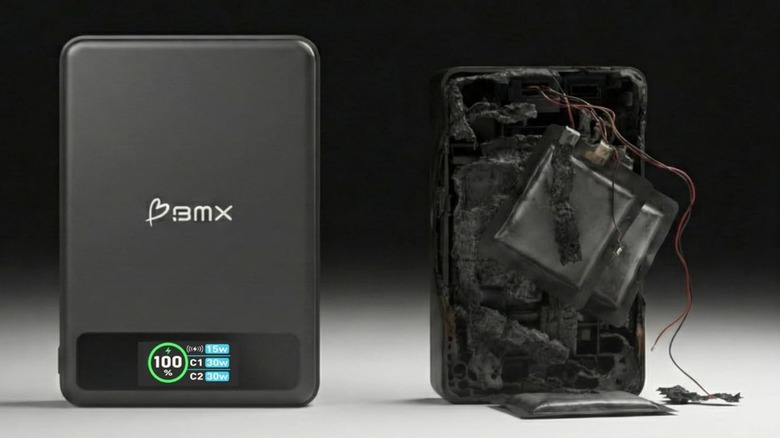
To demonstrate the superiority of solid-state batteries, ZDNet opened one up and stabbed it with a screwdriver. Yes, doing so rendered the device completely worthless, but the punctured solid-state battery just smoked a bit versus a damaged lithium-ion battery that can catch fire and explode. Clearly, solid-state battery packs are less likely to injure users, but that isn't the same as being reliable. While solid-state batteries might not blow up, some have an unfortunate tendency to form small metallic cracks, called dendrites.
Originally, engineers assumed these dendrites were the result of mechanical stress, but researchers recently published a study in Nature that outlines a completely different culprit: high electrical currents while charging. Turns out pushing electrons too quickly through these devices can create chemical reactions that weaken electrolytes and promote dendrite proliferation. Ironically, lithium-ion batteries became so popular because their graphite anodes (the electrode where energy enters the battery) are less prone to dendritic growth. The researchers who published the study said their findings will help scientists find new materials more suited to life as a solid-state battery. In fact, the study's senior author, Yet-Ming Chiang, floated the idea of using materials that grow tougher as cracks grow and accumulate, but that is a theory for another study.