

Can You Wear An Apple Watch On Your Ankle?
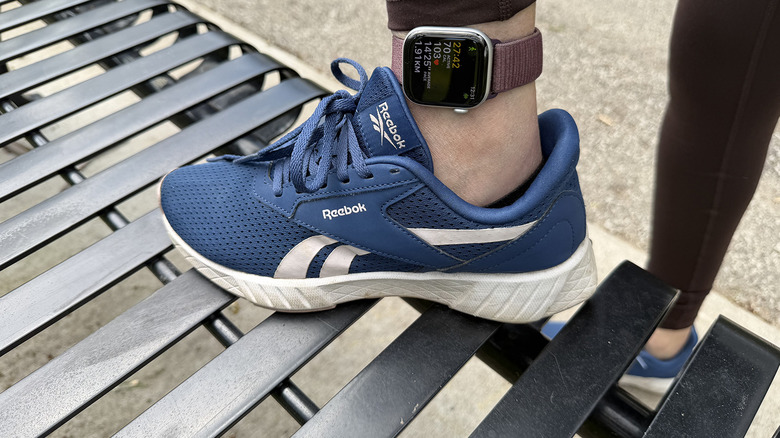
If you have an iPhone, the Apple Watch is the perfect smartwatch companion. It can track vitals, workouts and activity, calorie burn, and more. Not to mention you can get notifications, app access, and the ability to pay for items. Naturally, any watch is designed to be worn around your wrist, but if you've ever wondered if it could work around your ankle, you're not alone.
With the right strap, you can absolutely secure an Apple Watch around your ankle then go for a walk, do an intense workout, or go about your daily activities. And before you scoff at the idea, there are viable reasons why you might not be able to wear it on your wrist. Maybe it's during sports like boxing where it would get in the way. Perhaps you're not permitted to wear one at work, like if you're a surgeon. You might worry it could get damaged or dirty if you work in a kitchen. In these cases, you could move it to your ankle temporarily. But does it work? As an Apple Watch owner, I wanted to see if wearing the device on my ankle still provides accurate tracking, so I set out to try.
How Apple Watch works on the ankle
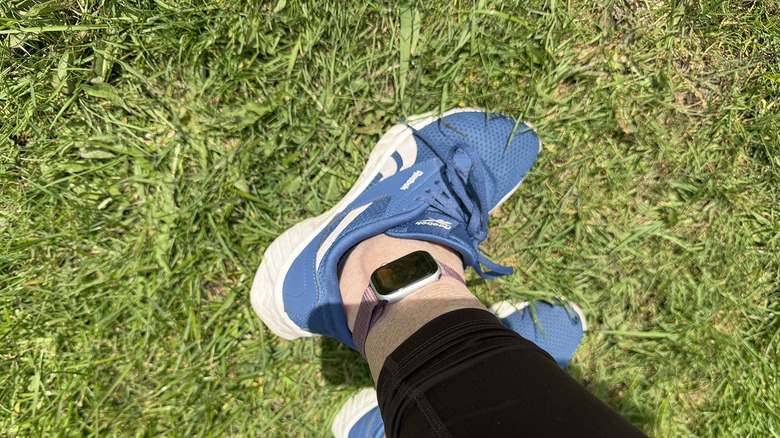
To wear an Apple Watch on your ankle, a comfortable band is important. My sport strap was too tight, but a Velcro band has enough slack and fits comfortably around my ankle without pressing against the bone. You might need to find a larger band depending on the circumference of your ankle. I positioned my Apple Watch Series 11 then started a walking workout. It's a route I walk weekly, so I know the distance and typical heart rate and calorie burn based on historical data from this same route in my Fitness app. I also went for the same walk the next day with the Apple Watch back on my wrist as usual.
With the Apple Watch on my ankle for my 3.57-kilometer (2.21 miles) walk, my average heart rate was measured at 120 bpm, and the Watch reported that I burned 200 total calories and 134 active calories. At the first kilometer, the audible marker through my earbuds suggested the Watch clocked my heart rate at much lower than it usually is at this point in the walk. But that didn't seem to matter because after the same walk the next day with the Watch on my wrist, it tracked the exact same distance with an almost identical 121 bpm average heart rate and 138 active, 202 total calories. There was very little variation in the data, whether I wore the Watch on my wrist or ankle.
A useful backup in a pinch
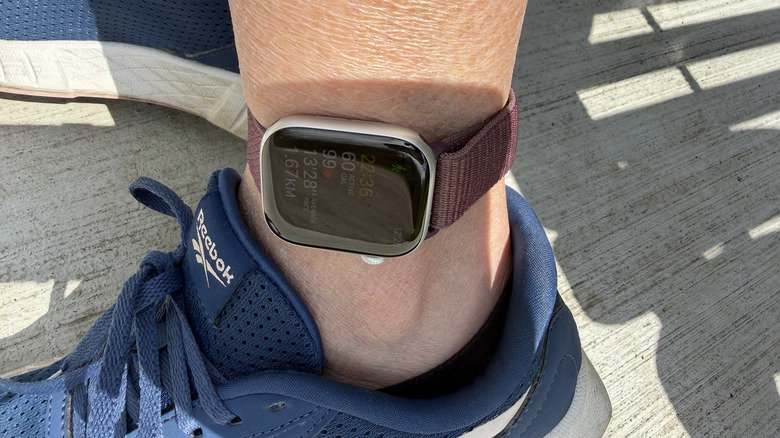
Along with convenience, there may be activity tracking advantages to wearing an Apple Watch on your ankle. Movement could potentially be more accurate since it counts steps even if your arms aren't moving, like while using a walking pad while working. The accuracy of heart rate tracking, however, will depend on how well the sensors touch the skin and detect blood flow. If you're concerned about heart rate tracking, consider wearing a chest heart rate monitor as well.
Ideally, Apple Watch should be worn on your wrist, which not only yields accurate results but also allows you to enjoy all the other features only Apple Watches have. But in certain instances, switching to the ankle, even temporarily for a specific activity, is a viable option. Beyond ensuring it doesn't get in the way of a specific sport or hand-focused activity, you might have wrist tattoos that interfere with accuracy, or a skin condition that prevents you from wearing it on your wrist all the time. Before you wear an Apple Watch on your ankle, keep in mind that while the data I got in my quick comparison test was spot-on, this might not be the case with every type of workout, nor for every person. Give it a try, do the same workout twice or wear it on your ankle for a few days and see how it compares.