

That Eerie Blue Light Surrounding Nuclear Reactors Has A Fascinating Scientific Explanation
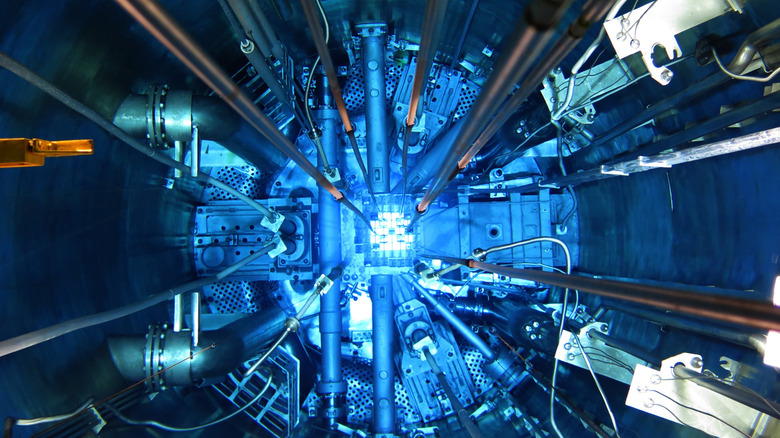
Nuclear power isn't 100% clean, but it does create huge amounts of energy while producing far less direct pollution than fossil fuels. It could be an important tool for lowering greenhouse gas emissions, though that comes with major risks made clear by the worst nuclear disasters of all time, and it leads to the creation of nuclear waste. One thing that makes it seem more dangerous is that eerie blue light you often see in photos of nuclear reactors, and its source is fascinating.
That blue light is called Cherenkov radiation, and it's the result of protons and electrons (particles with an electrical charge) moving faster than light in water or another clear substance. Things usually can't travel faster than the speed of light in a vacuum, but light actually moves about 25% slower in water, allowing charged particles to outpace it. This disrupts the water molecules and causes photons, or light particles, to be released, which is what creates that blue glow in what scientists compare to a sonic boom made of light rather than sound.
Cherenkov radiation appearing blue to the human eye has to do with how photons work. They're electromagnetic particles, meaning they travel in waves. The high frequency and short wavelengths of the photons emitted by Cherenkov radiation cause them to appear blue or violet to our eyes.
What Cherenkov radiation is used for
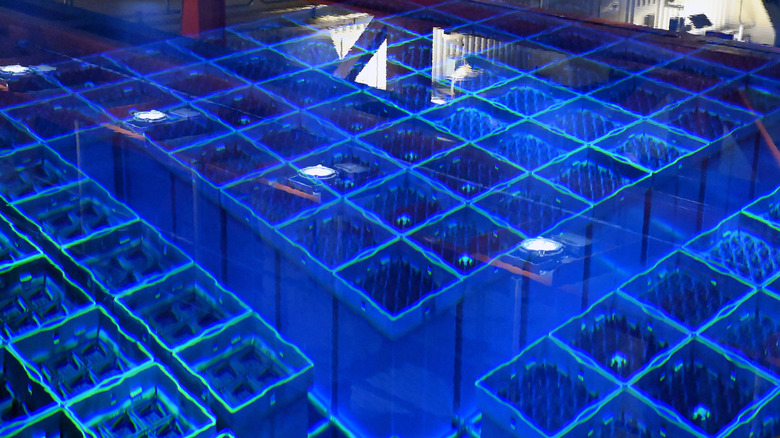
Cherenkov radiation is more than an aesthetic trick. It actually has a variety of uses ranging from biomedical applications to nuclear policy enforcement. The International Atomic Energy Agency requires that governments provide access to and disclose information regarding their nuclear facilities including location, amount, and intended purpose. Using equipment that measures emitted light, the agency can determine the amount of Cherenkov radiation present in a body of water and compare that to the nation's reported spent nuclear fuel usage to verify they are in compliance.
Cherenkov radiation is generated when patients undergo radiotherapy, a common cancer treatment. That means doctors can use it for medical imaging, allowing them to measure the amount of radiation in the body. Not only does that help manage dosage, but it also provides valuable information about the tumor that doctors can use to adjust care. Beyond that, Cherenkov radiation is also used for experiments in fields like astrophysics and particle physics.