

China's Bytedance AI Is Already Inside 7 Million Cars — And It's Only Getting Started
In a race to conquer the world's largest electric vehicle market, Chinese automakers continue to add advanced consumer-facing technologies to vehicles in an effort to win over potential buyers. The trend, which is coalescing with the country's explosive AI innovations, has led China's EV market to be dominated by AI features in the midst of declining domestic sales and an ongoing global price war. This convergence has led China's top social media company, ByteDance, to become a popular AI partner for players in the Chinese auto industry. And while advancements like sodium-ion EV batteries — which have the potential to charge in just 11 minutes — could upend the industry at large, Chinese manufacturers are betting that the country's strong AI push will help drive sales in the short term.
Similar to their American counterparts like Amazon and Alphabet, many of China's tech giants have evolved into conglomerates at the forefront of Beijing's AI charge. ByteDance, which most Americans know as the parent company that owns TikTok, may be the most dynamic and diverse firm in the PRC. A key example of ByteDance's success in diversification is its agentic AI system Doubao, which zoomed past competition from DeepSeek and Alibaba's Qwen to become the PRC's most popular LLM. Focusing on user-friendly interfaces, Doubao now boasts over 100 million daily users.
Developed by the cloud service provider Volcano Engine, a subsidiary of ByteDance, Doubao has proliferated across the Chinese car industry as a cockpit AI agent. According to the company, Doubao is now offered in 145 Chinese car models across 50 different manufacturers. These numbers are only set to expand as Doubao rolls out its next slate of AI-enabled systems. At Beijing's auto show, Auto China 2026, ByteDance announced its plans to bring two new AI programs to market. However, the conglomerate is facing stiff competition from companies like Alibaba and DeepSeek.
ByteDance is set to release a new suite of AI features in vehicles
First announced at Auto China 2026 back in April, Volcano Engine is set to release two new Doubao vehicle solutions this calendar year. The first is an AI cockpit suite through which manufacturers can integrate new AI features into their vehicles. Using a single "AI brain" comprised of three separate AI engines for dialogue reasoning, achieving goals, and growth and learning, the suite presents an upgraded agentic architecture that will afford automakers more flexibility with their own AI solutions. Manufacturers can either use the system to develop their own configurable AI systems, or they can deploy the Doubao suite wholesale.
The company also showcased its new driver-facing Doubao cockpit assistant. This tool isn't just capable of performing basic voice-activated functions to manage temperature adjustments or infotainment systems; its in-car AI-based offerings include route planning and parking assistance, as well as the ability to have conversations with drivers in real time. For example, with this system, drivers can instruct their Doubao cockpits to park in whichever spot is closest to a building's entrance. The AI agent can also act as a tour guide by adjusting a driver's route to maximize their exposure to scenery or historic landmarks. Such intelligent driving features could very well challenge Huawei's existing HarmonyOS driving software.
As it stands, the market is a crowded playing field
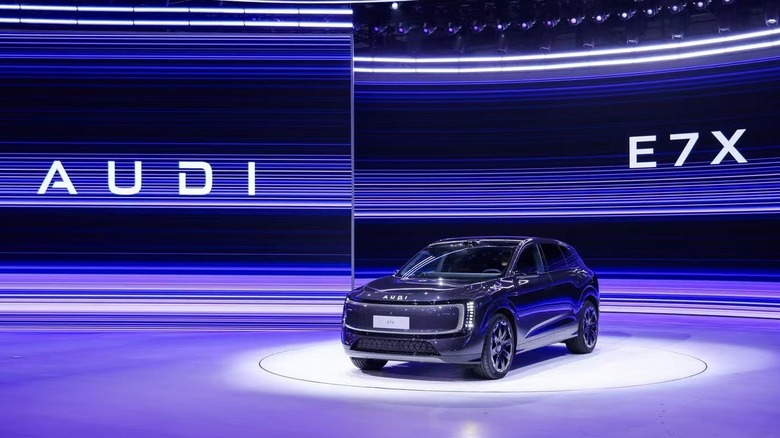
Doubao has quickly become the leading AI model in China's EV industry, with data from Volcano Engine claiming that Doubao has been installed in over 7 million vehicles, per 36Kr. According to Tan Dai, President of Volcano Engine, Doubao's Big Model renders over 30 million cockpit interactions daily. It's also proven to be a popular addition in foreign-made cars operating within the Chinese market, with Mercedes-Benz and Volkswagen both having deployed Doubao AI assistants in their vehicles sold in China. At Auto China 2026, Audi's Chinese division announced that its latest electric SUV, the E7X, will feature ByteDance's new AI system.
According to Dai, 100% of China's mainstream automakers have partnered with Volcano Engine to harness its AI solutions in their products. But despite its dominance, several competitors are looking to challenge Volcano Engine's lead. For instance, Alibaba wants to make its Qwen AI model a feature in the cockpits of Chinese vehicles. Running on Nvidia chips, Alibaba's system would allow drivers to initiate voice-activated transactions that are typically outside the scope of infotainment systems, such as hotel bookings, e-commerce deliveries, food orders, and event ticket purchases. The system is scheduled to be included in popular EV brand BYD's next slate of vehicles. Other major Chinese car makers — including Geely, Li Auto, Changan, Dongfeng, Great Wall Motor, and more — are also incorporating Qwen into their systems. DeepSeek is also pushing into China's vehicle market.
Many Chinese manufacturers do also divide different AI commands between multiple AI system providers. For instance, Tesla's Chinese EVs deploy both DeepSeek and Doubao AI voice command systems. While ByteDance's Doubao seeks to cement its lead ahead of its competitors, several manufacturers' rapid adoption of AI features reflects an ever-changing, high-stakes industry that's markedly difficult to predict. That said, though, ByteDance continues to make impressive strides in AI applications within the automotive sector.