

This Is Quickly Becoming The Most Popular EV Brand Worldwide In 2026
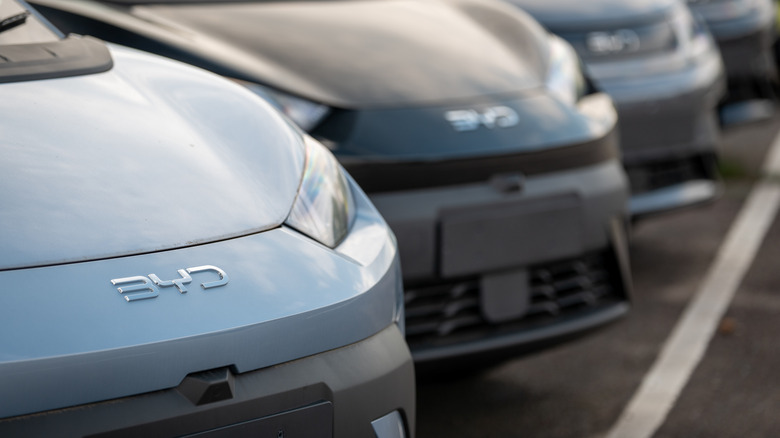
Once upon a time, Tesla was the most popular electric vehicle (EV) brand on the planet. That's not surprising since it was one of the earliest, and many drivers swear by these cars, even though Consumer Reports ranked Tesla as the least reliable used car brand. Nonetheless, Tesla is quickly losing ground to the Chinese EV manufacturer BYD.
According to reports from outlets such as BBC, BYD sales now surpass Tesla vehicles by a significant margin. In 2025, Tesla sold 1.64 million vehicles worldwide, a 9% decrease from the previous year. Meanwhile, BYD saw an uptick in sales and managed to push 2.25 million EVs, a 28% increase from the prior year. However, this is only half the story. According to CNN, BYD sells more than just EVs — if you also take into account the company's hybrid vehicles, BYD's 2025 performance blasted past Tesla with 4.27 million sales.
Of course, sales numbers are one thing, but technology is often the true decider in EV popularity, and BYD is the (alleged) victor on that front as well. BYD utilizes an "ultra-fast charging system" that can give its cars enough energy to last 250 miles in only five minutes. Tesla's Superchargers, meanwhile, take 15 minutes to provide 200 miles worth of energy. And some Tesla superchargers aren't approved for use in California — the state with the most registered EVs. Lately, it seems that BYD is outperforming Tesla at every turn.
Why BYD is now speeding past Tesla
Market performance of cars, especially EVs, is determined by numerous factors. Of course, the vehicle's actual performance is a major concern (you probably should avoid EVs that take up to 10 hours to charge), but availability is even more important. If your car doesn't sell well in the world's largest EV market, expect it to lag behind rivals. Also, it helps when your CEO isn't politically contentious.
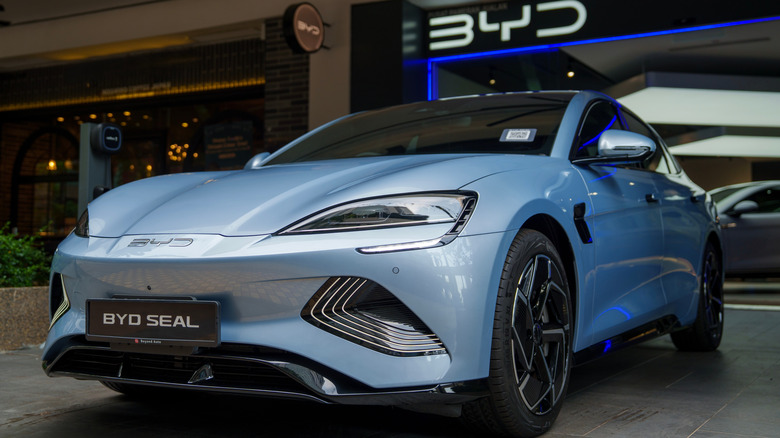
BYD can most likely attribute its success to its home-field advantage in China. The country is considered the world's largest auto consumer, and in March 2025, BYD controlled a 32% share of China's EV market. Meanwhile, Tesla lagged behind with a comparatively paltry 6.1% market share. But China isn't the only battleground. Tesla sales in regions such as Europe have been dropping like a lead weight. According to CNN, the company's European sales in early 2025 dropped by 40% compared to the previous year. Meanwhile, more and more buyers in the UK have adopted BYD cars — the hybrid version of the company's Seal U SUV has proven especially popular.
Sites such as CNN have also linked Tesla's slumping performance to the company's CEO, Elon Musk. His stint with the U.S. government, namely running the Department of Government Efficiency (DOGE) — which a court has since ruled made unconstitutional cuts — convinced many investors that he wasn't focusing enough attention on Tesla. Similarly, Musk's DOGE foray and other political activities have made a number of people reconsider whether his companies are worth supporting.
This news isn't all sunshine and rainbows
On paper, BYD sounds like a model company. After all, its market share of the EV industry must reflect the company's culture, right? Unfortunately, some people have discovered that BYD's sales numbers belie a potentially rotten core.
The BYD brand is no stranger to controversy. Between 2021 and 2024, 10 BYD showrooms caught fire. While BYD claimed fires such as the one on May 16, 2024, were caused by faulty or old wiring in the showroom offices, the local fire department ruled BYD car batteries as the cause. Moreover, countries such as Israel and Taiwan have restricted the import of BYD vehicles over national security and data-transfer concerns. Recently, the U.S. government banned routers produced in foreign countries on similar grounds before walking back the ban to an extent. However, one of BYD's biggest controversies doesn't stem from its country of origin, but rather, its attempts to secure a foothold in foreign markets.
Multiple BYD factories have come under fire for alleged worker mistreatment. In 2025, Brazilian authorities discovered that multiple people hired to build a BYD factory in Bahia were forced to sleep on beds without mattresses, and construction staff had their passports stolen and were forced to work under contracts with "illegal clauses" with next to no rest or pay. And in 2026, Hungarian officials discovered that contractors hired to build a construction plant in the country were forced to work under similar conditions: 12 hours a day, seven days a week. Whether these alleged labor exploitation incidents were the result of a few rogue agents or a broader cultural problem within BYD could determine the company's future.