

This Rejected Star Trek Tech Would Have Changed A Major Dynamic Of The Franchise

We may receive a commission on purchases made from links.
When "Star Trek: The Next Generation" was first in development in the 1980s, the creators were keen to upgrade and modernize the technology on display while retaining that sense of adventure and exploration so integral to the original series (which series founder Gene Roddenberry referred to as "Wagon Train to the stars," even if he wasn't concerned about creating new civilizations to populate those stars). According to "Star Trek: The Next Generation 365," a book that catalogs every episode of the series (including those fans unfairly hate), among the updates under consideration was a "landing envelope," a kind of shield that would protect away teams as they beamed down to planetary surfaces or other starcraft.
Conceptually, the idea makes a lot of sense. Many of the environments Starfleet personnel beam into are inherently dangerous, whether on the surfaces of unexplored planets or aboard derelict spacecraft. A landing envelope could mitigate much of that danger, providing protection against environmental hazards and weapon fire.
In a classic example of the clash between practicality/verisimilitude and storytelling, however, the idea was scrapped. The thinking was that a landing bubble like this would diminish the inherent danger of away missions so much that it would sabotage much of the dramatic tension of sending crew members off the ship.
Why Star Trek needs danger to work

One of the defining features of every "Star Trek" series is the idea of stepping into the unknown. It's one of the core conceits of a series that's largely about exploring, and to some extent taming, a wild and often hostile galaxy, even if the franchise took steps to humanize its "monsters." Away missions sharpen that tension to a razor's edge, whether it's Captain Kirk battling hostile aliens or Picard negotiating a tentative cease-fire between two warring cultures.
While the book also suggests that budgetary concerns may have been a factor, a landing envelope would've fundamentally undermined the vulnerability that's so central to away-mission sequences. That dramatic moment when the crew materializes on a distant planet or in the darkened corridor of a disabled vessel would've been stripped of its danger and unpredictability, neutering what should be one of the most tense events of an episode.
From a narrative perspective, danger isn't just a feature of "Star Trek," it's a necessity. So many episodes of both the original series and "The Next Generation" hinge on the possibility of things going badly, even fatally wrong, when the crew is outside the relatively safe confines of the Enterprise. A landing shield not only removes some of the worst possible consequences, but it also opens up a number of use cases beyond just that initial moment of dangerous transport. If the crew can be safely screened during transport, why not be surrounded by a shield at any other dangerous point during an away mission?
The tech that never beamed down
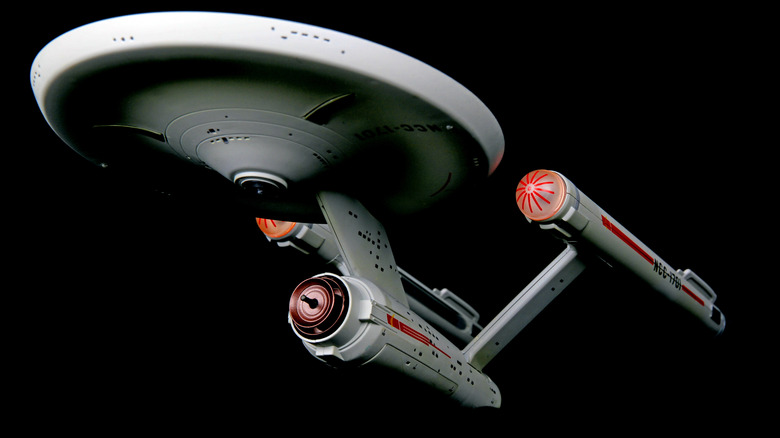
Ultimately, the landing envelope was scrapped before filming began on "The Next Generation." Its absence, however, speaks volumes about how well the show, like its predecessor, balances narrative tension with technological optimism.
It's that balance that defines the series and its setting. "Star Trek" is set in a universe where humanity has solved many of its issues: scarcity, poverty, and hunger have largely disappeared, as have large-scale wars between human nations. At the same time, the franchise needs to imperil its cast to drive the story, which is the primary reason it's set amongst the stars, often on the frontier of explored space, rather than on Earth. Landing bubbles would've mitigated a great deal of that sense of danger, and by extension, the thrill of discovery.
That said, the show does make excellent use of force fields at the spacecraft scale. Many of "The Next Generation's" most memorable sequences make use of the Enterprise's shield slowly collapsing as a dramatic timer, counting down to the moment when the crew must destroy a foe or overcome some obstacle lest they be destroyed themselves. In that case, however, the shield (and its steady decay) work to add a sense of danger to a scene that may otherwise be too abstract: crew members at electronic consoles on a sterile bridge conducting battle against distant opponents. On an away mission, the threat is usually much more immediate and visceral, and doesn't need additional gimmicks to ratchet up the tension.