

How Long Can You Expect Your Blu-Ray And DVD Collection To Last?
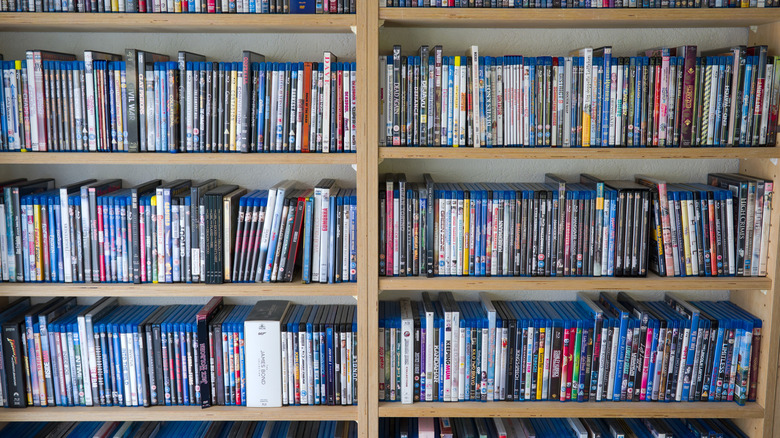
DVD and Blu-ray collections may still be a point of pride in many homes, with shelves or even entire walls adorned with movies and TV shows from across the decades. But what kind of condition are those discs in, and how long will they actually last? In general, DVDs and Blu-rays can last for years, or even decades, but that lifespan depends on the process used to make them and how they've been stored.
When DVDs first arrived in the 1990s, the promise seemed to be that these discs, like the CDs that came before them, were pretty much indestructible. Certainly, DVDs are easier to use than the VHS tapes they replaced, which often required fiddling with the VCR's "tracking" dial in a bid to reduce a jittery picture. And few will forget the horror of pulling a mangled tape from the machine. DVDs and Blu-rays, on the other hand, were perceived as durable, long-lasting media.
But the real-world lifespan of these discs varies widely and is heavily influenced by factors such as age, manufacturing quality, storage conditions, and whether the disc was pressed or recorded. In particular, home-recorded, or "burned", discs, are usually more sensitive to storage conditions and aging than factory-pressed DVDs due to differences in the type of physical material used to store the data.
Optical discs can last a long time

A study conducted by the Canadian Conservation Institute (CCI) involving various optical disc formats identified gold‑layer DVD‑Rs, where the R is short for Recordable, as the most robust, with an estimated longevity of between 50 and 100 years when properly stored. Silver-layer DVD-Rs were found to last around 20 to 50 years, while dye or non-dye Blu-ray‑R discs came in at five to 10 years of playability.
These figures are based on recordable discs that are burned at home. In contrast, the longevity of factory‑pressed DVDs and Blu‑ray discs (BD) — the type used for commercial movies and TV shows — ranges between 10 and 20 years, according to the CCI. Regardless of format, this type of pressed media is at risk of its reflective metal layer corroding when oxygen or moisture gets through the polycarbonate or lacquer, often via scratches or damaged edges.
So, just like with other optical discs, storage, handling, and manufacturing quality strongly influence longevity. However, perhaps the biggest risk to how long your DVD and BD collection lasts are these once cutting-edge media formats becoming obsolete due to lack of playability options. Knowing what kind of discs you have makes it easier to decide when it may be necessary to transfer your data, movies, or other media to newer storage formats before the discs deteriorate or become unusable.
How to properly store your collection

Disc longevity comes down to three main factors — effective storage, careful handling, and manufacturing quality. While it might be too late for boxes of DVDs, Blu-ray discs, and other vintage tech products hiding in a hot attic for years, a quick review of how you're storing other DVDs and Blu-rays in your collection might add some extra years to their lifespan. Sony suggests keeping them in a dry, cool area, avoiding hot locations, and maintaining storage temperatures between 39° and 73° Fahrenheit, with a humidity level of 40% to 50%.
If your discs are in a room with windows, make sure they're in a shaded spot, away from direct sunlight. It's also recommended to keep the discs upright, rather than flat, over long periods. Other tips include avoiding bending the discs, or touching the flat, readable surface with your fingers to reduce the chance of contamination. Like the cinephile with all the best Blu-ray box sets who likely already uses these storage and handling techniques with their collection, following this approach will help ensure your disc collection remains playable for years.