

NASA's New Fuel Cell Could Make Moon Colonies A Reality
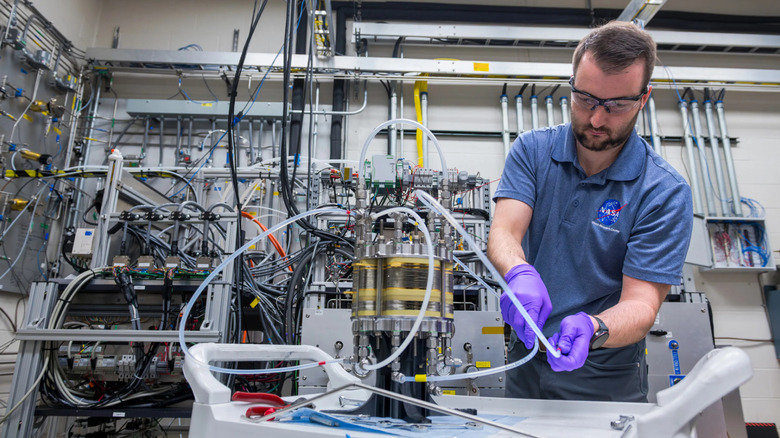
NASA's latest experiment may pave the way to extended explorations of the moon and Mars. Undergone at NASA's Fuel Cell Testing Laboratory in Cleveland, Ohio, the project aims to build a new regenerative fuel cell that could change the way NASA conducts its lunar missions. Similar to a rechargeable battery that combines and splits hydrogen and oxygen to generate electricity, NASA hopes the fuel cell will address critical issues when exploring the dark side of the moon, where solar power is ineffective due to the moon's 2-week-long rotations. Such limitations have prompted the agency to pursue nuclear reactors and other novel energy systems for potential moon bases.
The experiments come as NASA's Artemis program inches closer to reestablishing humanity's presence on the lunar surface. Earlier this year, NASA passed a major milestone in its lunar return when the Artemis II mission sent four astronauts on a nine day journey around the moon, the first crewed mission in its new deep space project. The agency's next Artemis mission, scheduled for 2027, will test commercial landers in low Earth orbit, a major step towards NASA's planned return to the moon in 2028.
NASA hopes that its regenerative fuel cells will help establish a long term presence on the lunar surface. Scientists involved in the project have hailed its various uses in lunar exploration, as "an ideal technology for habitats, exploration with rovers, and many of the systems that are envisioned under Artemis," according to Dr. Kerrigan Cain, led engineer at NASA's Glenn Research Center. "Developing a sustainable, long-term human presence on the moon requires power and energy storage solutions that fit those needs. Regenerative fuel cells fit into that puzzle perfectly."
Inside NASA's regenerative fuel cells
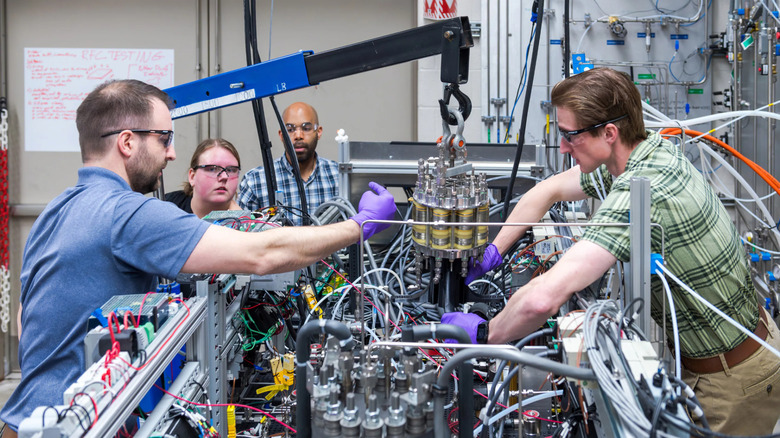
NASA's regenerative fuel cell system, lovingly described by Cain as "a behemoth," is roughly the size of a small sedan. Despite containing 270 sensors and around 1,000 components, scientists laude its relatively light weight compared to battery systems of a similar capacity. The cell works by combining hydrogen and oxygen to create electricity, heat, and water. To "recharge," the cell splits the water back into oxygen and hydrogen, allowing the fueling process to continue. Unfortunately, the efficiency of the recharge still experiences substantial drop off. As it stands, the battery will use a a photovoltaic array or another external power source, to fuel this recharging system.
Testing the machine is no easy endeavor. The cylindrical fuel cell, which NASA describes as "a stack of flattened silver and gold soda cans bundled together," must be lifted via a small crane. Once secured, scientists conduct experiments remotely via a control room. Beginning in 2019, researchers have achieved several key milestones on their way to an expected September 2027 completion date. Currently, the team is working on storing the gases produced by their novel recharge system. Eventually, Dr. Cain's team hopes to move testing procedures outside of typical laboratory settings into real-world analogs of harsh lunar surface conditions.
In addition to NASA's Glenn Research Center team, the agency has teamed up with two innovative industrial partners at the forefront of regenerative fuel cell technologies. The first, Giner, Inc., has partnered with NASA to build water electrolyzers. Infinity Fuel Cell and Hydrogen, Inc., the other private sector partner, delivered its prototype of a regenerative fuel cell with at least 500 hours of battery life in 2024.
Regenerating NASA's lunar push
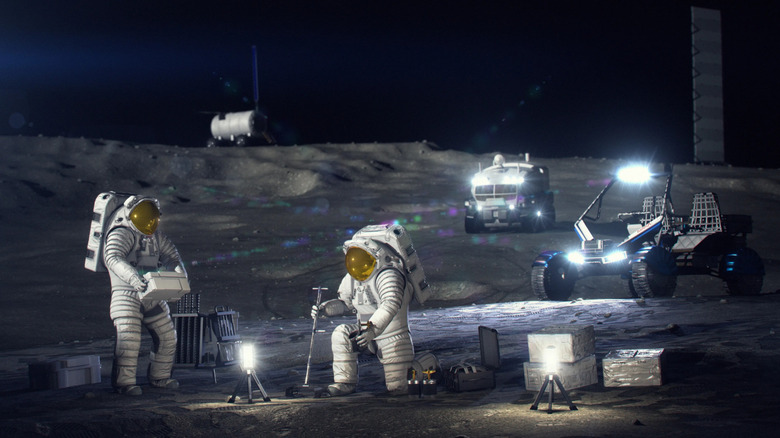
The moon presents several challenges to NASA engineers looking to power long-term bases and exploration projects. In particular, fourteen-day-long night and day cycles pose several problems for lunar exploration. For one thing, extreme temperatures that fluctuate between 292 degrees below zero to 248 degrees Fahrenheit can create precarious conditions. Furthermore, the lack of consistent sunlight eliminates solar as a reasonable power option. As such, NASA is in search of novel fueling systems that will enable rovers and habitats to persist through the harsh lunar conditions.
Developing sufficient regenerative fuel cell technologies could be crucial to fulfilling NASA's plans of prolonged lunar missions. Traditional lithium-ion batteries lack the energy density to power extended missions, and require onerous charging infrastructure. Regenerative fuel cells can hold up to 3.4 times the storage capacity of batteries of the same mass. Nuclear options, which have become increasingly popular when discussing lunar bases, still face key situational limitations. As it stands, no existing technology can sustain operations through an entire lunar night. But the agency is hopeful that its regenerative fuel cell program can turn the tides.
NASA scientists hope that their energy storage system will be operational for the agency's upcoming Artemis missions. With a lunar landing planned for early 2028, and sustained lunar mission operations slated for late 2028 and beyond, the agency hopes to establish its first lunar base by 2030. Seventy nine launches, up to five surface habitats, and $30 billion later, NASA hopes to erect the first permanent lunar colony within a decade. Regenerative fuel cells will likely play an essential role in powering these grandiose ambitions.