

European Rockets Might Be Amazon's Secret Weapon To Compete With Starlink
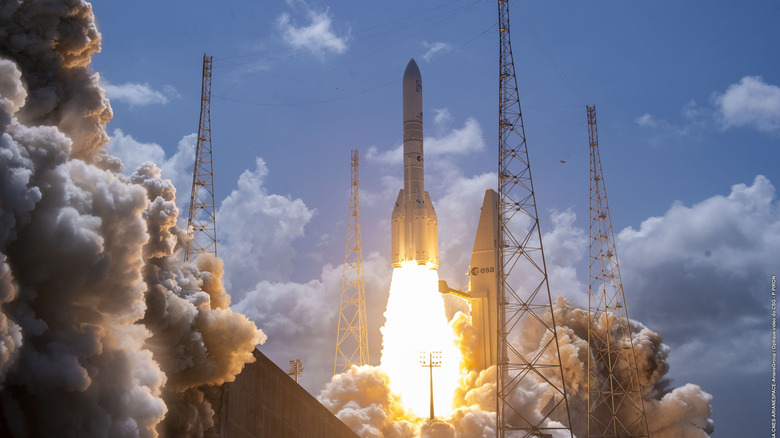
As the billionaire space race heats up, the world's astro-moguls are looking to keep up with SpaceX's lead in low Earth orbit (LEO), and Jeff Bezos's space ventures, Amazon Leo and Blue Origin, are gaining a foothold. In April, Amazon struck an $11-billion deal to purchase Globalstar, a major player in the smartphone connectivity space, that paved the way for a landmark deal with Apple. However, Amazon's satellite program likely hinges on its ability to establish a launch pipeline independent of SpaceX. A partnership with French firm Arianespace, which operates the European Space Agency's Ariane 6 rocket, may be the key to closing the LEO gap. Since February, the company has launched 64 satellites via the rocket.
Bezos has made it his mission to close the gap between himself and fellow space oligarch Elon Musk. With over 10,000 satellites in its Starlink constellation, SpaceX owns roughly two-thirds of all satellites currently in orbit. Amazon's constellation pales in comparison. With just over 300 satellites, Amazon's Leo is a distant third when it comes to private satellites. However, the conglomerate hopes to scale those numbers over the coming years. Between Amazon Leo's projected 7,700-satellite constellation and Blue Origin's upcoming 5,000-satellite TeraWave project, Bezos may soon be on the precipice of challenging Musk.
Built through stockpiles of cheap, reusable rockets, SpaceX's empire is founded on its ability to launch satellites at an unprecedented rate. This advantage has forced the industry to heavily rely on SpaceX to launch their own satellites. The lack of scalable launch capabilities is a notable issue for Amazon, which has struggled to meet its lofty projections. By diversifying its launch partners, Amazon may finally be on its way towards realizing its ambitions.
Partnering its way to low Earth orbit
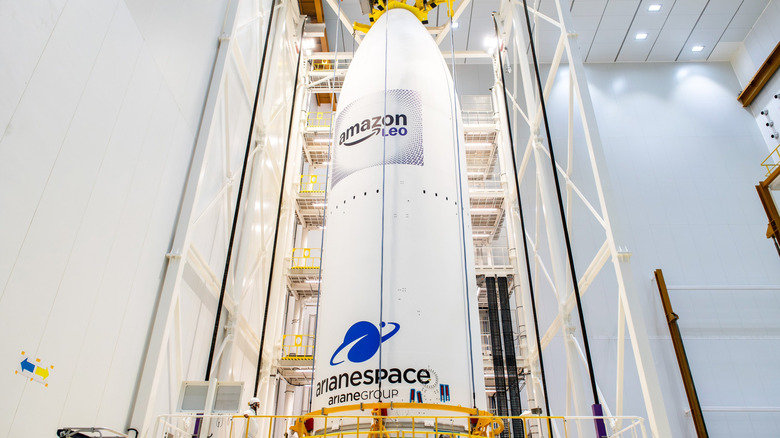
Beginning its full-scale launch program in 2025, Amazon's constellation is only a tenth of the way to full deployment. However, according to Amazon Leo executive Chis Weber, Amazon is set to dramatically scale its launch schedule. "The theme moving forward is acceleration," the executive said during an April launch event "What we've said is that over the next 12 months, we'll double the number of launches, satellites, et cetera." (via GeekWire)
Partners like Arianespace are crucial to building out Amazon Leo's internet constellation. To date, Amazon Leo has completed two of its 18 scheduled Ariane 6 launches. The 64 satellites deployed in said missions account for about 20% of Amazon Leo's total fleet. So far, Amazon has struck launch agreements for more than 80 missions. Beyond Arianespace, launch operators include Blue Origin, United Launch Alliance, and SpaceX. However, such advancements lag behind the company's initial projections, as the company struggles to meet the FCC's July 2026 deadline to deploy half its constellation fleet. Despite these difficulties, the FCC approved Amazon's request to expand Leo's constellation by 4,500 satellites.
Amazon's constellation project, formerly known as Project Kuiper, will compete with SpaceX's Starlink. Once fully deployed, the 7,700 satellite constellation will target both consumers and enterprise users. As it stands, Amazon offers three tiers of antenna: Leo Nano, Leo Pro, and Leo Ultra. The latest, Leo Ultra, is an enterprise-level system that Amazon claims is the "fastest customer terminal in production, with download speeds up to 1 Gbps and upload speeds up to 400 Mbps."
An astronomical future for satellite internet
The stakes for Amazon's satellite expansion couldn't be higher, as global powers and corporate giants race to to win the new space race. According to McKinsey, the space economy could triple to a whopping $1.8 trillion over the next decade. With orbital datacenters and lunar colonies potentially on the horizon, the need for affordable, scalable launch operations will be defining factor of the current space race.
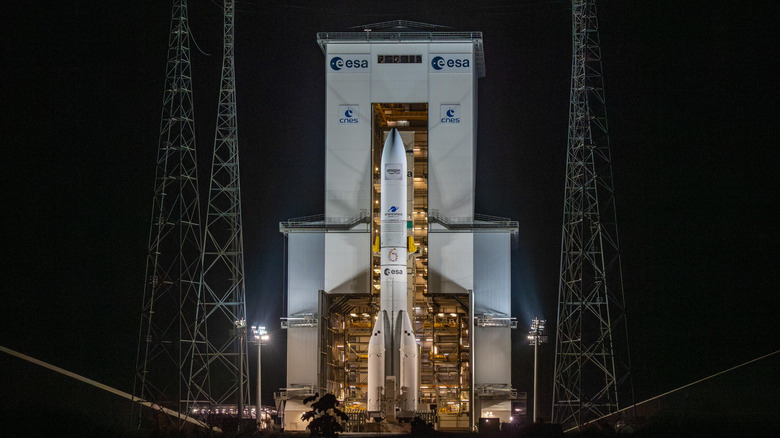
To what degree Europe benefits from these trends remains to be seen. However, the Amazon Leo project points towards Europe's potential strategy in an increasingly crowded market. The Ariane 6 exemplifies Europe's multi-jurisdictional approach to space exploration, where national-level groups, intergovernmental agencies like the ESA, and the EU's European Commission all play a crucial role in member states' space projects. Although built and operated by France's CNES space agency, hundreds of firms across 13 European countries were involved in developing the heavy lift rocket. For European planners, it is a sign that the continent may be able to hold its own in the space industry's quickly evolving economic model.
For Amazon, the Ariane launch represents an important piece of its low Earth orbit puzzle. While Bezos' Blue Origin has been at the forefront of reusable rocket systems, its 38 launches are not enough to satisfy Amazon's high demands. Instead, the company needs to contract with a variety of launch partners in order to achieve its stated mission. And although the conglomerate has been unable to reach its promised heights, the Ariane 6 launch may propel it in the right direction. Whether the Ariane 6 can narrow the astronomical gap between Amazon and SpaceX's 10,000 satellite constellation could define the space race.