

Cassettes Vs. CDs: Which Has Better Audio Quality?
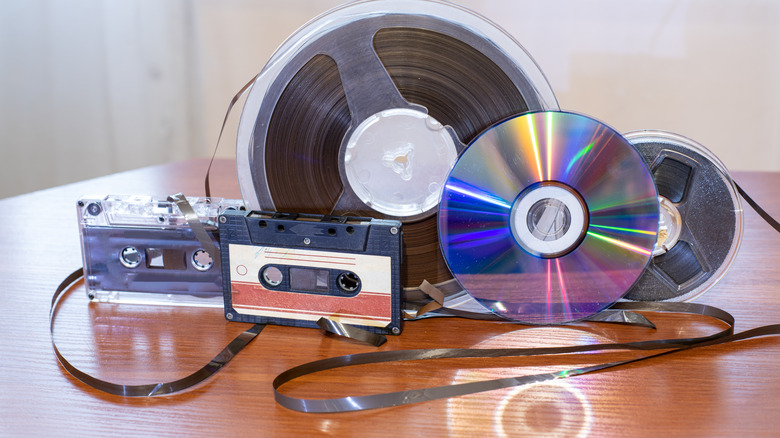
Sound quality is, to some extent, in the ear of the beholder. The qualities you prioritize and crave may be wildly different than those of a person standing alongside you, meaning making strict determinations about which format is better than another can be a fraught business. That doesn't mean, however, that you can't assess different media for different use cases or assess their strengths and weaknesses, though a lot of determining "sound quality" is situational and comes down to preference.
For instance, when evaluating cassettes against CDs, if you're judging purely by audio fidelity, CDs have a clear advantage. As the more modern and technologically refined medium, CDs have a natural advantage in cleanly duping a recording. That said, cassettes have advantages of their own, swapping that sharp fidelity for character, warmth, and, in many cases, nostalgia. Ultimately, like the battle between CDs and vinyl, the debate largely comes down to a matter of analog charm pitted against digital accuracy. Now that both CDs and cassettes appear to be making a comeback, let's dig into the major differences.
Why CDs win the technical battle

On paper, CDs may look like the superior choice for audiophiles largely because they offer a higher signal-to-noise ratio, broader frequency response, and far more stable playback than a cassette tape is capable of delivering. This means fewer of those tiny, mechanical imperfections that can color cassette recordings, as well as less distortion and hiss. The tape that's the vital component of cassettes is naturally more fragile than CDs; it's susceptible to wear and tear. In audio terms, that means blemishes.
By contrast, the digital nature of CDs means that they're able to retain remarkable detail, consistently across different players and listening sessions. If a disc is well-preserved and in good shape, and if the player is working as intended, the fidelity will likely be much closer to the original recording than what's possible on a cassette. CDs are also capable of better dynamic range, meaning they tend to handle quiet passages and loud peaks with greater precision than cassette tapes, which tend to compress music in ways that can flatten contrast.
Cassettes win on character
Cassettes, on the other hand, deliver something that CDs can't: character. Precisely because of how accurately they're able to reproduce the original sound, CDs tend a bit towards the cold, sterile end of the audio spectrum. Old-school tapes, however, deliver a specific kind of softness that many listeners interpret as warmth, which is why cassettes are making a comeback. While in some contexts it's considered a hindrance, the slightly rolled-off, compressed sound that tapes deliver can actually be a desirable part of the listening experience.
While it may not reflect on the actual audio quality, tapes also deliver a tactile experience that CDs can't match. There's something meditative about the ritual of flipping, fast forwarding, and rewinding tapes that's lost in the era of digital media. That said, the limitations are hard to ignore. Tape wears faster, decks can vary widely in quality (and quirks), and even a really great cassette setup can't match the low noise and sharp detail of a good CD player.