

Why Did Old PCs Have A Turbo Button On Them?
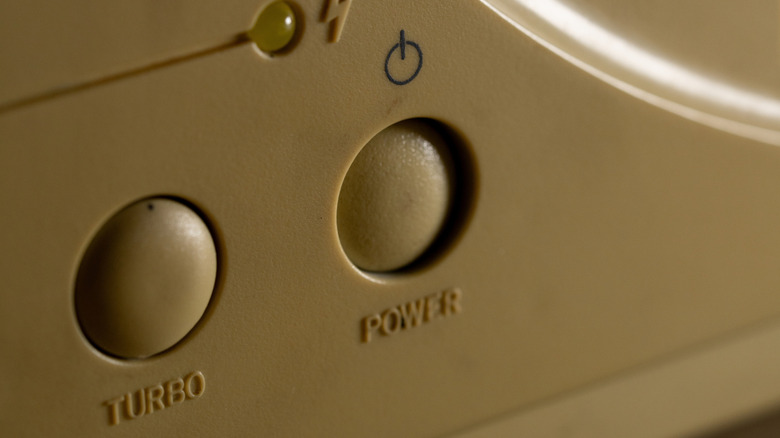
If the current wave of retro nostalgia has you remembering the computers of your childhood (particularly those from extinct manufacturers), you may remember a bizarre feature of some old PCs: the turbo button. Amongst the resurgence of physical hardware and devices that have largely been replaced by digital equivalents currently happening across the tech landscape, people are seeing designs that hearken back to 90s PC cases, and I personally would love to see a nod to one of the most delightful quirks of that era.
While it may have brought to mind the NOS button in the "Fast and Furious" films, the turbo button actually had the opposite effect: pushing it would slow a computer down. While it may seem counterintuitive to want to slow down a PC, especially now in an era where performance is king, it was sometimes necessary to ensure that your hardware played nice with all of the software you loaded onto it.
How the turbo button worked
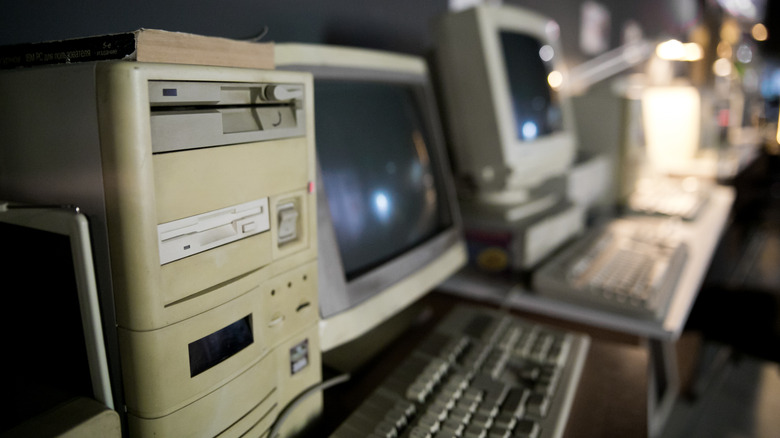
The turbo button tended to live right on the front of a PC tower, typically below or right alongside the power button. Like these forgotten computer accessories, they used to be absolutely essential to a properly functioning PC. Pushing it would toggle the system down to a lower CPU clock speed, which was occasionally necessary to allow certain pieces of software to run (or function properly). For instance, some games would speed up as the clock speed increased, which could render them unplayable (or cause any number of glitches or unintended behaviors). Some software, programmed to run only at a very specific system speed, wouldn't load at all, or would crash almost immediately upon launch.
According to a 1984 issue of PCMagazine (link will download a PDF to your device), the first turbo button appeared on the Eagle PC Turbo and allowed users to swap between 8 and 4.77 MHz modes. They were soon widely adopted, especially by manufacturers producing clones of IBM PCs that were capable of much faster processing speeds than the original IBM models could achieve.
Why the turbo button disappeared
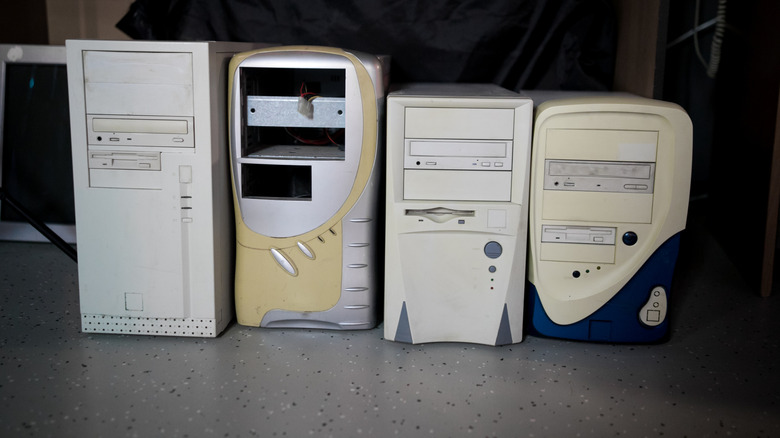
In an age when CPU overclocking is all the rage, the idea of needing to slow down a PC to get it to function properly seems charmingly antiquated. Eventually, however, the need largely disappeared, as software engineers began to future-proof their programs with speedier (or, at least, more diverse) hardware in mind. Software that may normally struggle with faster clock speeds introduced built-in delays to ensure it remained stable even if advanced hardware was trying to push it faster than intended.
Turbo buttons began to vanish from prebuilt PCs and PC cases around the mid-90s, and by the aughts had almost completely disappeared. That said, a lot of software written during that era is still kicking around today, especially in the retro games scene, propped up largely by sites like GoG. Most of that software has been retroactively patched to natively deal with any clock speed issues, but there are also a number of dedicated third-party solutions, like DOSBox, which can artificially slow CPU cycles so timing-sensitive games behave correctly.