

5 Of The Cheapest 3D Printers You Can Buy On Amazon
We may receive a commission on purchases made from links.
The sheer variety of what you can create with a 3D printer is amazing. If you have the time and materials, you can produce everything from figurines and knick-knacks, to tools, gadget accessories, and more. There are even some giant things you probably didn't know could be 3D printed — with commercial printers, of course.
But printing can be an expensive hobby, not just because of the upfront cost of the printer, but also due to the materials, failed prints, software tools, and beyond. The cheapest way to get into 3D printing is to essentially borrow or rent someone else's. That'll never give you the true freedom of owning your own printer, however. The good news is you can start with a relatively budget-friendly option, and there are many of them available on Amazon.
When you're looking to purchase a new 3D printer for home or office projects, or whatever it is you're planning, there's something very important to consider. Prices have come down in recent years, but even so, going too cheap is not ideal. To cut costs, some printer manufacturers will sacrifice important features and quality components which can affect future projects. Cheaper options may also come with safety hazards, such as no thermal runaway protection, which is a fire risk. Noting that, here are the cheapest 3D printers you can buy on Amazon, that also provide a lot of value. The intent was to keep the price reasonably below $350 and select from well-known, proven brands with decent recommendations either from respected tech outlets or verified consumer reviews.
1. Creality Ender 3 V3 SE
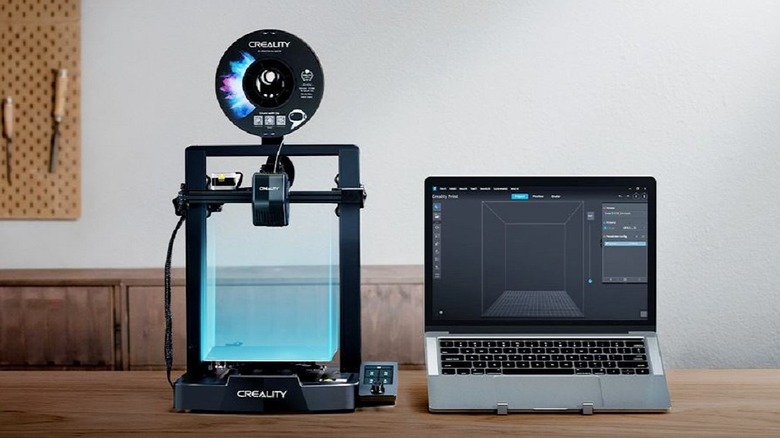
The Creality Ender 3 V3 SE is not only one of the cheapest options on this list, at $219 full price, but it's also one of the highest rated by critics and users alike. TechRadar and Tom's Hardware have each given it high scores. It's garnered over 1,600 reviews on Amazon with a total 4 out of 5 star rating. More on what people are saying in a bit.
The decently-sized build plate is 8.66 inches by 8.66 inches by 9.84 inches, larger than most comparable systems. That gives you a suitable area to create. It also has auto-leveling, dual z-axis auto filament loading, and supports a speed of 250mm/s with an acceleration of 2,500mm/s. Supported materials are PLA, TPU, and PETG. The downside is it doesn't have built-in Wi-Fi, so you'll need an SD card to upload 3D modeling data.
One reviewer even says forget the Adventurer 5M — another printer listed here — and go with this instead as a "true and easy to use beginner machine." Others confirm it's a "great entry-level" option, and add that it works fine with stock settings, meaning you don't need to fiddle with them as much between projects. As with some of the other printers, there are users that had customer support problems or trouble getting their printers to work correctly. Don't let that scare you away but do keep it in mind.
2. Bambu Lab A1 mini
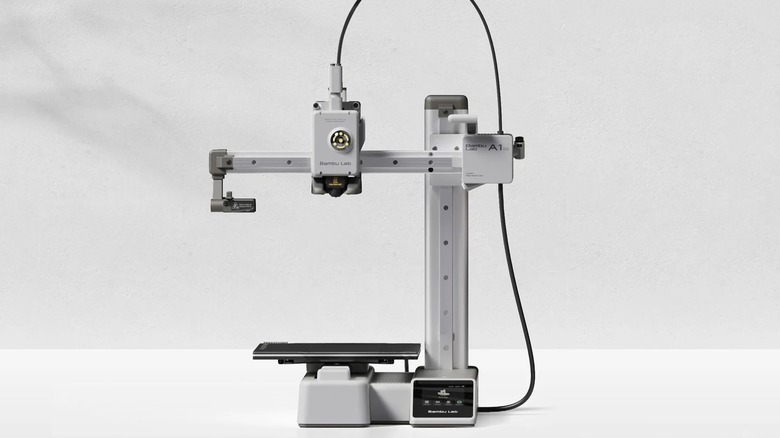
Bambu Lab is praised for its wide range of 3D printing machines, budget-friendly to premium. The Bambu Lab A1 mini at $259 full price is no exception. It comes pre-assembled, pre-squared, and pre-tuned for precision, which means it should be mostly usable right out of the box — an ideal option for novice to intermediate tinkerers.
Moreover, it automatically calibrates, getting everything ready for you, and a simple touchscreen makes it easy to configure. It's quiet, prints at 500mm/s, with a 10m/s max acceleration, and supports PLA, PETG, TPU, and PVA filaments. You can also print in multiple colors. It does have a smaller build plate area than some other options, 7 inches by 7 inches by 7 inches, so keep that in mind.
It earned a spot on Tom's Hardware's best budget 3D printers, but also scored high with PCMag, and TechRadar, as well, so you know it's good. It only has a handful of reviews on Amazon currently, but still earned a 4.5 out of 5 star rating. There aren't many low scores either, but one three star review mentions running into troubles with prints detaching from the table.
3. Creality SparkX i7
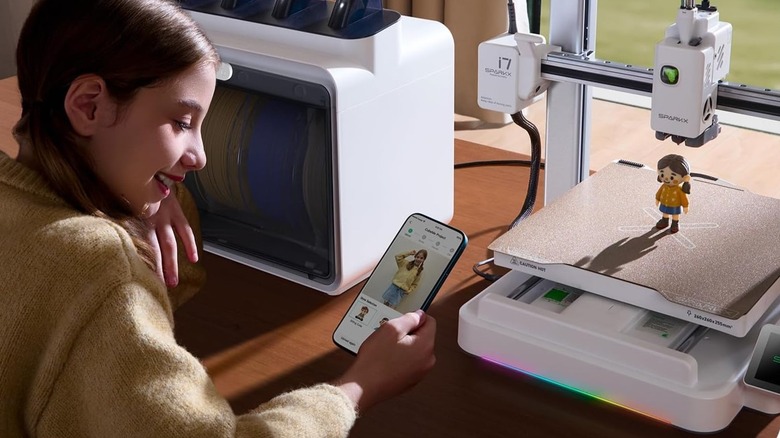
The Creality SparkX i7 is a newer printer from the company, and has already earned lots of praise from critics, including Tom's Hardware. It's a solid entry-level printer for $299 that's also fairly low maintenance without cutting down on great features.
It has a large, open bed size of 10.24 inches by 10.24 inches by 10 inches with a 500mm/s speed and 10,000mm/s acceleration. The direct drive extruder works with PLA, PETG, and TPU materials. One of the more unique features supported through the app is the ability to use AI to create 3D models out of portraits "in seconds," which can then be brought to life using the machine.
Additionally, it has over 30 reviews on Amazon with a 3.8 out of 5 star rating. It's noted as being plug-and-play friendly, ideal for beginners with smart features to support new printing techniques, and great for all ages provided the right supervision is administered. A handful of low scores are visible too, with comments that recommend spending more to get a higher quality printer. Your mileage may vary.
4. Flashforge Adventurer 5M
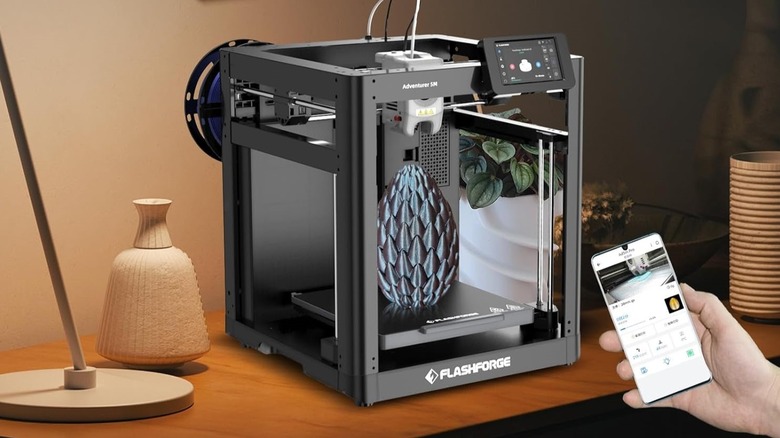
Under $300 seems to be the sweet spot for affordable yet feature-rich 3D printers, with several Flashforge models being prime examples. A standout is the Flashforge Adventurer 5M, with a full price of $300. It goes on sale often, making it a solid option for those who want to save a few bucks but splurge on a more premium system.
As for the printer, it's an enclosed system with print area dimensions of 8.66 inches by 8.66 inches by 8.66 inches. The 600mm/s travel speed and 20,000mm/s acceleration indicate decently fast prints, with one-click automatic printing modes and smart app support. The enclosure is made of metal and has a detachable nozzle that can handle extrusion temperatures up to 280 degrees Celsius. It works with a wide range of materials, too, such as PLA, ABS, PETG, TPU, PLA-CF, PETG-CF, PC, and ASA.
None of that means anything worthwhile if the printer isn't reliable and doesn't deliver quality prints. The best way to figure out if it does or not is to look at user reviews and comments. The Flashforge Adventurer 5M has top marks from CNET, for starters. It also has over 2,200 reviews, with a score of 4 out of 5 stars. Several of the top comments mention it offers "amazing" value, that it has "solid" reliability, and is a great entry-level option. To balance that out and give a more objective look, the one star reviews do claim the hardware and software can be "unreliable," and there are a few frustrated users that said their experience devolved over time.
5. Anycubic Photon Mono 4 Ultra
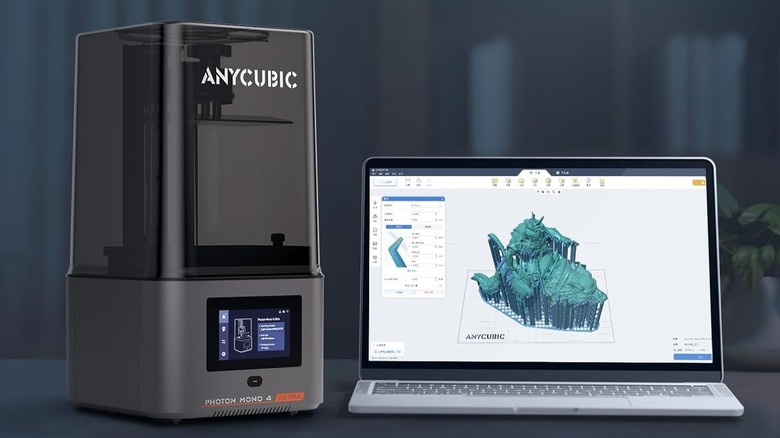
Anycubic is a well-known brand in the 3D printing world. It features more than once on BGR's list of the cheap 3D printers you should buy, and for good reason. The Anycubic Photon Mono 4 Ultra for $320, at full price, is another affordable standout of the brand's offerings. It's an enclosed system with a printing size of 6.04 inches by 3.42 inches by 6.49 inches.
The premiere feature here is the 7-inch LCD HD touchscreen on the front that makes it easier to control the printer and adjust settings. It's also a resin printer that uses UV light to cure the liquid polymer, which allows for more precise details in the finished product.
Currently, it has 60 reviews on Amazon with a 4.6 out of 5 star rating. That's not a whole lot, however, the original Photon Mono 4 has nearly 500 reviews with a 4.4 out of 5 star rating. Reviewers say it's a "good printer" for starting out in the hobby, and that's it's easy to use. Another user points out that it "sets the bar for all other resin printers" in its size and price range. Though, it does appear some encountered defective units and problems with their prints. That doesn't appear to be the norm even with its limited reviews.
Methodology
As mentioned previously, the goal with this list was to highlight 3D printers that meet three criteria, the first of those being availability for purchase on Amazon. From there, a price ceiling of $350 was set, while also applying nearly equal weight to brand reliability, quality, and features. After all, a cheaper 3D printer that produces bad results isn't preferable to a somewhat more expensive option that performs better.