

Nicolas Cage Starred In A Sci-Fi Movie That Adapted An H. P. Lovecraft Story

It's not easy to adapt anything written by H.P. Lovecraft to the big (or small) screen and keep the core of the source material intact. Yet Richard Stanley's "Color Out of Space" — based on the legendary author's mind-bending short story of the same name — managed to capture that strange and otherworldly weirdness perhaps with more accuracy than anybody before him. His film begins as a lingering nightmare that slowly escalates into a full-on tentacled madness pulsating with vivid colors, grotesque gore, and a ubiquitously unsettling mood that will stay with the viewer even after the credits roll.
"Color Out of Space" follows the Gardners, led by Nicolas Cage's patriarch, Nathan, as the family of five moves to a rural farm in Massachusetts (close to the fictional town of Arkham) for Theresa's (Joely Richardson) recovery after she's had a mastectomy six months prior. The kids, Benny (Brendan Meyer), Lavinia (Madeleine Arthur), and Jack (Julian Hilliard), all try to cope with the situation in their own ways. But the healing and strengthening of the family unit quickly runs off track when one night a bright meteorite crash-lands in their front yard and begins to affect and change everything in its vicinity.
From plants to animals to humans to the environment and time itself (similarly to "Annihilation"), the pink-purple energy the rock emits will eventually contort, poison, and consume nearly every living thing in a horrifying manner, typical of virtually everything Lovecraft has written during his relatively short career. And the original director of "The Island of Dr. Moreau" does his best to adhere to the cosmic horror, transferring it from paper to screen with striking flair and a decent amount of off-putting gore.
Color Out of Space turns madness into a ravishing feast of horror
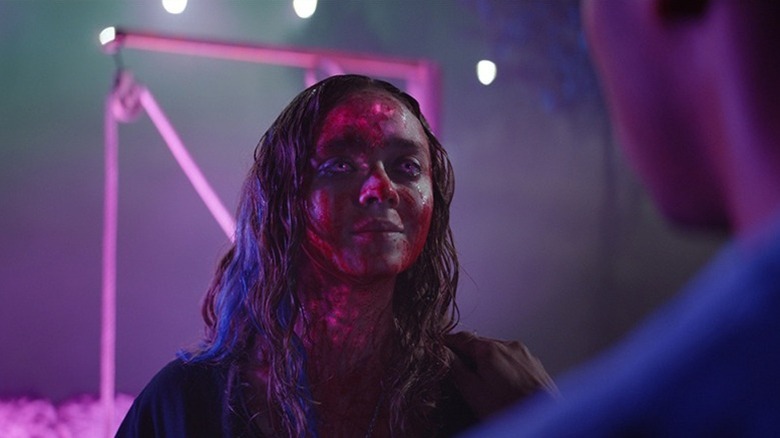
What "Color Out of Space" loses in its leisurely unfolding plot and stereotypical characters, it makes up for in visual prowess and an ever-flowing atmosphere. Despite the occasional odd CGI here and there, you can feel every cent of the modest $6 million budget spent in the living and breathing milieu that becomes its own entity by the end of the movie. Whether it's the vast colors of the unknown, the grossly mutating animals, or the ominous soundtrack that serves as the bedrock of the cosmic unease the material calls for, "Color Out of Space" never fails to capture its thick, ethereal mood.
Unfortunately, that magic touch doesn't always extend to the characters, who often feel too hollow for what they're meant to encapsulate. Therefore, the actors feel restricted by the story to go beyond a certain point despite all of them giving more than adequate performances — especially Cage, who enters his full-on madness mode in the second half, embracingly. Something's lacking emotionally for the narrative to really hit deep, even though the usual beats are there in some shape or form.
However, it is a cosmic horror first and foremost, and besides the unnerving atmosphere, Stanley and Co. simply revel in the gross-out gore that's in full flow in the second hour. Without giving anything away, the terrors of body horror portrayed are pure nightmare fuel — bloody and deliciously repulsive in a way that surely satisfies many genre fans. It's hardly surprising that "Color Out of Space" flopped at the box office, garnering only a million dollars worldwide. But that's ok, since it had "cult film" written all over it right from the start, which it has become in the years since its 2019 release.