

China's 'Artificial Sun' Is Gearing Up For A Major Milestone By 2027
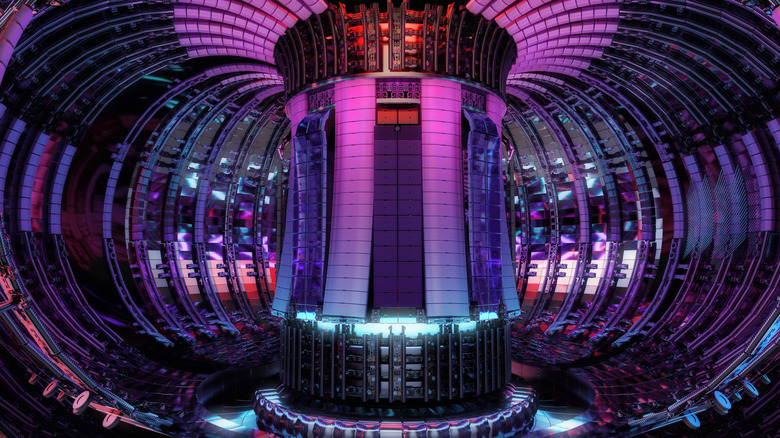
China's tokamak reactors, referred to as "artificial suns" for their mimicry of the plasma fusion occurring in the sun's core, have the potential to generate massive amounts of low-cost clean energy at scale. Beijing's most advanced effort is the Experimental Advanced Superconducting Tokamak (EAST), a nuclear fusion reactor capable of burning six times hotter than the sun. Operated by the Institute of Plasma Physics, Beijing expects its reactor to record its first fusion ignition experiment in 2027, a milestone that would make EAST the world's first self-sustained reactor, in which plasma can burn without external heating sources.
In a fusion reactor, scientists combine two positively charged nuclei to generate mass energy and heat. However, because of the nuclei are both positively charged, reactors must generate enough power to overcome the magnetic forces repelling them. Tokamaks are cylindrical reactors that address these challenges by electrically charging these hydrogen nuclei, turning them into a dense plasma. However, said plasma is incredibly unstable, requiring the plasma to reach densities capable of generating self-sustaining heat. To do so, tokomaks must operate at unfound scales, generating temperatures 150 million degrees Celsius, roughly 10 times that of the sun's core, and magnetic fields hundreds of thousands times larger than Earth's.
The EAST tokamak is just one of several fusion projects on the horizon for Beijing, which has invested an estimated $6.5 billion in the technology since 2023. A pillar of its most recent Five-Year Plan, China's fusion industry has harnessed an entrepreneurial spirit mirroring that of Silicon Valley, riding a wave of public investments, coordinated research efforts, and concerted supply chain developments to soar past global competitors. However, Western firms are fast on its heels. In the United States, for instance, roughly 42 companies have garnered $8 billion of capital to pursue the technology, constituting roughly half of global investment.
Fusion forward
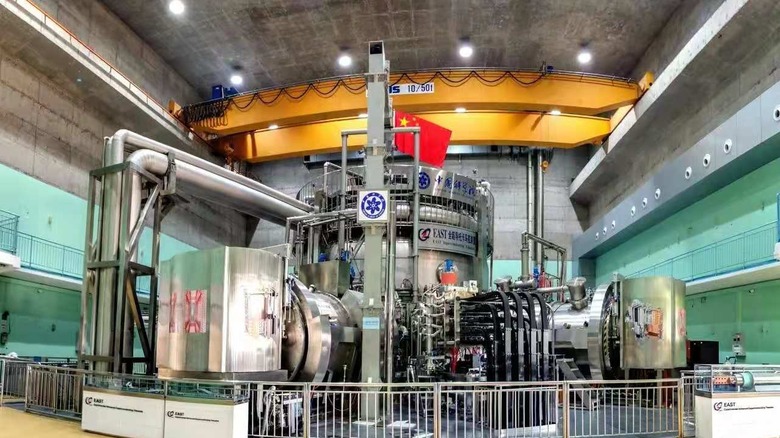
Since its establishment in 2006, EAST has grown into the preeminent fusion reactor project, accomplishing several key milestones on its way towards achieving sustained fusion reactions. In January 2025, for instance, EAST set a record for the longest "high-quality burn" in plasma fusion history. Lasting 1,066 seconds, the reaction more than doubled the previous record set by EAST in 2023. During the experiment, EAST reached temperatures of 100 million degrees Celsius. A year later, researchers broke a major density barrier known as the Greenwald limit, which describes the mathematical limit to the number of atoms within a plasma before the reaction becomes unstable.(Shortly after, a different 70-year-old nuclear problem was also solved.) The record proved that plasma could remain stable at extremely high densities, a major milestone towards widescale operability.
Although the EAST reactor could revolutionize China's clean energy sector, another reactor has already stolen its spot as the central force of China's fusion ambitions. Set to finish construction in 2027, the Burning Plasma Experimental Superconducting Tokamak (BEST), is expected to be the first reactor to successfully generate electricity from fusion in human history. Larger than its predecessor, BEST will initially utilize external supplies of deuterium and tritium hydrogen isotopes, the latter of which is exceedingly rare and difficult to maintain. Eventually, however, scientists hope that BEST will generate its own tritium atoms through the installation of a lithium blanket lining, a development that could change the self-sustaining capabilities of fusion power generation. An even more advanced project, China Fusion Engineering Demo Reactor, is also expected to be up and running at the end of the decade. Moreover, Beijing aims to have the Xinghuo, the world's first nuclear plant to deploy both fusion and fission reactions, operational by 2030.
The future of energy
China's fusion push is orchestrated through a top-down approach, in which a national program sets developmental priorities, funds research, and builds out supply chain capacity to address critical choke points. In July 2025, for instance, Beijing established its state-owned China Fusion Energy company to lead the country's research effort, injecting $2.1 billion in the public venture. In March 2026, Beijing released its 15th Five-Year Plan, in which it listed fusion energy has one of eight "frontier technologies" it would prioritize, setting the stage for continued investment. Whether such investments will enable Beijing to meet its radically ambitious fusion goals remains to be seen.
Despite these advancements, several roadblocks remain. One challenge is the need to produce specialized components at scale. And although Beijing has invested in metallic carpentry and other advanced manufacturing techniques to advance its critical supply chains, the country has had to rely on foreign producers for certain key components. One indicative example is Hastelloy (C276) metallic substrates, an essential alloy in manufacturing the super magnets utilized in the fusion process, which China has began to produce at scale in October 2025.
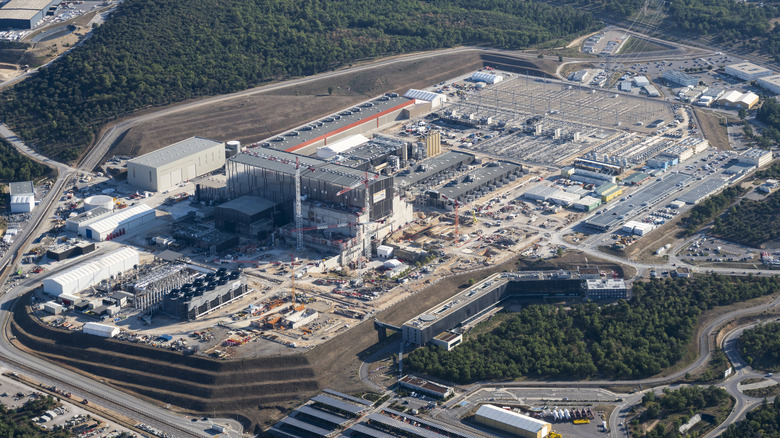
China isn't alone in pursuing the technology, however, as investment in fusion technologies has skyrocketed in recent years. To date, at least 77 fusion-centric startups have garnered $15 billion in investment worldwide. Some have pursued tokamaks, while others have invested in stellarators or laser-based inertial confinement fusion technologies. American startups have proclaimed similarly ambitious timelines as China's fusion sector, hoping to become operational in the next decade. The largest human project ever actually entered its final reactor phase; the International Thermonuclear Experimental Reactor (ITER), a joint tokamak project undertaken by 34 countries in southern France, continues its development, though it's unlikely to be operational until at least 2039. In light of such advancements, fusion power may be on the way.